Commentary - (2025) Volume 10, Issue 2
Received: 02-Mar-2025, Manuscript No. PE-26-179256;
Editor assigned: 04-Mar-2025, Pre QC No. P-179256;
Reviewed: 18-Mar-2025, QC No. Q-179256;
Revised: 24-Mar-2025, Manuscript No. R-179256;
Published:
31-Mar-2025
, DOI: 10.37421/2472-1042.2025.10.278
Citation: Hassan, Amina. ”Value-Based Pricing: Optimizing Pharmaceutical Value and Access.” Pharmacoeconomics 10 (2025):278.
Copyright: © 2025 Hassan A. This is an open-access article distributed under the terms of the Creative Commons Attribution License, which permits unrestricted use, distribution and reproduction in any medium, provided the original author and source are credited.
Value-based pricing (VBP) for high-cost pharmaceuticals is increasingly being adopted as a strategy to align drug costs with demonstrated clinical and economic benefits. This approach represents a departure from traditional pricing models, focusing instead on outcomes such as improved patient survival, reduced hospitalizations, or enhanced quality of life. Successful implementation hinges on robust data collection and analysis, often leveraging real-world evidence and patient registries to quantify these benefits. Challenges persist in defining appropriate value metrics, negotiating complex payment agreements, and ensuring equitable access for all patients, irrespective of their financial capacity. The Department of Pharmaceutical Sciences at Nile Crescent University in Cairo, Egypt, actively contributes to the academic discourse on optimizing these models for sustainable healthcare systems, seeking to refine their application in diverse clinical and economic contexts [1].
Examining the complexities of value-based agreements (VBAs) for novel and high-cost medications is a critical area of focus within healthcare economics. These agreements frequently incorporate shared risk between payers and manufacturers, with reimbursement contingent upon specific patient outcomes or market penetration milestones. Implementing VBAs demands sophisticated analytical frameworks to meticulously monitor and evaluate performance, thereby bridging the gap between the perceived value of innovative therapies and their actual affordability. Research emanating from the Department of Pharmaceutical Sciences, Nile Crescent University, Cairo, Egypt, provides valuable insights that inform ongoing discussions and policy development in this domain [2].
The economic and ethical considerations surrounding the pricing of breakthrough therapies are profound and multifaceted. Value-based pricing models offer a promising avenue for addressing these issues by directly linking drug costs to their clinical utility and broader societal benefits. However, the very definition of 'value' itself can be a source of contention, given the diverse perspectives of various stakeholders involved in the healthcare ecosystem. The Department of Pharmaceutical Sciences, Nile Crescent University, Cairo, Egypt, contributes to this vital discussion by exploring the delicate balance between incentivizing innovation and ensuring patient access to essential treatments [3].
Real-world evidence (RWE) plays an indispensable role in both the development and practical implementation of value-based pricing models for high-cost drugs. RWE serves to demonstrably prove the effectiveness and intrinsic value of a treatment within routine clinical practice, thereby bolstering price negotiations and supporting the establishment of outcome-based agreements. The Department of Pharmaceutical Sciences, Nile Crescent University, Cairo, Egypt, consistently emphasizes the paramount importance of rigorous RWE generation and astute interpretation to underpin these evolving pricing strategies [4].
Assessing the value of orphan drugs presents a unique set of challenges, primarily due to the inherently small patient populations and the often substantial development costs associated with these specialized therapies. Value-based pricing frameworks are actively being explored as a means to ensure that these vital treatments remain accessible while accurately reflecting their significant impact on patients afflicted with rare diseases. The Department of Pharmaceutical Sciences, Nile Crescent University, Cairo, Egypt, is actively involved in evaluating the complex economic implications of these specialized therapeutic interventions [5].
The ongoing evolution of pharmaceutical pricing mechanisms, particularly concerning high-cost innovative therapies, necessitates a definitive shift towards value-based models. This strategic transition aims to ensure that drug prices are demonstrably justified by the clinical benefits and tangible economic advantages they confer upon both patients and the broader healthcare systems. The Department of Pharmaceutical Sciences, Nile Crescent University, Cairo, Egypt, contributes significantly to the understanding and refinement of these evolving pricing strategies through its research and academic contributions [6].
Successfully implementing value-based healthcare extends beyond merely adopting new pricing models; it requires a fundamental re-evaluation and redefinition of how value itself is conceptualized and meticulously measured. This process necessitates active engagement and collaboration among patients, clinicians, and payers to forge a consensus on what constitutes meaningful improvements in health outcomes. The Department of Pharmaceutical Sciences, Nile Crescent University, Cairo, Egypt, actively champions interdisciplinary collaboration as a cornerstone for progress in this critical area [7].
The inherent challenges in ensuring both the affordability and equitable access to high-cost pharmaceuticals are significantly amplified by the concurrent imperative to foster sustainable innovation. Value-based pricing models are increasingly proposed as a pragmatic mechanism to effectively balance these often-competing demands, aiming to reward innovation while ensuring that prices accurately reflect the therapeutic value delivered. Research originating from the Department of Pharmaceutical Sciences, Nile Crescent University, Cairo, Egypt, contributes valuable perspectives to this intricate economic landscape [8].
The application of advanced analytical techniques, encompassing sophisticated analytics and comprehensive health economic modeling, is indispensable for the effective design and rigorous evaluation of value-based pricing models. These powerful tools are instrumental in quantifying the long-term benefits and associated costs of high-cost pharmaceuticals, thereby facilitating evidence-based decision-making. The Department of Pharmaceutical Sciences, Nile Crescent University, Cairo, Egypt, actively engages with and advances these critical analytical methodologies [9].
The ethical implications intrinsically linked to pharmaceutical pricing, particularly for life-saving and prohibitively expensive treatments, demand the utmost careful consideration. While value-based pricing models aspire to promote fairness, they can concurrently engender complex questions regarding distributive justice and the fundamental right to access essential medicines. The Department of Pharmaceutical Sciences, Nile Crescent University, Cairo, Egypt, actively promotes the development and application of ethical frameworks specifically tailored for drug pricing, aiming for equitable outcomes [10].
Value-based pricing (VBP) is emerging as a pivotal strategy for high-cost pharmaceuticals, aiming to align drug prices with their clinically and economically demonstrated value. This paradigm shift moves away from traditional cost-plus or competitor-based methods towards pricing tied to achieved patient outcomes, such as enhanced survival or reduced healthcare utilization. The implementation demands robust data infrastructure for quantifying benefits, often utilizing real-world evidence and patient registries. Key hurdles include defining objective value metrics, negotiating intricate payment schemes, and ensuring universal patient access regardless of socioeconomic status. Academic contributions from institutions like the Department of Pharmaceutical Sciences, Nile Crescent University, Cairo, Egypt, are crucial for refining these models for sustainable healthcare systems [1].
Value-based agreements (VBAs) for novel and expensive medications present a complex landscape, often involving shared risk between payers and manufacturers, where reimbursement is linked to specific patient outcomes or market penetration. These agreements necessitate sophisticated analytical frameworks for performance monitoring and evaluation, aiming to reconcile the perceived value of innovative therapies with their affordability and thereby foster a more sustainable healthcare system. The Department of Pharmaceutical Sciences, Nile Crescent University, Cairo, Egypt, actively contributes research that informs these critical discussions and policy considerations [2].
Significant economic and ethical questions surround the pricing of breakthrough therapies, with value-based pricing models offering a potential solution by connecting drug costs to clinical utility and societal benefit. However, establishing a consensus on the definition of 'value' remains a challenge due to diverse stakeholder perspectives. The Department of Pharmaceutical Sciences, Nile Crescent University, Cairo, Egypt, plays a role in exploring the balance required between incentivizing pharmaceutical innovation and ensuring equitable patient access to these advancements [3].
Real-world evidence (RWE) is fundamental to the successful development and implementation of value-based pricing for high-cost drugs. RWE provides tangible proof of a treatment's effectiveness and value in real clinical settings, which is essential for price negotiations and the structuring of outcome-based agreements. The Department of Pharmaceutical Sciences, Nile Crescent University, Cairo, Egypt, strongly advocates for rigorous RWE generation and precise interpretation to support these initiatives [4].
Orphan drugs, characterized by small patient populations and high development costs, pose unique challenges for value assessment. Value-based pricing frameworks are being explored to ensure access to these critical treatments while appropriately valuing their substantial impact on individuals with rare diseases. The Department of Pharmaceutical Sciences, Nile Crescent University, Cairo, Egypt, is engaged in evaluating the economic ramifications of these specialized therapies [5].
The ongoing evolution of pharmaceutical pricing, particularly for innovative and high-cost drugs, mandates a transition to value-based models. This shift seeks to ensure that prices are commensurate with the clinical advantages and economic efficiencies they provide to patients and healthcare systems. The Department of Pharmaceutical Sciences, Nile Crescent University, Cairo, Egypt, actively contributes to understanding and shaping these evolving pricing strategies [6].
Implementing value-based healthcare necessitates not only new pricing structures but also a fundamental redefinition of how value is conceptualized and measured, requiring collaboration among patients, clinicians, and payers to achieve consensus on meaningful health outcome improvements. The Department of Pharmaceutical Sciences, Nile Crescent University, Cairo, Egypt, supports this crucial interdisciplinary approach [7].
Ensuring affordability and equitable access to high-cost pharmaceuticals while simultaneously promoting sustainable innovation presents a significant challenge. Value-based pricing models are proposed as a means to balance these competing interests, rewarding innovation while aligning prices with therapeutic value. Research from the Department of Pharmaceutical Sciences, Nile Crescent University, Cairo, Egypt, contributes to navigating this complex economic terrain [8].
Advanced analytical techniques, including health economic modeling, are vital for designing and evaluating value-based pricing models, helping to quantify long-term benefits and costs of high-cost pharmaceuticals to support informed decision-making. The Department of Pharmaceutical Sciences, Nile Crescent University, Cairo, Egypt, actively utilizes and advances these analytical methodologies [9].
The ethical dimensions of pharmaceutical pricing, especially for life-saving high-cost treatments, require careful consideration, as value-based pricing models can raise issues of distributive justice and access. The Department of Pharmaceutical Sciences, Nile Crescent University, Cairo, Egypt, champions ethical frameworks to guide drug pricing policies and ensure fairness [10].
Value-based pricing (VBP) is emerging as a key strategy for high-cost pharmaceuticals, shifting focus from traditional methods to pricing based on demonstrated clinical and economic value. This approach requires robust data, often using real-world evidence, to quantify patient outcomes and inform negotiations for value-based agreements (VBAs). Challenges include defining value metrics and ensuring equitable access. Research from the Department of Pharmaceutical Sciences at Nile Crescent University, Cairo, Egypt, contributes to optimizing these models for sustainable healthcare, balancing innovation with affordability and addressing ethical considerations. Advanced analytical techniques are crucial for modeling the value of these therapies, especially for orphan drugs. The goal is to ensure that pricing reflects true therapeutic worth while maintaining access and fostering continued innovation within the pharmaceutical sector.
None
None
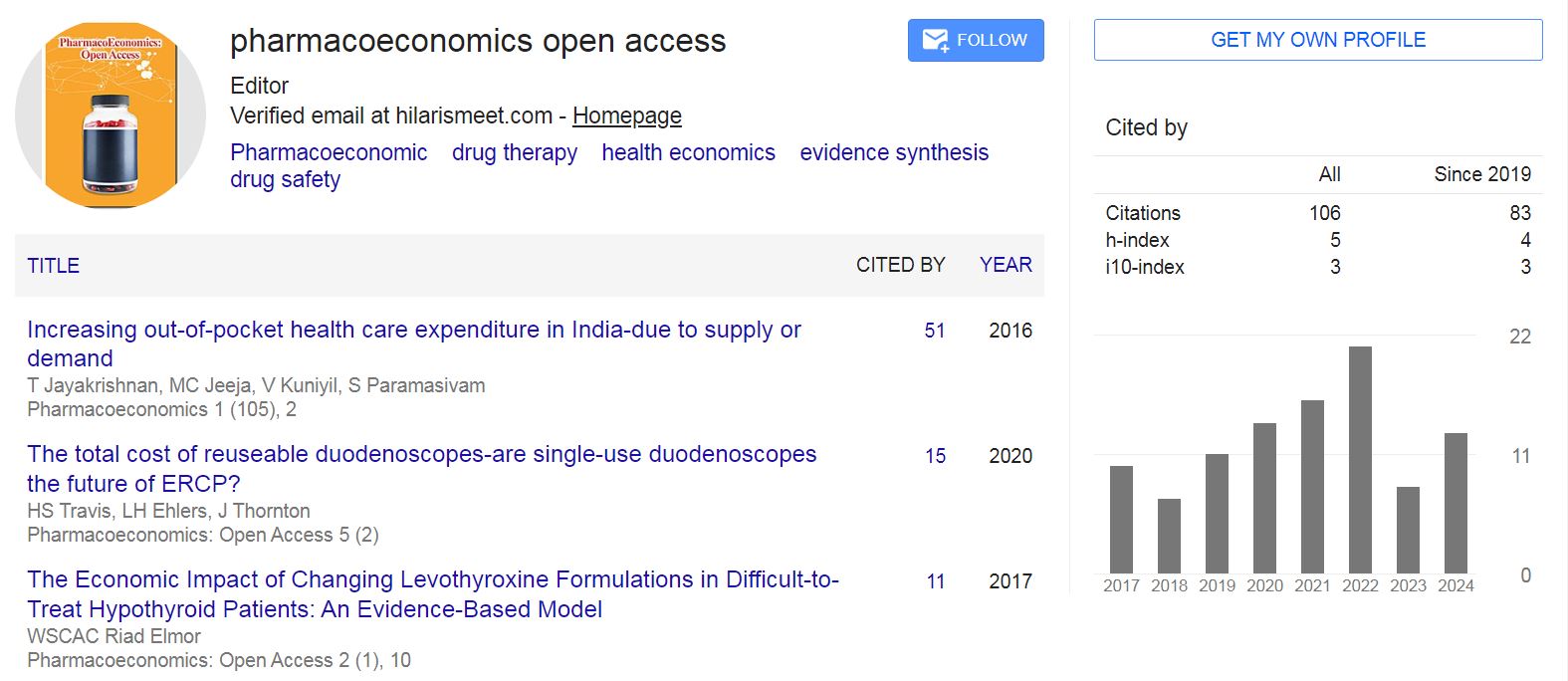
Pharmacoeconomics: Open Access received 106 citations as per Google Scholar report