Brief Report - (2025) Volume 10, Issue 6
Received: 01-Nov-2025, Manuscript No. PE-26-179314;
Editor assigned: 03-Nov-2025, Pre QC No. P-179314;
Reviewed: 17-Nov-2025, QC No. Q-179314;
Revised: 24-Nov-2025, Manuscript No. R-179314;
Published:
29-Nov-2025
, DOI: 10.37421/2472-1042.2025.10.311
Citation: Calderón, Paula Ríos. ”Value Assessment Of High-Cost Specialty Drugs.” Pharmacoeconomics 10 (2025):311.
Copyright: © 2025 Calderón R. Paula This is an open-access article distributed under the terms of the Creative Commons Attribution License, which permits unrestricted use, distribution and reproduction in any medium, provided the original author and source are credited.
The assessment of high-cost specialty drugs necessitates a comprehensive strategy that extends beyond mere clinical efficacy to encompass economic implications and patient-centered outcomes. This multifaceted approach is crucial for understanding the true value proposition of these advanced therapies. Various methodologies are employed to navigate this complex landscape, including cost-effectiveness analyses and budget impact models, which aim to guide decision-makers in health economics [1].
Evaluating novel oncology drugs involves a deep dive into their economic considerations, particularly their launch and adoption phases. Payers and healthcare systems must assess the incremental value of these treatments against existing standards of care, looking beyond direct medical costs to include factors like productivity gains and quality of life improvements [2].
Pharmacoeconomic evaluations for gene therapies present unique challenges due to their potentially curative nature and exceptionally high upfront costs. Traditional cost-effectiveness analyses often struggle to capture the long-term value, underscoring the need for societal perspectives and novel valuation frameworks to accommodate these transformative treatments [3].
The integration of patient-reported outcome measures (PROMs) is becoming increasingly vital in the value assessment of specialty drugs. PROMs offer crucial insights into symptom relief, functional improvement, and overall quality of life, aspects frequently missed by traditional clinical endpoints, ensuring a patient-centric view of drug value [4].
Value-based pricing models for specialty drugs, especially those with limited therapeutic alternatives, are a growing area of focus. These models explore collaborative mechanisms between manufacturers and payers to link pricing to demonstrated clinical value and long-term outcomes, addressing affordability and access while maintaining innovation incentives [5].
Orphan drugs, often high-cost specialty medications for rare diseases, pose distinct challenges in value assessment. Small patient populations, limited real-world evidence, and the ethical imperative to provide access to life-saving treatments for vulnerable groups necessitate adjusted thresholds and specialized approaches [6].
Ethical considerations are paramount in the value assessment of high-cost specialty drugs, balancing the pharmaceutical industry's need for innovation incentives with the societal demand for equitable access. Issues of distributive justice and fair pricing are central to ensuring fair access to essential medicines [7].
Health technology assessment (HTA) methodologies for specialty drugs are continuously evolving. Traditional approaches like incremental cost-effectiveness ratios (ICERs) may not fully capture the value of therapies with transformative potential, leading to the exploration of newer methods like multi-criteria decision analysis [8].
The uptake of biosimilars significantly impacts the value assessment of biologic specialty drugs. Biosimilars can influence pricing, market dynamics, and treatment cost-effectiveness, with strategies to encourage their adoption aimed at generating savings that can be reinvested or used to expand patient access [9].
Real-world evidence (RWE) offers substantial opportunities for the value assessment of high-cost specialty drugs. RWE complements clinical trial data by providing insights into long-term effectiveness, safety, and adherence in everyday practice, thus informing reimbursement decisions and post-market surveillance [10].
The evaluation of high-cost specialty drugs requires a comprehensive approach that integrates clinical effectiveness with economic impact and patient-reported outcomes. This necessitates a deep understanding of various assessment methodologies, such as cost-effectiveness analysis and budget impact models, to support informed decision-making in health economics and ensure appropriate reimbursement and access to these critical treatments [1].
Examining the economic landscape of novel oncology drugs involves scrutinizing their launch and adoption, with a focus on how payers and healthcare systems appraise their incremental value. This evaluation extends beyond direct medical expenditures to encompass productivity gains and improvements in quality of life, addressing the complex challenges of defining and measuring value in this dynamic therapeutic area [2].
Assessing the pharmacoeconomic value of gene therapies is particularly intricate due to their curative potential and substantial upfront costs. Traditional methods often fall short in capturing long-term benefits, leading to the exploration of broader societal perspectives and innovative valuation frameworks tailored to these groundbreaking treatments [3].
The critical role of patient-reported outcome measures (PROMs) in specialty drug value assessment cannot be overstated. PROMs capture essential aspects of treatment benefit, including symptom relief and functional improvements, which may not be fully reflected in conventional clinical endpoints. Their integration ensures that patient experiences are central to defining drug value [4].
Value-based pricing strategies for specialty drugs, especially in markets with limited alternatives, are designed to align pricing with demonstrated clinical value and long-term outcomes. This collaborative approach between manufacturers and payers aims to enhance affordability and access through outcome-based contracts and performance metrics [5].
Orphan drugs, often characterized by high costs and intended for rare diseases, present unique value assessment hurdles. The scarcity of patient data and ethical considerations surrounding access to potentially life-saving treatments require adapted cost-effectiveness thresholds and robust patient advocacy to shape reimbursement policies [6].
The ethical dimensions of high-cost specialty drug value assessment are crucial, particularly regarding the balance between fostering pharmaceutical innovation and ensuring equitable access to medicines. Distributive justice and fair pricing practices are essential ethical considerations that guide decision-making in this domain [7].
Health technology assessment (HTA) methodologies are evolving to better capture the value of specialty drugs. Recognizing the limitations of traditional approaches like ICERs for therapies with transformative potential, newer methods such as multi-criteria decision analysis are being explored to inform more accurate reimbursement and access decisions [8].
The increasing availability and uptake of biosimilars significantly influence the value assessment of biologic specialty drugs. By fostering market competition, biosimilars can lead to cost savings, which can then be reinvested in further innovation or expanded patient access to advanced therapies [9].
Real-world evidence (RWE) plays an increasingly important role in the value assessment of high-cost specialty drugs. RWE provides valuable insights into long-term effectiveness, safety, and adherence in real-world settings, complementing clinical trial data and informing post-market surveillance and reimbursement decisions [10].
High-cost specialty drugs require multifaceted value assessments considering clinical effectiveness, economic impact, and patient outcomes. Methodologies like cost-effectiveness analysis, budget impact models, and value-based pricing are employed. Patient-reported outcomes and real-world evidence are crucial for a holistic understanding. Gene therapies and orphan drugs present unique challenges due to high costs and specific patient populations. Ethical considerations surrounding access and pricing are paramount. The evolution of health technology assessment and the impact of biosimilars also shape value determination and reimbursement strategies. Ultimately, the goal is to balance innovation incentives with equitable patient access.
None
None
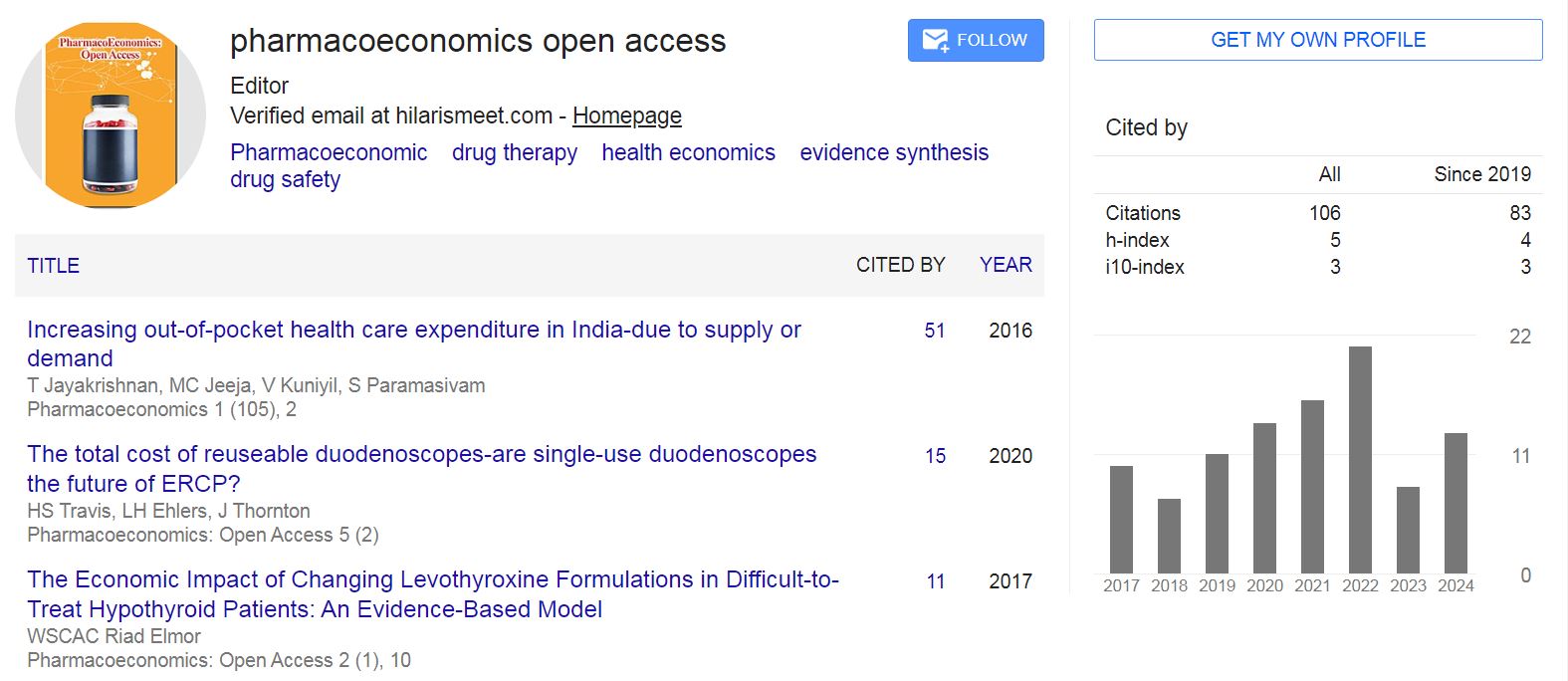
Pharmacoeconomics: Open Access received 106 citations as per Google Scholar report