Perspective - (2025) Volume 16, Issue 4
Received: 01-Jul-2025, Manuscript No. jhmi-26-178859;
Editor assigned: 03-Jul-2025, Pre QC No. P-178859;
Reviewed: 17-Jul-2025, QC No. Q-178859;
Revised: 22-Jul-2025, Manuscript No. R-178859;
Published:
29-Jul-2025
, DOI: 10.37421/2157-7420.2025.16.605
Citation: Hosseini, Zahra M.. ”User-Centered Design: Enhancing Health Information Systems.” J Health Med Informat 16 (2025):605.
Copyright: © 2025 Hosseini M. Zahra This is an open-access article distributed under the terms of the Creative Commons Attribution License, which permits unrestricted use, distribution and reproduction in any medium, provided the original author and source are credited.
User-centered design (UCD) stands as a cornerstone in the development of effective health information systems (HIS), fundamentally prioritizing the understanding of user needs, workflows, and contextual factors to create systems that are not only usable and useful but also readily adopted by healthcare professionals and patients alike. This approach is pivotal for enhancing the quality of patient care, mitigating medical errors, and boosting the overall efficiency of healthcare delivery within complex clinical environments. The iterative nature of UCD, encompassing user research, design, prototyping, and evaluation, ensures that HIS development remains closely aligned with the practical realities of clinical practice, thereby fostering better outcomes and smoother operations for all stakeholders involved. [1] Implementing UCD principles within electronic health record (EHR) systems has demonstrably significant impacts on clinician satisfaction and the prevalence of workarounds, which are often adopted to compensate for system deficiencies. By actively involving clinicians throughout the entire design and development lifecycle, it becomes possible to engineer EHR interfaces that are considerably more intuitive and less disruptive to established clinical workflows. This leads to more accurate data entry, enhanced access to critical information, and ultimately, a marked improvement in patient safety by substantially minimizing the potential for errors. [2] Patient engagement is powerfully amplified through the utilization of user-centered health information systems, which serve to empower individuals in actively managing their own health and well-being. The design of systems that are inherently accessible and easy for patients to navigate, comprehend, and contribute to fosters greater adherence to prescribed treatment plans and actively promotes healthier lifestyle behaviors. This inclusive design approach necessitates careful consideration of diverse patient populations, their varying levels of health literacy, and their individual comfort and familiarity with technology. [3] The application of UCD principles in the development of mobile health (mHealth) applications is absolutely paramount to their ultimate success and widespread adoption. These applications must be designed to be intuitive, engaging, and precisely tailored to the specific needs of their intended users, whether they are patients seeking to manage chronic conditions or healthcare providers aiming to streamline communication and monitoring. A robust UCD approach ensures that mHealth solutions transcend mere technological soundness, becoming practically useful and seamlessly integrated into the daily routines of those who rely on them. [4] Usability testing, a critical and integral component of the UCD methodology, is indispensable for the effective identification and subsequent rectification of design flaws within health information systems prior to their formal deployment. Rigorous usability testing, conducted with representative end-users, is crucial for uncovering potential issues related to navigation ease, data entry efficiency, and information retrieval effectiveness. This process directly contributes to an improved overall user experience and a significant enhancement of system effectiveness and performance in real-world settings. [5] Incorporating UCD into the development process of clinical decision support systems (CDSS) is critically important for their successful adoption and their meaningful impact on actual clinical practice. Systems that are developed with a deep understanding of clinicians' cognitive processes, their information needs, and their existing workflow requirements are far more likely to be utilized effectively and consistently. This effective utilization, in turn, leads to demonstrably improved diagnostic accuracy and more informed treatment decisions, ultimately benefiting patient care. [6] The inherently iterative nature of UCD, which is characterized by continuous feedback loops established with end-users, is absolutely vital for the ongoing refinement and enhancement of health information systems. This iterative design process facilitates the early detection and prompt correction of usability issues as they arise. It ensures that the system can evolve and adapt in close alignment with both evolving user needs and rapid technological advancements, thereby enhancing its long-term viability and maximizing its overall impact on healthcare. [7] Effectively addressing the persistent digital divide through thoughtful user-centered design presents a significant and ongoing challenge in the realm of health information systems. Ensuring that these systems are genuinely accessible and usable by individuals who possess varying levels of digital literacy, who may have limited access to technology, or who come from diverse cultural backgrounds is absolutely essential for the equitable delivery of healthcare services. [8] Evaluating the true effectiveness of health information systems often necessitates the incorporation of comprehensive user feedback collected throughout the entire system lifecycle, from conception to post-deployment. UCD methodologies provide well-structured and systematic approaches for gathering and integrating these invaluable user insights. This comprehensive approach leads to the development of systems that are not only functionally robust but also precisely meet the dynamic and evolving needs of both healthcare providers and patients. [9] The successful adoption of new health information technologies hinges critically on their seamless alignment with the specific needs of users and their integration into existing clinical workflows. User-centered design processes are instrumental in ensuring that these new systems are not perceived as burdensome additions to an already demanding workload but are instead embraced as valuable tools that significantly enhance the quality of patient care and improve operational efficiency across healthcare organizations. [10]
User-centered design (UCD) is fundamental to creating health information systems (HIS) that are effective, usable, and ultimately adopted, by placing a strong emphasis on understanding user needs, workflows, and the specific contexts in which these systems will operate. This approach directly contributes to improved patient care, a reduction in medical errors, and increased efficiency for healthcare professionals. The typical UCD process involves iterative cycles of user research, design, prototyping, and evaluation to ensure the final product aligns with the realities of clinical practice. [1] When UCD is implemented in electronic health record (EHR) systems, it significantly influences clinician satisfaction and reduces the need for workarounds, which are often developed to overcome system usability issues. By engaging clinicians throughout the design and development stages, it is possible to create EHR interfaces that are more intuitive and less disruptive to their daily workflows, leading to better data entry practices, improved access to patient information, and enhanced patient safety by minimizing error potential. [2] Patient engagement is substantially enhanced through user-centered health information systems, empowering individuals to take a more active role in managing their health. Systems designed with accessibility and ease of use in mind for patients to navigate, understand, and contribute data foster greater adherence to treatment plans and promote healthier behaviors. This necessitates careful consideration of diverse patient populations, their literacy levels, and their technological proficiencies. [3] The application of UCD principles is essential for the success of mobile health (mHealth) applications. These applications must be intuitive, engaging, and tailored to the specific needs of their target users, whether patients or healthcare providers. A UCD approach ensures that mHealth solutions are not only technologically sound but also practically useful and easily integrated into daily routines, thereby increasing their utility and impact. [4] Usability testing, a core element of UCD, is crucial for identifying and resolving design flaws in health information systems before they are implemented. Thorough usability testing with representative users helps uncover issues related to navigation, data entry, and information retrieval, ultimately improving the overall user experience and the system's effectiveness in supporting healthcare delivery. [5] Integrating UCD into the development of clinical decision support systems (CDSS) is critical for their adoption and their positive impact on clinical practice. Systems designed with a keen understanding of clinicians' cognitive processes and workflow needs are more likely to be used effectively, leading to improved diagnostic accuracy and better treatment decisions, which are vital for patient outcomes. [6] The iterative nature of UCD, characterized by continuous feedback from users, is vital for refining health information systems. This iterative process allows for the early detection and correction of usability issues, ensuring the system evolves in alignment with user needs and technological advancements, thereby enhancing its long-term viability and impact on healthcare quality. [7] Addressing the digital divide through user-centered design is a critical challenge for health information systems. Ensuring that systems are accessible and usable by individuals with varying levels of digital literacy, technology access, and diverse cultural backgrounds is fundamental to achieving equitable healthcare delivery and preventing disparities. [8] Evaluating the effectiveness of health information systems often requires incorporating user feedback throughout their lifecycle. UCD methodologies provide structured approaches for gathering and integrating user insights, resulting in systems that are not only functional but also meet the evolving needs of both healthcare providers and patients, ensuring ongoing relevance and utility. [9] The successful adoption of new health information technologies depends heavily on their alignment with user needs and existing workflows. UCD processes ensure these systems are viewed as valuable tools that enhance care quality and operational efficiency, rather than as burdensome additions, thereby facilitating smoother integration and greater acceptance. [10]
User-centered design (UCD) is essential for creating effective health information systems (HIS) by prioritizing user needs, workflows, and contexts. This approach leads to improved patient care, reduced errors, and increased efficiency. UCD is crucial for electronic health records (EHRs), enhancing clinician satisfaction and patient safety. It empowers patients through accessible systems and is vital for the success of mobile health (mHealth) applications. Usability testing, a key UCD component, identifies and fixes design flaws. UCD improves clinical decision support systems (CDSS) and ensures HIS are useful tools rather than burdens. Iterative feedback and addressing the digital divide are also critical aspects of UCD in healthcare technology.
None
None
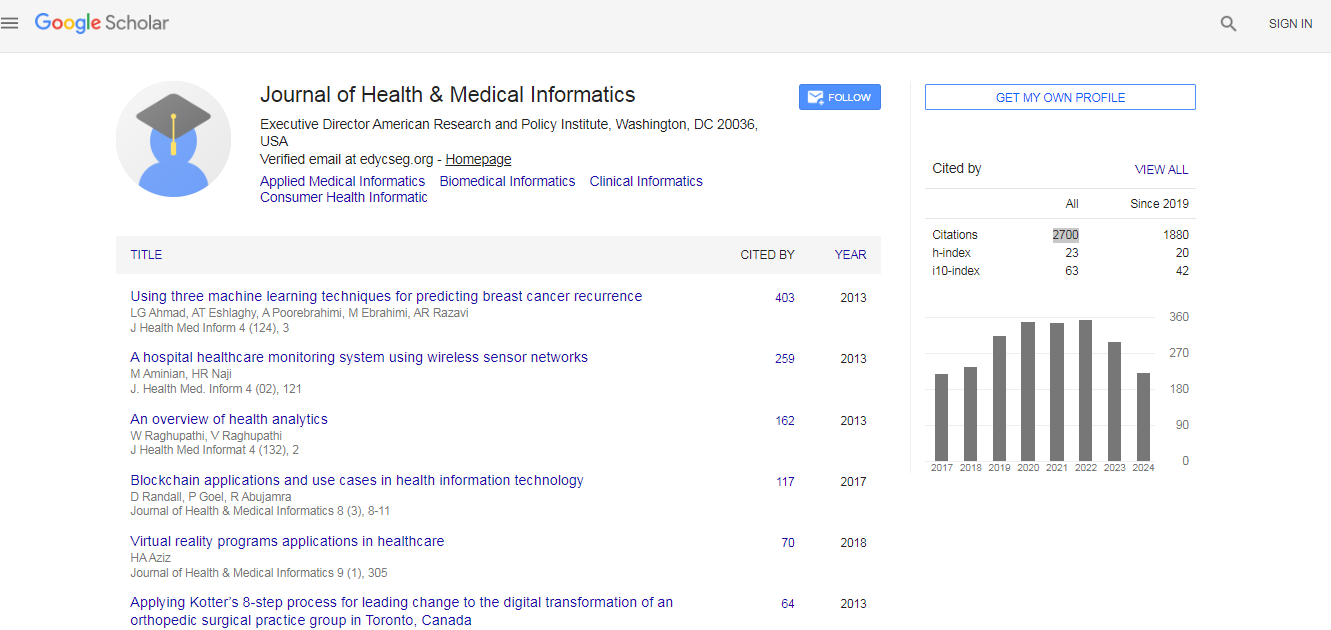
Journal of Health & Medical Informatics received 2700 citations as per Google Scholar report