Brief Report - (2025) Volume 11, Issue 6
Received: 03-Nov-2025, Manuscript No. OHCR-25-167873;
Editor assigned: 05-Nov-2025, Pre QC No. P-167873;
Reviewed: 17-Nov-2025, QC No. Q-167873;
Revised: 22-Nov-2025, Manuscript No. R-167873;
Published:
29-Nov-2025
, DOI: 10.37421/2471-8726.2025.11.214
Citation: Schupbach, Miller. “Use of Collagen Membranes in Aesthetic Gingival Augmentation.” Oral Health Case Rep 11 (2025): 214.
Copyright: © 2025 Schupbach M. This is an open-access article distributed under the terms of the Creative Commons Attribution License, which permits unrestricted use, distribution and reproduction in any medium, provided the original author and source are credited.
Aesthetic gingival augmentation has become a key component of modern periodontal and cosmetic dentistry, as patients increasingly seek harmonious gum contours to complement their smiles. Gingival recession, volume loss, and irregular margins can significantly detract from dental aesthetics, even when teeth are well aligned and restored. Traditionally, autogenous soft tissue grafts have been used to address these concerns, but their invasiveness and limited availability have prompted the search for alternatives. Collagen membranes have emerged as a promising biomaterial in this context, offering both functional and aesthetic benefits. Derived from porcine or bovine sources, these membranes act as scaffolds that support tissue regeneration while reducing patient morbidity. Their application in guided tissue regeneration and soft tissue augmentation aligns with the goals of minimally invasive, predictable, and cosmetically pleasing outcomes in gingival reconstruction [1].
Collagen membranes are increasingly being adopted in gingival augmentation due to their biocompatibility, structural support, and ability to promote tissue integration. In aesthetic zones, where precision and subtlety are critical, these membranes provide a scaffold for new tissue formation without the need for harvesting donor tissue. This reduces surgical time, discomfort, and risk of complications, especially in patients requiring bilateral or multiple-site correction. The role of collagen membranes has expanded from periodontal regeneration to soft tissue thickening, root coverage, and papilla reconstruction all essential for smile aesthetics. As demand for non-invasive and predictable cosmetic procedures grows, collagen membranes offer a valuable tool that balances biological function with aesthetic refinement. Their ease of use and compatibility with various surgical techniques make them particularly suited for contemporary aesthetic periodontal therapy [2].
Collagen membranes serve as effective scaffolds for promoting soft tissue regeneration in gingival augmentation procedures, particularly in areas of high aesthetic demand. These membranes are composed primarily of type I and type III collagen, which are the major structural proteins in natural gingival tissue. When placed over the recession or defect site, the membrane provides a protective barrier that facilitates cell migration and angiogenesis while preventing epithelial down-growth. This supports the formation of new connective tissue and enhances the volume and quality of the augmented gingiva. Compared to autogenous grafts, collagen membranes offer the advantage of eliminating donor site morbidity, thereby reducing postoperative pain and recovery time. Furthermore, they are resorbable and typically integrate well into host tissues without the need for removal. In cases of gingival recession or soft tissue deficiencies around implants or natural teeth, collagen membranes can be combined with coronally advanced flaps or used as standalone grafting material. Their use results in thicker, healthier soft tissue that improves root coverage, reduces sensitivity, and contributes to a more symmetrical gingival margin. Clinical studies have demonstrated satisfactory aesthetic outcomes, particularly when membranes are stabilized properly and used in patients with good oral hygiene. Overall, collagen membranes are transforming gingival augmentation into a more patient-friendly and cosmetically refined procedure [3].
The integration of collagen membranes into gingival augmentation protocols has enabled clinicians to achieve more predictable and aesthetically pleasing outcomes with less surgical complexity. These membranes provide a three-dimensional matrix that supports fibroblast proliferation, collagen synthesis, and new blood vessel formation. Their porous structure allows for nutrient exchange and gradual resorption, typically within 4 to 12 weeks, depending on membrane composition. They are available in cross-linked and non-cross-linked forms, with cross-linked varieties offering extended stability for larger or more complex defects. In aesthetic applications, such as root coverage and ridge preservation, collagen membranes help restore gingival contour and improve the pink-to-white esthetic balance of the smile. Their effectiveness can be further enhanced by combining them with biologic agents like enamel matrix derivatives or platelet-rich fibrin to promote faster and more robust healing. Importantly, the placement technique and flap design are crucial to achieving optimal results; improper adaptation or inadequate vascular support can lead to membrane exposure and failure. Despite these limitations, collagen membranes offer substantial benefits in terms of patient comfort, reduced surgical morbidity, and natural-looking outcomes. Their ability to facilitate soft tissue augmentation without additional donor site surgery makes them a valuable option for clinicians focused on achieving aesthetic excellence in periodontal therapy [4].
Clinical use of collagen membranes in aesthetic gingival augmentation has shown promising results across a variety of indications, including Miller Class I and II gingival recessions, peri-implant soft tissue deficiencies, and interdental papilla reconstruction. In cases of root coverage, collagen membranes combined with coronally advanced flaps have demonstrated significant improvement in gingival thickness, root coverage percentage, and aesthetic scores. The translucent and pliable nature of these membranes allows for easy adaptation over curved root surfaces and into subgingival spaces, ensuring proper integration. When used around implants, they help create a stable soft tissue seal that not only enhances aesthetic outcomes but also supports long-term peri-implant health. Their ability to preserve soft tissue contours during healing is especially important in anterior regions where even minor gingival discrepancies can be visually noticeable. Additionally, collagen membranes have been employed in the management of black triangles through papilla augmentation techniques. While long-term comparative studies are still needed, early evidence suggests that collagen membranes can achieve results comparable to connective tissue grafts in selected cases. Patient-reported outcomes consistently highlight reduced discomfort, shorter recovery periods, and high satisfaction with the aesthetic improvements. As part of a comprehensive soft tissue management strategy, collagen membranes offer a practical and effective means of enhancing the visual harmony of the gingival architecture [5].
Google Scholar Cross Ref Indexed at
Google Scholar Cross Ref Indexed at
Google Scholar Cross Ref Indexed at
Google Scholar Cross Ref Indexed at
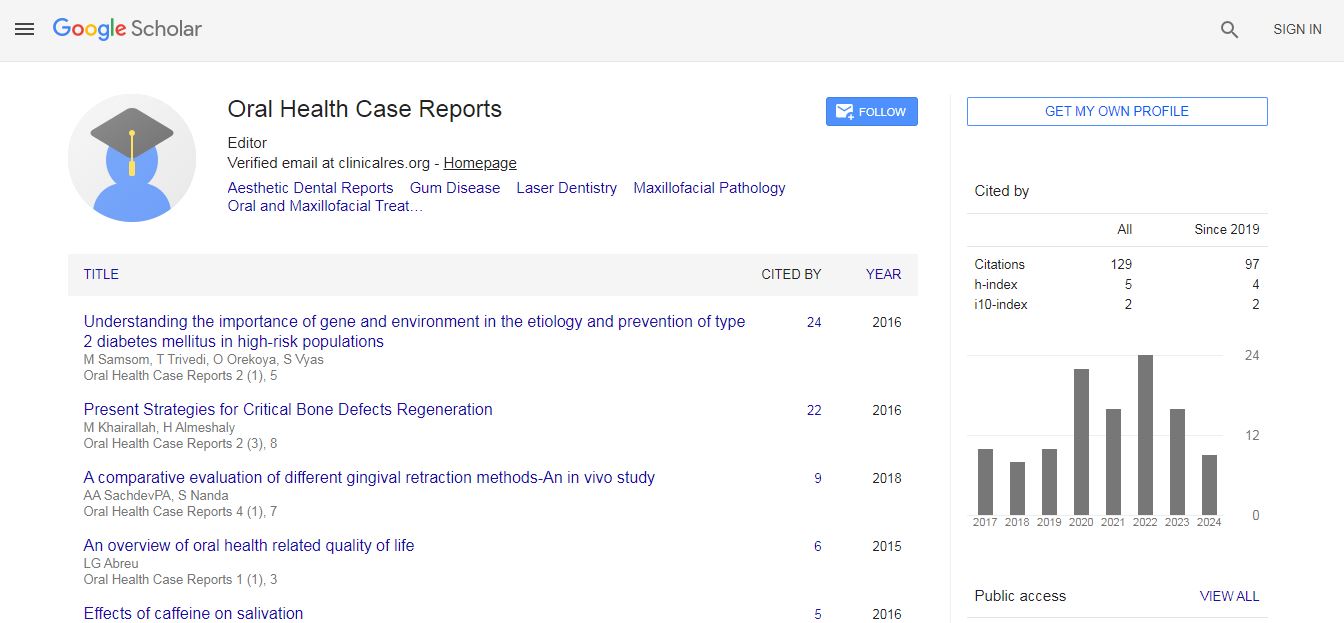
Oral Health Case Reports received 120 citations as per Google Scholar report