Short Communication - (2025) Volume 8, Issue 4
Received: 28-Nov-2025, Manuscript No. pollution-25-176616;
Editor assigned: 01-Feb-0025, Pre QC No. P-176616;
Reviewed: 15-Dec-2025, QC No. Q-176616;
Revised: 22-Dec-2025, Manuscript No. R-176616;
Published:
29-Dec-2025
, DOI: 10.37421/2684-4958.2025.8.392
Citation: T, Anderson, Mark. ”Urgent Challenges in Global Emissions Management.” Pollution 08 (2025):392.
Copyright: © 2025 T M. Anderson, This is an open-access article distributed under the terms of the Creative Commons Attribution License, which permits unrestricted use,
distribution and reproduction in any medium, provided the original author and source are credited.
Climate change remains a paramount global challenge, driven largely by anthropogenic greenhouse gas emissions. Understanding the dynamics of these emissions and developing effective mitigation strategies are crucial for addressing this crisis. This collection of research offers a comprehensive overview of various facets of greenhouse gas science and policy. This paper presents the most up-to-date assessment of the global carbon cycle, quantifying anthropogenic CO2 emissions, their distribution among the atmosphere, ocean, and terrestrial biosphere, and the remaining carbon budget for 1.5°C and 2°C warming targets. It highlights continued increases in global CO2 emissions in 2023 despite some regional decreases[1].
This comprehensive assessment details global methane sources and sinks, providing updated estimates and trends. It identifies dominant anthropogenic and natural contributions, emphasizing the critical role of methane in short-term climate forcing and the need for targeted mitigation strategies to achieve climate goals[2].
This paper presents the most recent global assessment of nitrous oxide (N2O) emissions and sinks, identifying agricultural practices as the largest anthropogenic source. It underscores the continued increase in atmospheric N2O concentrations and its potent contribution to both global warming and stratospheric ozone depletion, highlighting the urgency of reducing these emissions[3].
This article examines the critical and evolving role of greenhouse gas removal (GGR) technologies in climate change mitigation efforts during the 2030s. It discusses the necessity, feasibility, and potential scale of GGR, emphasizing that these technologies are not a substitute for rapid emissions reductions but a crucial complement for achieving ambitious climate targets and managing residual emissions[4].
This research compares climate models from CMIP6 and CMIP5 to better attribute global temperature changes to greenhouse gas and aerosol forcings. It highlights how improved model representations enhance our understanding of the distinct contributions of these factors to observed warming, providing more robust evidence for the dominant role of greenhouse gases[5].
This study analyzes the effectiveness of various global greenhouse gas policies in reducing emissions. It assesses policy impacts across different sectors and regions, identifying key factors for successful implementation and emphasizing the importance of integrated approaches that combine technological advancements with strong regulatory frameworks to achieve significant emission cuts[6].
This research presents evidence of an accelerating release of carbon, primarily as greenhouse gases, from thawing permafrost in the Arctic. It highlights the positive feedback loop where warming temperatures cause permafrost degradation, leading to further emissions and exacerbating global warming, emphasizing the urgent need to understand and incorporate these processes into climate models[7].
This paper outlines various technological and policy pathways to achieve net-zero greenhouse gas emissions from the global cement industry, a major industrial emitter. It explores innovations in clinker substitution, carbon capture, utilization, and storage (CCUS), and energy efficiency, providing a roadmap for one of the hardest-to-abate sectors[8].
This critical review synthesizes emerging technologies for mitigating greenhouse gas emissions from the agricultural sector, covering areas like improved nutrient management, enteric methane reduction strategies, and sustainable land use practices. It assesses their potential effectiveness, scalability, and economic viability, offering insights into how agriculture can contribute to climate change mitigation[9].
This review explores the complex role of the ocean as both a sink and source for potent non-CO2 greenhouse gases, specifically methane and nitrous oxide. It synthesizes current understanding of marine biogeochemical processes that regulate these fluxes, highlighting how ocean warming and acidification could alter these dynamics, impacting the overall global greenhouse gas balance[10].
These studies collectively highlight the complexity of the global greenhouse gas balance, involving both major long-lived gases like Carbon Dioxide (CO2) and potent short-term climate forcers such as methane and nitrous oxide. They also explore emerging solutions and the profound impacts of climate change on natural systems. From detailed budget assessments to technological and policy roadmaps, the research underscores a shared urgency in addressing climate change. The scientific community continues to refine models, identify new emission sources, and propose pathways for a sustainable future, acknowledging that rapid, integrated efforts are essential to achieve global climate targets. The ongoing commitment to monitor and report on these emissions provides a critical foundation for international climate action. Facing the reality of continued emission increases and the severe consequences of permafrost degradation, the global effort to mitigate greenhouse gases requires innovation, policy alignment, and a deep understanding of Earth's complex systems. Ultimately, this body of work emphasizes that while challenges are significant, pathways to net-zero emissions and climate stabilization are achievable through concerted, evidence-based interventions across all sectors of society.
The most recent assessment of the global carbon cycle quantifies anthropogenic Carbon Dioxide (CO2) emissions, their distribution across the atmosphere, ocean, and terrestrial biosphere, and the remaining carbon budget for both 1.5°C and 2°C warming targets. Worryingly, global CO2 emissions continued to increase in 2023, despite some regional reductions in certain areas [1]. Complementing this, a comprehensive evaluation of global methane sources and sinks provides updated estimates and trends. It pinpoints dominant anthropogenic and natural contributions, emphasizing methane’s critical role in short-term climate forcing and the urgent need for targeted mitigation strategies to meet climate goals [2]. Similarly, the latest global assessment of nitrous oxide (N2O) emissions and sinks identifies agricultural practices as the primary anthropogenic source. This potent greenhouse gas continues to show increasing atmospheric concentrations, significantly contributing to global warming and stratospheric ozone depletion, underscoring the necessity for immediate emission reductions [3].
Addressing these emission challenges necessitates a dual approach of direct emission reductions and technological interventions. The critical and evolving role of Greenhouse Gas Removal (GGR) technologies in climate change mitigation efforts for the 2030s has been examined. These technologies are not a substitute for rapid emissions reductions but serve as a crucial complement for achieving ambitious climate targets and managing residual emissions [4]. Furthermore, a study analyzes the effectiveness of various global greenhouse gas policies. It assesses policy impacts across different sectors and regions, identifying key factors for successful implementation and emphasizing the importance of integrated approaches that combine technological advancements with strong regulatory frameworks to achieve significant emission cuts [6]. The agricultural sector, a significant emitter, has seen a critical review of emerging technologies aimed at mitigating its greenhouse gas emissions. This includes improved nutrient management, enteric methane reduction strategies, and sustainable land use practices, assessing their potential effectiveness, scalability, and economic viability [9].
Certain industrial sectors face unique challenges in achieving net-zero emissions. For example, pathways to Net-Zero Emissions from the global cement industry, a major industrial emitter, have been outlined. These pathways explore innovations in clinker substitution, Carbon Capture, Utilization, and Storage (CCUS), and energy efficiency, providing a roadmap for one of the hardest-to-abate sectors [8]. Beyond anthropogenic sources, natural systems also play a complex role. Research presents evidence of an accelerating release of carbon, primarily as greenhouse gases, from thawing permafrost in the Arctic. This phenomenon highlights a dangerous positive feedback loop where warming temperatures cause permafrost degradation, leading to further emissions and exacerbating global warming, emphasizing the urgent need to understand and incorporate these processes into climate models [7]. Additionally, the complex role of the ocean as both a sink and source for potent non-CO2 greenhouse gases, specifically methane and nitrous oxide, has been reviewed. This synthesizes current understanding of marine biogeochemical processes that regulate these fluxes, highlighting how ocean warming and acidification could alter these dynamics, impacting the overall global greenhouse gas balance [10].
To refine our understanding and projections, research compares climate models from CMIP6 and CMIP5 to better attribute global temperature changes to greenhouse gas and aerosol forcings. This work highlights how improved model representations enhance our understanding of the distinct contributions of these factors to observed warming, providing more robust evidence for the dominant role of greenhouse gases [5]. This continuous effort in refining climate models is crucial for accurate predictions and for validating the effectiveness of mitigation and adaptation strategies being developed globally. The combined insights from these studies provide a robust scientific foundation for urgent climate action, emphasizing the need for both aggressive emission reductions and innovative technological solutions to safeguard the planet for future generations.
Recent assessments highlight the urgent challenges in managing global greenhouse gas emissions. The latest Global Carbon Budget shows continued increases in CO2 emissions in 2023, despite some regional efforts, while detailing anthropogenic CO2 distribution and remaining carbon budgets for critical warming targets. Similarly, global methane sources and sinks have been thoroughly evaluated, underlining methane's significant role in short-term climate forcing and the need for focused mitigation strategies. Nitrous oxide emissions, primarily from agriculture, also show a worrying increase, contributing powerfully to global warming and ozone depletion, which demands immediate emission reductions. Beyond understanding these principal gases, research points to accelerating carbon release from thawing Arctic permafrost, creating a positive feedback loop that intensifies global warming. Addressing these complex issues requires a multi-faceted approach. Greenhouse Gas Removal (GGR) technologies are emerging as crucial complements to rapid emissions reductions, particularly for managing residual emissions by 2030. Studies analyze the effectiveness of various global greenhouse gas policies, advocating for integrated strategies that merge technological innovation with robust regulatory frameworks across sectors. Specific sectors like the global cement industry, a major emitter, are exploring pathways to net-zero emissions through innovations like clinker substitution, Carbon Capture, Utilization, and Storage (CCUS), and energy efficiency. The agricultural sector is also seeing a critical review of emerging technologies aimed at mitigating its greenhouse gas emissions, including improved nutrient management and enteric methane reduction. Furthermore, the ocean's intricate role as both a sink and source for non-CO2 greenhouse gases, such as methane and nitrous oxide, is under review, with concerns that ocean warming and acidification could disrupt this delicate balance. Effectively managing climate change thus necessitates understanding specific gas budgets, addressing positive feedback loops, and implementing targeted policies and technologies across industries and natural systems.
None
None
Pierre F, Robbie MA, Jose GC. "Global Carbon Budget 2023".Earth Syst. Sci. Data 15 (2023):5301–5369.
Indexed at, Google Scholar, Crossref
Marielle S, Philippe B, Edward JD. "The Global Methane Budget 2022".Earth Syst. Sci. Data 14 (2022):1581–1623.
Indexed at, Google Scholar, Crossref
Robert BJ, Marielle S, Philippe B. "The Global Nitrous Oxide Budget: 2020 Update".Earth Syst. Sci. Data 13 (2021):2123–2160.
Indexed at, Google Scholar, Crossref
Joeri R, Robin L, Oliver G. "The role of greenhouse gas removal in the 2030s".Nat. Clim. Change 13 (2023):1251-1258.
Indexed at, Google Scholar, Crossref
Bernard THL, Kevin LS, Nathalie JS. "Attribution of global temperature change to greenhouse gas and aerosol forcing: comparison of CMIP6 and CMIP5 climate models".Environ. Res. Lett. 15 (2020):094073.
Indexed at, Google Scholar, Crossref
Paola C, Luigi S, Bianca G. "Effective global greenhouse gas policies".Nat. Commun. 13 (2022):1-14.
Indexed at, Google Scholar, Crossref
Sander TEvdV, Christina LS, Peter AR. "Recent acceleration of carbon release from degrading permafrost in the Arctic".Nat. Clim. Change 13 (2023):1097-1105.
Indexed at, Google Scholar, Crossref
Prashant KG, Sung HK, Jung SH. "Pathways to Net-Zero Emissions from the Global Cement Industry".Environ. Sci. Technol. 57 (2023):5218–5229.
Indexed at, Google Scholar, Crossref
Xu T, Sha H, Yue L. "Mitigating greenhouse gas emissions from agriculture: A critical review of emerging technologies".Sci. Total Environ. 856 (2023):159049.
Indexed at, Google Scholar, Crossref
J. CJJ, A. JSDS, S. ALP. "The Ocean as a Sink and Source of Methane and Nitrous Oxide: A Review".Front. Mar. Sci. 9 (2022):978949.
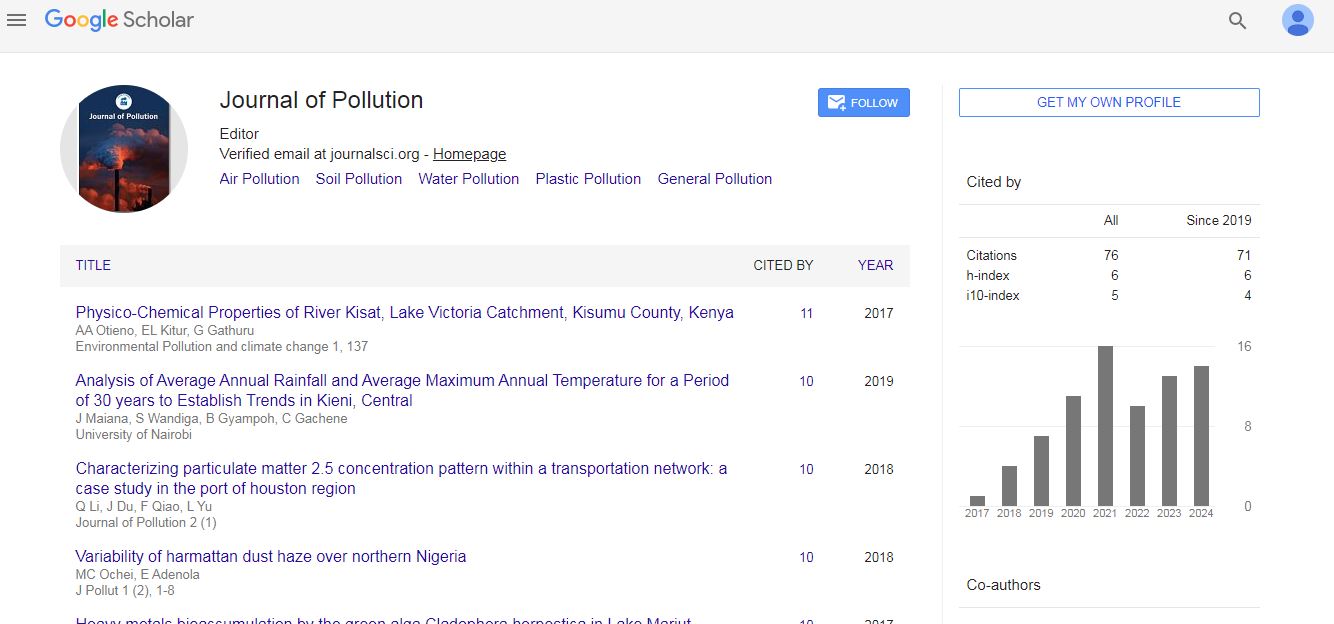
Journal of Pollution received 64 citations as per Google Scholar report