Commentary - (2025) Volume 13, Issue 6
Received: 03-Nov-2022, Manuscript No. economics-26-186080;
Editor assigned: 05-Nov-2025, Pre QC No. P-186080;
Reviewed: 19-Nov-2025, QC No. Q-186080;
Revised: 24-Nov-2025, Manuscript No. R-186080;
Published:
01-Dec-2025
, DOI: 10.37421/2375-4389.2025.13.554
Citation: Haddad, Leila. ”Urbanization’s Complexities: Growth,
Inequality, and Policy.” J Glob Econ 13 (2025):554.
Copyright: © 2025 Haddad L. This is an open-access article distributed under the terms of the Creative Commons Attribution License, which permits unrestricted use,
distribution and reproduction in any medium, provided the original author and source are credited.
Urbanization in developing countries is a multifaceted phenomenon with significant economic implications. It is characterized by rapid population shifts from rural to urban areas, leading to the growth of cities and the transformation of economies. This process, while often driving economic growth, also presents substantial challenges that require careful management and policy intervention. One of the primary drivers of economic development in urban centers is the concept of agglomeration economies. These economies arise from the clustering of businesses and people, leading to increased productivity, innovation, and job creation. The concentration of economic activity in cities allows for the efficient sharing of resources, knowledge spillovers, and the development of specialized labor markets, all of which contribute to enhanced economic output [1].
However, the benefits of urbanization are not always evenly distributed, and a significant consequence in developing countries is the exacerbation of inequality. As cities grow, disparities in income, access to opportunities, and living standards can widen. This can be attributed to various factors, including unequal access to education, healthcare, and formal employment, as well as the spatial segregation of different socioeconomic groups within urban areas [3].
Furthermore, the rapid influx of people into urban centers places immense strain on existing infrastructure. Inadequate transportation networks, housing shortages, and insufficient provision of essential services such as water, sanitation, and electricity can hinder economic growth and degrade the quality of life for urban residents. Addressing these infrastructure deficits is paramount for sustainable urban development [4].
Effective urban governance is also a critical factor in shaping the economic trajectory of cities in developing countries. Strong governance structures are necessary to manage urban growth effectively, ensure the delivery of public services, and create an environment conducive to business and investment. Decentralization and inclusive participation are often cited as key elements for improving urban governance [5].
The informal sector plays a substantial role in the economies of cities in developing countries, often providing employment and livelihoods for a significant portion of the urban population. Integrating this sector into the formal economy through supportive policies can unlock its potential for contributing more effectively to overall economic development and poverty reduction [6].
Concerns about sustainable urbanization are increasingly important as developing countries grapple with the environmental consequences of rapid urban growth. Issues such as pollution, resource depletion, and vulnerability to climate change impacts necessitate the adoption of green urban planning and investment in sustainable technologies to ensure long-term economic viability and environmental well-being [7].
Rural-to-urban migration is a major driver of urbanization in developing nations, with profound economic implications. While it fuels urban labor markets and can alleviate poverty in rural areas, it also contributes to rapid population growth in cities, intensifying pressure on services and housing. Understanding the dynamics of this migration is crucial for effective urban planning and policy formulation [8].
Economic diversification within urban centers is essential for developing countries to build more resilient economies and reduce their dependence on single industries. Cities that foster a wide array of economic activities are better equipped to withstand economic shocks, create stable employment opportunities, and promote sustained growth [9].
Finally, financing urban development, particularly infrastructure and services, presents a significant challenge for cities in developing countries. Many cities face substantial funding gaps, necessitating the exploration of innovative financing mechanisms, such as public-private partnerships and municipal bonds, to mobilize the required capital for urban development [10].
The economic landscape of developing countries is profoundly shaped by the ongoing process of urbanization. This trend, characterized by a significant migration of populations from rural to urban areas, brings with it a complex interplay of opportunities and challenges that have become central to economic development discourse. At the heart of urban economic vibrancy lie agglomeration economies. These economic benefits, derived from the concentration of economic activities and people, are instrumental in fostering productivity gains, spurring innovation, and generating employment within cities. The dense network of businesses and skilled labor in urban areas creates synergies that are difficult to replicate in more dispersed settings, thereby boosting overall economic efficiency and competitiveness [1].
However, the economic ascent of cities in developing nations is often accompanied by a widening chasm of inequality. While urbanization can create new avenues for prosperity, it frequently leads to stark disparities in income, access to essential services, and opportunities for advancement. This social stratification can manifest as spatial segregation, with disadvantaged groups concentrated in informal settlements lacking basic amenities [3].
Critical to the functioning and growth of urban economies is the development of robust infrastructure. Rapid urbanization frequently outpaces the development of essential infrastructure, including transportation, housing, and utilities. Deficiencies in these areas can significantly impede economic productivity, increase operational costs for businesses, and diminish the overall quality of life for residents [4].
Effective urban governance emerges as a pivotal determinant of a city's economic success. The capacity of local authorities to manage urban expansion, provide essential public services, and foster a supportive business environment directly influences economic outcomes. Decentralized decision-making and active citizen participation are often posited as crucial elements for enhancing governance effectiveness [5].
A defining characteristic of urban economies in many developing countries is the substantial presence of the informal sector. This sector provides a vital source of employment and income for a large segment of the urban population, contributing significantly to livelihoods. Policies aimed at integrating the informal sector into the formal economy can unlock its potential for greater economic contribution and improved working conditions [6].
The pursuit of sustainable urbanization is an increasingly pressing concern, given the environmental pressures exerted by rapid urban growth. Developing countries are increasingly recognizing the need to address environmental degradation, resource scarcity, and the impacts of climate change through forward-thinking urban planning and the adoption of greener technologies [7].
Rural-to-urban migration stands as a primary engine of urbanization in developing economies. This demographic shift has a dual impact: it fuels urban labor markets and can help alleviate rural poverty, but it simultaneously intensifies the demand for urban resources, leading to strain on housing and public services [8].
To build resilient and prosperous urban economies, diversification is key. Developing countries are increasingly focusing on strategies to promote economic diversification within their cities, moving away from over-reliance on a single industry or sector. A diverse economic base enhances a city's ability to withstand external economic shocks and create varied employment opportunities [9].
Finally, the financial aspect of urban development, particularly the funding of infrastructure and services, remains a significant hurdle. Cities in developing countries often contend with substantial funding deficits. Consequently, there is a growing emphasis on innovative financing models, such as public-private partnerships and the issuance of municipal bonds, to mobilize the necessary capital for sustainable urban growth [10].
Urbanization in developing countries drives economic growth through agglomeration economies but also exacerbates inequality and strains infrastructure. Effective policy interventions are crucial for managing these complex dynamics. Key challenges include inadequate infrastructure development, the need for effective urban governance, the significant role of the informal sector, and the pursuit of sustainable urban development. Rural-to-urban migration fuels urban growth but also intensifies pressure on services. Economic diversification is essential for building resilient urban economies. Financing urban development, particularly for infrastructure, remains a major hurdle, requiring innovative financing mechanisms.
None
None
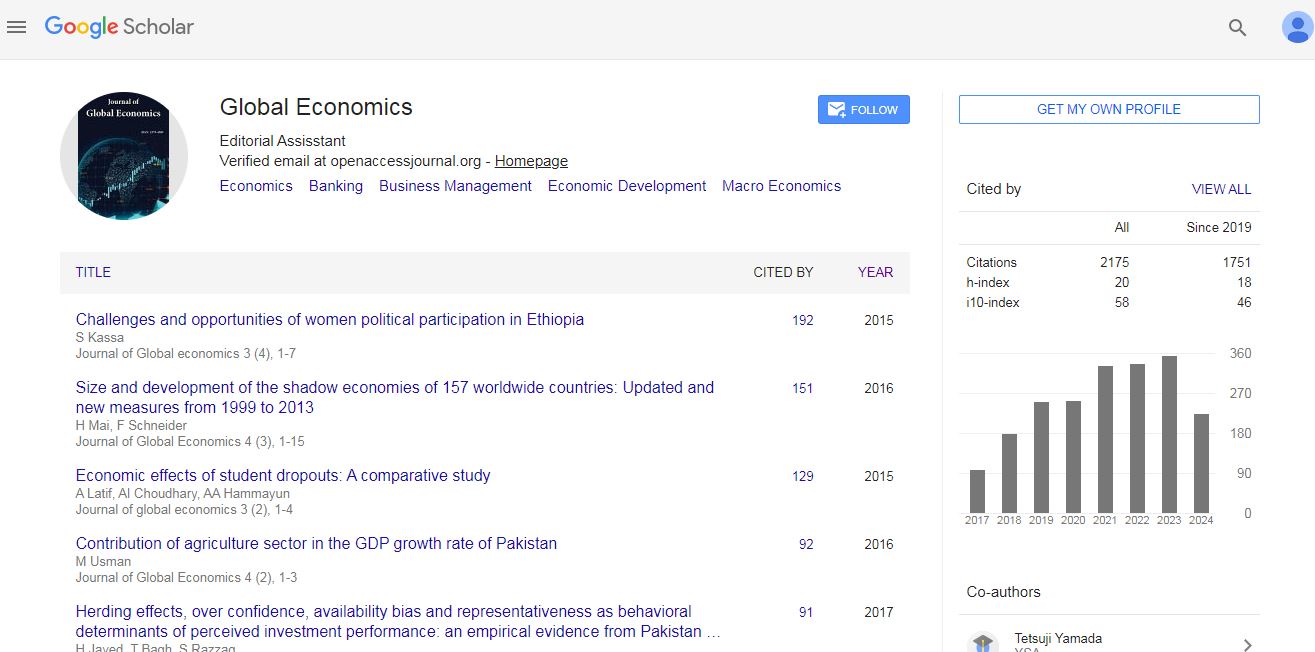
Journal of Global Economics received 2175 citations as per Google Scholar report