Commentary - (2025) Volume 10, Issue 6
Received: 01-Nov-2025, Manuscript No. jfm-26-183004;
Editor assigned: 03-Nov-2025, Pre QC No. P-183004;
Reviewed: 17-Nov-2025, QC No. Q-183004;
Revised: 24-Nov-2025, Manuscript No. R-183004;
Published:
29-Nov-2025
, DOI: 10.37421/2472-1026.2025.10.441
Citation: El-Fahim, Amina. ”Urban Medico-Legal Autopsies: Patterns, Public Health, Justice.” J Forensic Med 10 (2025):441.
Copyright: © 2025 El-Fahim A. This is an open-access article distributed under the terms of the Creative Commons Attribution License, which permits unrestricted use, distribution and reproduction in any medium, provided the original author and source are credited.
The performance and distribution of medico-legal autopsies are critical components of public health and legal systems, particularly within urban tertiary care centers. These investigations provide essential data on the causes and circumstances of death, informing public health policies and contributing to criminal justice processes. Understanding the patterns and trends in autopsies is crucial for resource allocation and service improvement. This introduction aims to synthesize findings from several studies that examine various facets of medico-legal autopsies in urban settings, highlighting their significance and the insights they offer into societal health and safety. The first study by Gomaa et al. (2022) delves into the patterns and distribution of medico-legal autopsies performed at an urban tertiary care center, analyzing demographic data, causes of death, and case types to gauge the burden and nature of these investigations [1].
Following this, Hassan et al. (2023) examine the epidemiological profile of deaths subjected to forensic autopsy, with a focus on causes of death and contributing factors, underscoring the role of forensic pathology in identifying unnatural deaths and informing prevention strategies [2].
El-Demerdash et al. (2021) analyze trends in medico-legal autopsies concerning specific types of deaths, such as those due to violence or accidents in a large urban setting, aiming to identify shifts over time and discuss potential societal influences [3].
El-Shorbagy et al. (2023) focus on the demographic characteristics of individuals undergoing medico-legal autopsy, including age, sex, and socioeconomic status, recognizing that understanding these demographics aids in tailoring public health interventions and forensic resource allocation [4].
Aboul-Fadll et al. (2022) explore the distribution of autopsy findings in cases of sudden, unexpected deaths that necessitate medicolegal examination, categorizing common causes and histological changes to enhance diagnostic accuracy and efficiency [5].
Ibrahim et al. (2023) investigate the workload and turnaround time of medico-legal autopsies in a busy urban hospital, identifying potential bottlenecks and areas for workflow management improvement to optimize resource utilization and timely completion of investigations [6].
Abdel-Hamid et al. (2021) examine the specific types of unnatural deaths most frequently encountered in medico-legal autopsies within an urban environment, categorizing these deaths and exploring underlying causes to understand prevalent mortality necessitating forensic scrutiny [7].
Soliman et al. (2022) delve into the role of advanced imaging techniques and ancillary tests in interpreting medico-legal autopsy findings in complex cases, demonstrating how these tools contribute to more accurate cause-of-death determination in subtle or challenging scenarios [8].
Ghareeb et al. (2023) focus on the pattern of drug-related deaths requiring medico-legal autopsy, analyzing prevalent substances and contributing factors, emphasizing the public health implications of substance abuse and the role of forensic pathology in documenting such fatalities [9].
Finally, El-Masry et al. (2021) provide a retrospective analysis of the distribution of homicidal deaths autopsied in an urban center, characterizing methods of homicide, victim demographics, and circumstances surrounding these events to aid crime investigation and prevention strategies [10].
The landscape of medico-legal autopsies in urban tertiary care centers is multifaceted, encompassing a wide range of cases and requiring specialized investigative approaches. Gomaa et al. (2022) characterized the patterns and distribution of these autopsies, finding that a thorough analysis of demographic data, causes of death, and case types is essential for understanding the scope and nature of medicolegal investigations in such facilities, thereby highlighting the importance of efficient autopsy services for public health and legal accountability [1].
Hassan et al. (2023) further elaborated on this by investigating the epidemiological profile of deaths undergoing forensic autopsy, focusing on the identification of unnatural deaths and their contributing factors, emphasizing the crucial role of forensic pathology in public health by informing strategies for prevention through accurate data collection [2].
In parallel, El-Demerdash et al. (2021) provided an analysis of trends in medico-legal autopsies specifically for violent and accidental deaths within a metropolis, identifying shifts over time and discussing potential societal influences that shape these patterns, offering insights into the evolving nature of forensic investigations [3].
Complementing these findings, El-Shorbagy et al. (2023) conducted a retrospective review focusing on the demographic analysis of medico-legal autopsy cases, highlighting how understanding the age, sex, and socioeconomic status of individuals involved can inform tailored public health interventions and optimize the allocation of forensic resources [4].
Aboul-Fadll et al. (2022) contributed by examining the distribution of autopsy findings in sudden and unexpected deaths requiring medicolegal examination, categorizing common causes and histological changes to enhance the precision and effectiveness of forensic diagnoses [5].
Addressing the operational aspects, Ibrahim et al. (2023) assessed the workload and efficiency of medico-legal autopsy services in a busy urban hospital, identifying bottlenecks and proposing improvements in workflow management to ensure optimal resource utilization and timely completion of crucial forensic investigations [6].
Abdel-Hamid et al. (2021) focused on the spectrum of unnatural deaths most frequently encountered in urban medico-legal autopsies, categorizing these deaths and exploring their underlying causes, which is vital for a comprehensive understanding of mortality patterns that warrant forensic scrutiny [7].
Soliman et al. (2022) explored the integration of advanced imaging and ancillary tests in medico-legal autopsies, demonstrating their utility in interpreting complex findings and improving the accuracy of cause-of-death determinations in challenging cases [8].
Ghareeb et al. (2023) investigated the specific patterns of drug-related deaths undergoing medico-legal autopsy, analyzing prevalent substances and contributing factors, thereby underscoring the public health implications of substance abuse and the critical role of forensic pathology in documenting these fatalities [9].
Lastly, El-Masry et al. (2021) presented a retrospective analysis of homicidal deaths autopsied in an urban tertiary care center, characterizing the methods, victim demographics, and circumstances, which offers essential data for crime investigation and the development of prevention strategies [10].
This collection of studies examines medico-legal autopsies in urban settings, focusing on patterns, demographics, causes of death, and operational efficiency. Research highlights the importance of these autopsies in identifying unnatural deaths, informing public health strategies, and aiding legal accountability. Studies analyze trends in violent and accidental deaths, as well as specific categories like drug-related fatalities and homicides. Demographic profiling is used to tailor interventions and resource allocation. The integration of advanced techniques and the efficiency of autopsy services are also discussed. Overall, these investigations underscore the vital role of forensic pathology in understanding mortality patterns, contributing to public safety, and supporting the justice system.
None
None
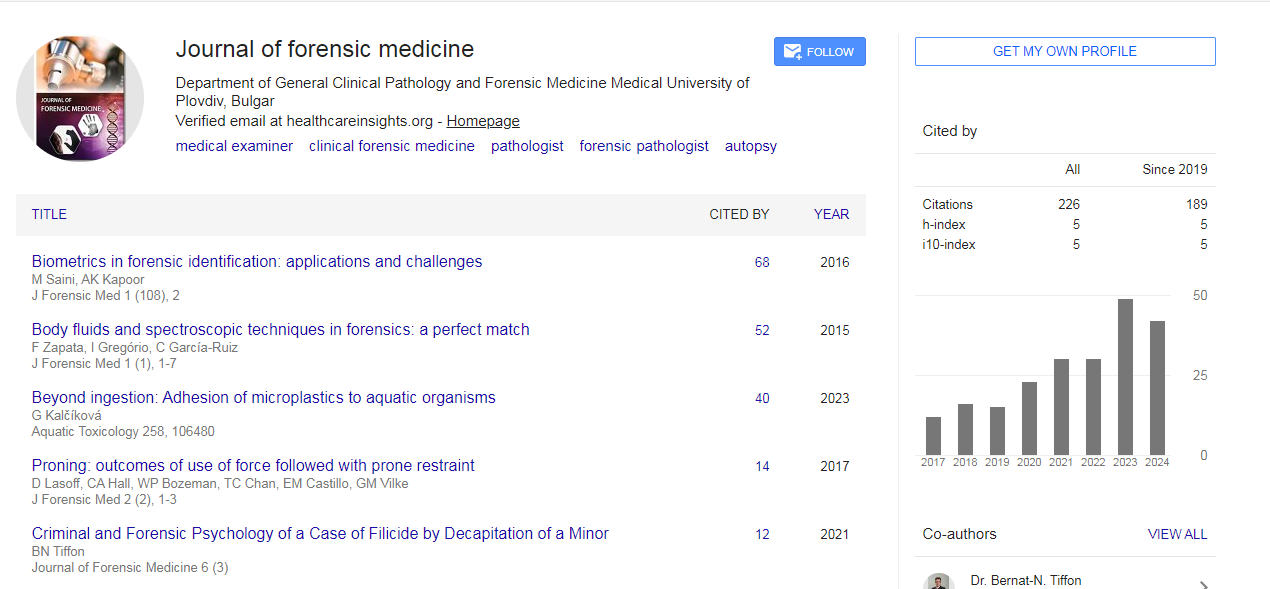
Journal of Forensic Medicine received 165 citations as per Google Scholar report