Opinion - (2025) Volume 14, Issue 3
Received: 01-May-2025, Manuscript No. mcce-26-190168;
Editor assigned: 05-May-2025, Pre QC No. P-190168;
Reviewed: 19-May-2025, QC No. Q-190168;
Revised: 22-May-2025, Manuscript No. R-190168;
Published:
29-May-2025
, DOI: 10.37421/2470-6965.2025.14.403
Citation: Ramanathan, Priya. ”Universal Health Coverage: Key to Malaria Elimination.” Malar Contr Elimination 14 (2025):403.
Copyright: © 2025 Ramanathan P. This is an open-access article distributed under the terms of the Creative Commons Attribution License, which permits unrestricted use, distribution and reproduction in any medium, provided the original author and source are credited.
Universal Health Coverage (UHC) serves as a fundamental catalyst for achieving malaria elimination by ensuring that prevention, diagnosis, and treatment services are accessible to all individuals without discrimination. This comprehensive approach dismantles financial barriers that often prevent vulnerable populations from seeking necessary healthcare, thereby strengthening the overall health system's capacity to deliver integrated malaria interventions. Furthermore, UHC actively promotes community engagement, a crucial element for sustaining progress in the fight against malaria and for achieving its ultimate eradication. By prioritizing UHC, malaria control strategies can effectively reach the most at-risk groups, thus preventing resurgence and paving the way for sustained elimination efforts. Integrating malaria-specific services into UHC packages is a vital step towards ensuring the sustainability of elimination initiatives. This strategic integration guarantees that essential malaria interventions are not overlooked and remain accessible to everyone, particularly in regions grappling with limited resources. The strengthening of primary healthcare systems under UHC frameworks is instrumental in providing consistent access to crucial services such as diagnostics, prompt treatment, and effective vector control measures, all of which directly contribute to reducing malaria transmission and ultimately achieving elimination. The financial protection offered by UHC is of paramount importance in the context of malaria elimination. Catastrophic out-of-pocket expenditures for malaria treatment can impose a severe financial burden on impoverished households, frequently leading to delays in seeking medical attention and consequently exacerbating disease transmission. UHC effectively mitigates this risk by ensuring that healthcare services are available without causing financial hardship, thereby encouraging timely diagnosis and treatment â?? critical steps necessary for the successful eradication of malaria. Strengthening health system governance and implementing robust financing mechanisms within UHC frameworks are indispensable for the sustained control and eventual elimination of malaria. These well-established systems ensure the consistent availability of essential medicines, the presence of skilled healthcare professionals, and the efficient operation of service delivery networks, all of which are vital for effectively combating malaria. UHC provides the essential policy and financial infrastructure to support and sustain these critical health system components. The core principle of UHC, which emphasizes leaving no one behind, directly underpins and supports efforts aimed at malaria elimination. UHC actively promotes the inclusion of marginalized and remote populations who often bear a disproportionately high burden of malaria. By extending healthcare access to these underserved groups, UHC ensures that vital interventions reach even the most remote areas, effectively preventing the persistence of localized transmission pockets that can impede comprehensive elimination goals. Community engagement and health education, recognized as integral components of UHC, play a crucial role in achieving malaria elimination. UHC frameworks offer a structured approach to empower communities, encouraging their active participation in malaria prevention activities, fostering the recognition of disease symptoms, and promoting the timely seeking of medical care. This participatory model cultivates a sense of ownership and ensures the long-term sustainability of malaria control initiatives, which is fundamental to achieving a malaria-free status. The effectiveness of UHC in driving malaria elimination is intrinsically linked to the strength of primary healthcare systems. UHC reforms that place a strong emphasis on enhancing primary care infrastructure, including the development of skilled personnel and the expansion of diagnostic capabilities, directly improve the delivery of malaria interventions at the community level. This enhancement facilitates early detection and prompt treatment, thereby effectively breaking the cycles of disease transmission. Investing in UHC establishes a sustainable and predictable financing mechanism for malaria elimination programs. By integrating malaria interventions within broader national health financing strategies, countries can secure consistent and adequate funding for essential services, surveillance activities, and ongoing research. This approach moves away from fragmented, project-based funding towards a more stable, long-term, and system-wide financial sustainability for malaria control. The multisectoral approach inherent in the principles of UHC is highly beneficial for malaria elimination efforts. Malaria's complex determinants extend beyond the direct purview of the healthcare sector, encompassing crucial factors such as sanitation, housing quality, and educational attainment. UHC frameworks can effectively facilitate inter-sectoral coordination among different government agencies, as well as collaboration with development partners, thereby fostering a more comprehensive and holistic strategy for disease control and eventual elimination. Robust data and information systems are essential for accurately monitoring progress towards malaria elimination, and UHC plays a significant role in strengthening these critical systems. UHC underscores the importance of well-developed health information systems for effective service delivery, comprehensive surveillance, and thorough program evaluation. The enhancement of these systems enables the timely identification of areas with ongoing transmission and the efficient allocation of resources for targeted interventions, both of which are indispensable for achieving malaria elimination goals.
Universal Health Coverage (UHC) is a critical enabler for malaria elimination by ensuring equitable access to prevention, diagnosis, and treatment services. UHC helps to overcome financial barriers, strengthens health systems to deliver integrated malaria interventions, and promotes community engagement necessary for sustained progress. Focusing on UHC ensures that malaria control efforts reach the most vulnerable populations, preventing resurgence and ultimately achieving elimination [1].
Integrating malaria services into UHC packages is essential for sustainable elimination. This approach ensures that essential malaria interventions are not overlooked and are accessible to all, especially in resource-limited settings. Strengthening primary healthcare under UHC frameworks allows for consistent access to diagnostics, prompt treatment, and vector control measures, directly contributing to reduced transmission and eventual elimination [2].
The financial protection offered by UHC is paramount in malaria elimination. Out-of-pocket expenditures for malaria treatment can be catastrophic for poor households, leading to delayed care-seeking and increased transmission. UHC mitigates this by ensuring services are available without causing financial hardship, thereby promoting timely diagnosis and treatment, which are crucial steps towards elimination [3].
Strengthening health system governance and financing mechanisms within UHC frameworks is vital for sustained malaria control and elimination. Robust systems ensure the availability of essential medicines, skilled healthcare workers, and efficient service delivery networks necessary to combat malaria effectively. UHC provides the policy and financial architecture to support these critical health system components [4].
The principle of leaving no one behind, central to UHC, directly supports malaria elimination efforts. UHC promotes the inclusion of marginalized and remote populations who are often disproportionately affected by malaria. By extending healthcare access to these groups, UHC ensures that interventions reach the last mile, preventing pockets of transmission that can hinder elimination [5].
Community engagement and health education, key components of UHC, are crucial for malaria elimination. UHC frameworks can empower communities to participate in malaria prevention activities, recognize symptoms, and seek timely care. This participatory approach fosters ownership and sustainability of malaria control initiatives, essential for achieving zero malaria [6].
The effectiveness of UHC in malaria elimination is contingent on strong primary healthcare systems. UHC reforms that prioritize strengthening primary care infrastructure, including skilled personnel and diagnostic capacity, directly enhance the delivery of malaria interventions at the community level, facilitating early detection and prompt treatment to break transmission cycles [7].
Investing in UHC provides a sustainable financing mechanism for malaria elimination programs. By embedding malaria interventions within broader health financing strategies, countries can ensure predictable and adequate funding for essential services, surveillance, and research, moving beyond project-based funding towards long-term, system-wide sustainability [8].
The multisectoral approach inherent in UHC is beneficial for malaria elimination. Malaria's determinants extend beyond healthcare, involving factors like sanitation, housing, and education. UHC frameworks can facilitate coordination across different government sectors and with development partners, creating a more holistic approach to disease control and elimination [9].
Data and information systems are critical for monitoring progress towards malaria elimination, and UHC strengthens these systems. UHC emphasizes the importance of robust health information systems for service delivery, surveillance, and evaluation. These strengthened systems enable timely identification of transmission hotspots and effective allocation of resources for targeted interventions, crucial for achieving elimination [10].
Universal Health Coverage (UHC) is crucial for malaria elimination by ensuring equitable access to services, overcoming financial barriers, and strengthening health systems. Integrating malaria interventions into UHC packages guarantees continuous access, particularly in resource-limited settings, by reinforcing primary healthcare. Financial protection from UHC prevents catastrophic expenses, promoting timely treatment and reducing transmission. Strong governance and financing within UHC are vital for sustained control, ensuring essential resources and personnel are available. UHC's 'leave no one behind' principle extends access to vulnerable populations, preventing localized outbreaks. Community engagement, a UHC tenet, fosters ownership and sustainability of control efforts. Robust primary healthcare under UHC facilitates early detection and treatment. Sustainable financing from UHC supports long-term malaria elimination programs. The multisectoral approach of UHC addresses broader determinants of malaria, while strengthened health information systems enable effective monitoring and resource allocation.
None
None
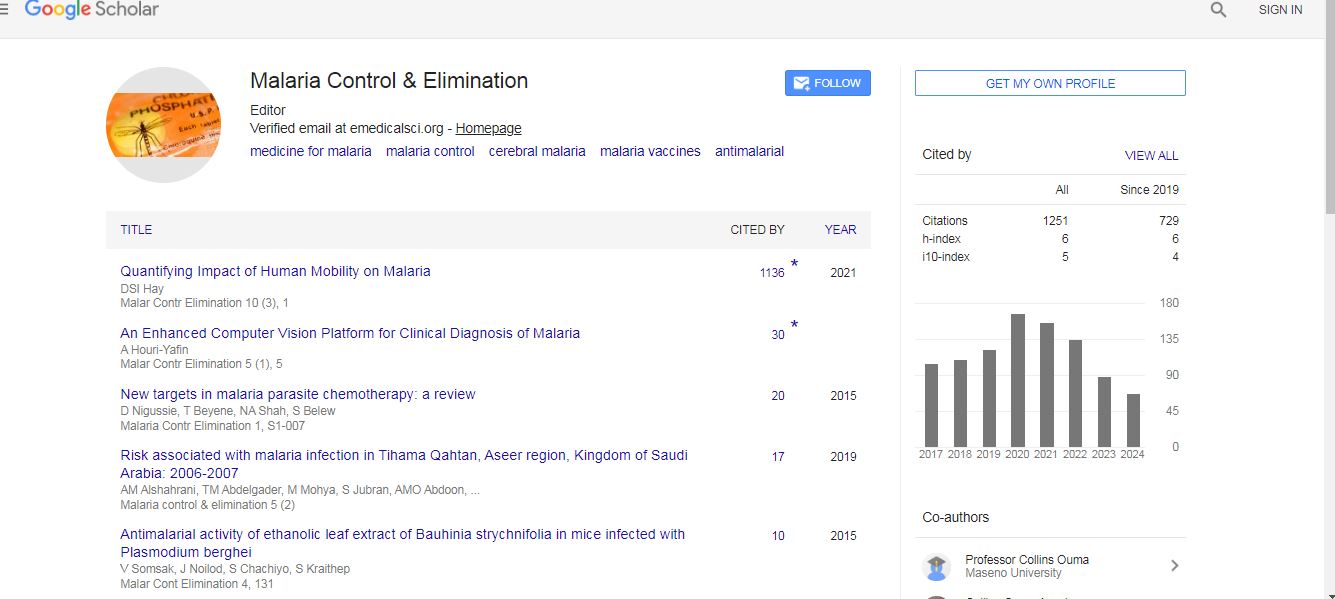
Malaria Control & Elimination received 1187 citations as per Google Scholar report