Perspective - (2025) Volume 9, Issue 3
Received: 01-May-2025, Manuscript No. hps-26-184446;
Editor assigned: 05-May-2025, Pre QC No. P-184446;
Reviewed: 19-May-2025, QC No. Q-184446;
Revised: 22-May-2025, Manuscript No. R-184446;
Published:
29-May-2025
, DOI: 10.37421/2573-4563.2025.9.346
Citation: Kim, Yuna H.. ”Understanding DILI: Pathways, Prediction, and Prevention.” J Hepatol Pancreat Sci 09 (2025):346.
Copyright: © 2025 Kim H. Yuna This is an open-access article distributed under the terms of the Creative Commons Attribution License, which permits unrestricted use, distribution and reproduction in any medium, provided the original author and source are credited.
Drug-induced liver injury (DILI) represents a substantial clinical challenge, characterized by diverse mechanisms that are heavily influenced by the specific causative agent. Understanding these intricate mechanisms, particularly the roles of immune responses, metabolic activation, and mitochondrial dysfunction, is paramount for effective management and prevention [1].
The development of accurate predictive models for DILI is of utmost importance. These models are designed to integrate a variety of data sources, including genomic susceptibility, demographic characteristics, and drug exposure profiles, to effectively stratify patients according to their risk of developing liver injury [2].
Hepatoprotective strategies against DILI encompass a range of approaches. While the withdrawal of the offending drug remains the primary intervention, current research is actively exploring pharmacological agents that can mitigate oxidative stress, modulate immune system activity, and support optimal mitochondrial function [3].
Immune-mediated DILI is recognized as a complex pathological process. A thorough understanding of the intricate interplay between drug-specific T-cell responses, innate immune activation, and the resulting cytokine profiles is essential for accurate diagnosis and effective patient management [4].
Mitochondrial dysfunction is understood to play a critical role in the pathogenesis of numerous forms of DILI. Drugs can disrupt normal mitochondrial respiration, generate oxidative stress, and initiate programmed cell death through the intrinsic apoptotic pathway. Consequently, therapies aimed at preserving mitochondrial integrity and function are considered promising avenues for hepatoprotection [5].
The field of DILI pharmacogenomics is experiencing significant expansion. This area focuses on identifying specific genetic variations that can confer either susceptibility or resistance to drug-induced liver damage, offering insights into personalized risk assessment and preventative strategies [6].
Biomarkers are crucial for the early detection and precise diagnosis of DILI. Beyond the traditional liver function tests, researchers are investigating novel circulating microRNAs, extracellular vesicles, and specific protein panels for their potential to provide more sensitive and specific indicators of liver damage [7].
Drug metabolism, primarily mediated by cytochrome P450 enzymes, presents a dual role in the context of DILI. While vital for drug clearance, this metabolic process can also generate reactive metabolites that contribute to cellular toxicity. Elucidating the precise balance between metabolic activation and detoxification pathways is key to understanding DILI mechanisms [8].
The gut-liver axis has been identified as a significant contributor to DILI. Dysregulation of the gut microbiota and increased intestinal permeability can facilitate the translocation of bacterial products, exacerbating systemic inflammation and liver injury. Modulating the gut microbiome thus emerges as a potential strategy for DILI prevention and treatment [9].
In vitro and in silico models are increasingly utilized to predict the DILI potential of novel drug candidates during the early stages of drug development. These advanced models, including organ-on-a-chip systems and sophisticated computational simulations, offer promising alternatives or complements to traditional animal testing, thereby accelerating the discovery of safer drugs [10].
Drug-induced liver injury (DILI) is a significant clinical challenge, with mechanisms varying widely depending on the causative agent. Understanding these mechanisms, particularly the roles of immune responses, metabolic activation, and mitochondrial dysfunction, is crucial for effective management and prevention [1].
Predictive models for DILI are paramount, aiming to leverage diverse data sources such as genomic susceptibility, demographic factors, and drug exposure profiles to stratify patients based on their risk. Advances in machine learning and artificial intelligence are accelerating the development of these sophisticated tools, which could revolutionize early diagnosis and personalized treatment of DILI [2].
Hepatoprotective strategies against DILI are multi-faceted. While drug withdrawal remains the cornerstone, research is focusing on pharmacological interventions, including agents that mitigate oxidative stress, modulate immune responses, and support mitochondrial function. Identifying specific cellular targets for therapeutic intervention is a key area of ongoing investigation to develop more effective DILI treatments [3].
Immune-mediated DILI is a complex phenomenon. Understanding the interplay between drug-specific T-cell responses, innate immune activation, and cytokine profiles is essential for diagnosis and management. Novel diagnostic markers and immunomodulatory therapies are being explored to specifically target these aberrant immune responses in DILI [4].
Mitochondrial dysfunction plays a pivotal role in the pathogenesis of many forms of DILI. Drugs can disrupt mitochondrial respiration, induce oxidative stress, and trigger apoptosis via the intrinsic pathway. Therapies aimed at preserving mitochondrial integrity and function are thus promising hepatoprotective strategies [5].
The pharmacogenomics of DILI is an expanding field, identifying genetic variations that confer susceptibility or resistance to drug-induced liver damage. Genome-wide association studies (GWAS) and targeted sequencing are instrumental in uncovering these genetic predispositions, paving the way for personalized risk assessment and preventative measures [6].
Biomarkers for DILI are critical for early detection and accurate diagnosis. Beyond traditional liver function tests, novel circulating microRNAs, extracellular vesicles, and protein panels are being investigated for their potential to provide more sensitive and specific indicators of liver injury [7].
Drug metabolism, particularly via cytochrome P450 enzymes, is a double-edged sword in DILI. While essential for drug clearance, it can also lead to the generation of reactive metabolites that cause cellular toxicity. Understanding the intricate balance of metabolic activation and detoxification pathways is key to elucidating DILI mechanisms [8].
The gut-liver axis plays a crucial role in DILI. Alterations in gut microbiota and increased intestinal permeability can lead to the translocation of bacterial products, contributing to systemic inflammation and liver injury. Modulating the gut microbiome presents a potential avenue for DILI prevention and treatment [9].
In vitro and in silico models are increasingly being used to predict DILI potential of new drug candidates early in the development process. These models, including organ-on-a-chip systems and advanced computational simulations, offer promising alternatives or complements to traditional animal testing, accelerating safer drug discovery [10].
Drug-induced liver injury (DILI) is a complex clinical issue driven by varied mechanisms including immune responses, metabolic activation, and mitochondrial dysfunction. Understanding these pathways is crucial for developing effective treatments. Predictive models are emerging, integrating genetic, clinical, and molecular data to identify at-risk individuals and improve drug development. Hepatoprotective strategies focus on early detection, prompt drug withdrawal, and novel therapies targeting inflammation and oxidative stress. Advances in artificial intelligence and machine learning are enhancing predictive capabilities. Pharmacogenomics and the study of the gut-liver axis offer personalized approaches. Biomarkers and novel in vitro/in silico models are also vital for early detection and safer drug discovery.
None
None
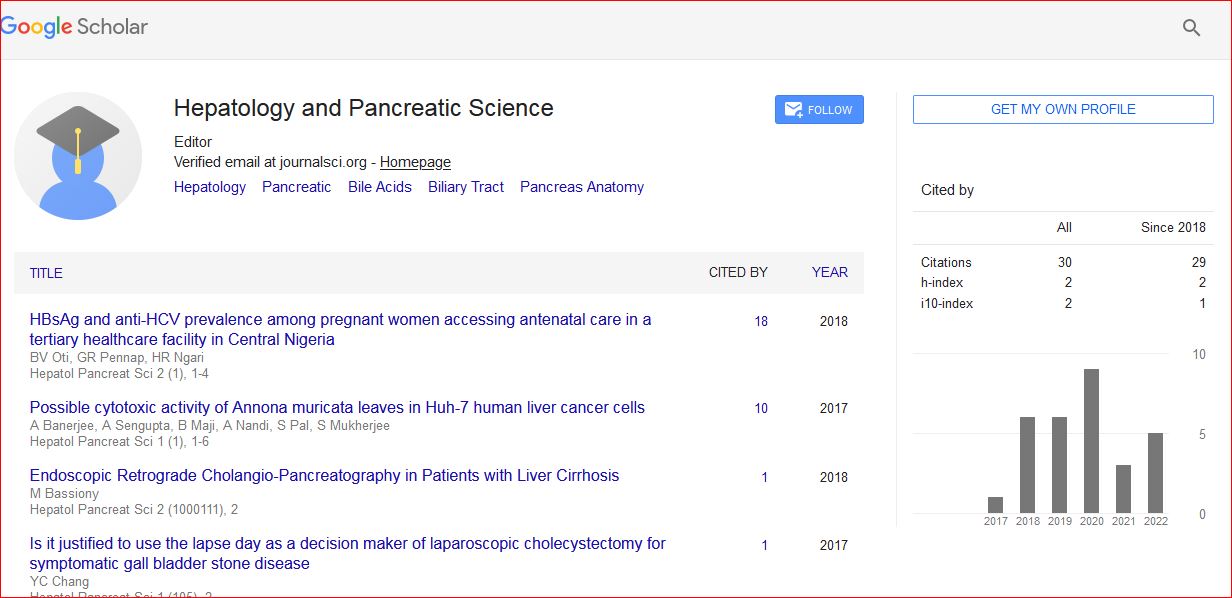
Hepatology and Pancreatic Science received 34 citations as per Google Scholar report