Commentary - (2025) Volume 14, Issue 3
Received: 01-May-2025, Manuscript No. jtm-26-185727;
Editor assigned: 03-May-2025, Pre QC No. P-185727;
Reviewed: 19-May-2026, QC No. Q-185727;
Revised: 22-May-2025, Manuscript No. R-185727;
Published:
29-May-2025
, DOI: 10.37421/2167-1222.2025.14.679
Citation: Anderson, Michael. ”Traumatic Injury Management: Resuscitation, Stabilization, Recovery.” J Trauma Treat 14 (2025):679.
Copyright: © 2025 Anderson M. This is an open-access article distributed under the terms of the Creative Commons Attribution License, which permits unrestricted use, distribution and reproduction in any medium, provided the original author and source are credited.
Early intervention in severe traumatic injury is a critical determinant of patient outcomes, with rapid assessment, resuscitation, and hemorrhage control forming the cornerstone of initial management. Damage control orthopaedics represents a paradigm shift, focusing on temporary stabilization of injuries to facilitate physiological recovery, thereby minimizing the risks associated with prolonged operative times and reducing the inflammatory cascade. This approach prioritizes restoring physiological stability before definitive surgical intervention [1].
Effective hemorrhage control is paramount in severe trauma, necessitating swift attention to the 'ABCs' of resuscitation: Airway, Breathing, and Circulation. Optimizing hemodynamic stability through balanced blood product resuscitation, guided by advanced monitoring, is crucial for reversing coagulopathy and improving outcomes. The timely intervention for bleeding sources, whether surgical or radiological, is a cornerstone of this strategy [2].
The management of severe extremity trauma requires a comprehensive, multidisciplinary approach. Early orthopedic consultation is vital for prompt fracture assessment and management, with careful consideration given to the principles of 'limb salvage' versus 'amputation'. Aggressive soft tissue management and meticulous wound care are essential to prevent infection and promote healing [3].
Pain management is an indispensable component of early intervention in severe traumatic injuries. Multimodal analgesia, integrating pharmacological and non-pharmacological strategies, is recommended. Opioid-sparing approaches are increasingly emphasized to mitigate the risks of dependence and adverse effects. Early initiation of physical therapy and mobilization can also significantly contribute to pain reduction and functional recovery [4].
The role of imaging in early trauma management cannot be overstated, providing crucial information to guide diagnosis and treatment decisions. Rapid and accurate imaging, encompassing X-rays, CT scans, and ultrasound, must be judiciously employed, balancing the need for information with radiation exposure and time constraints. Advanced imaging techniques can further delineate complex injuries and inform surgical planning [5].
Infection prevention and control are critical considerations in the care of severely injured patients. Early antibiotic administration, tailored to local resistance patterns and injury characteristics, is standard practice. Aggressive wound debridement and meticulous surgical site care are also key. Vigilant monitoring for signs of infection and prompt management are essential to avert systemic complications [6].
Early nutritional support plays a vital role in the recovery of severely injured patients. Initiating appropriate nutrition, often via enteral routes, within the initial 24-48 hours can help mitigate the hypermetabolic response and promote wound healing. Regular monitoring of nutritional status and adaptive regimens are crucial for optimizing patient outcomes and preventing malnutrition [7].
The management of severe pelvic fractures demands a structured, multidisciplinary approach, with early recognition and management of associated hemorrhage being critical. Damage control principles, including temporary external fixation and staged surgical reconstruction, are frequently employed. The increasing utilization of minimally invasive techniques addresses complex pelvic injuries effectively [8].
Early mobilization in severe traumatic injury, when physiologically appropriate, is crucial for preventing complications such as deep vein thrombosis, pneumonia, and muscle atrophy. Careful patient selection and a progressive approach to activity are essential. Integrating physical and occupational therapy into the early management plan supports functional recovery and reduces overall hospital length of stay [9].
The initial management of severe traumatic injury is critically dependent on the rapid implementation of a structured protocol that includes swift assessment, aggressive resuscitation, and effective hemorrhage control. Damage control orthopaedics has emerged as a key strategy, focusing on the temporary stabilization of orthopedic injuries. This approach aims to restore physiological balance, allowing the patient's body to recover before definitive surgical intervention, thereby minimizing the risks associated with prolonged operative times and mitigating the systemic inflammatory response [1].
Hemorrhage control is a primary concern in severe trauma, underscoring the importance of addressing the 'ABCs' of resuscitationâ??Airway, Breathing, and Circulationâ??with utmost urgency. Optimizing hemodynamic stability through balanced blood product resuscitation, often guided by thromboelastography or point-of-care testing, is essential for correcting coagulopathy and improving patient survival. Prompt surgical or interventional radiology intervention to control bleeding sources is a fundamental aspect of this management [2].
The comprehensive management of severe extremity trauma necessitates a multidisciplinary approach, with early orthopedic consultation being vital for accurate fracture assessment and timely intervention. The critical decision-making process between 'limb salvage' and 'amputation' involves careful consideration of injury severity, potential for functional recovery, and individual patient factors. Furthermore, aggressive soft tissue management and meticulous wound care are indispensable for preventing infection and facilitating optimal healing [3].
Effective pain management is an integral part of the early intervention strategy for severe traumatic injuries. A multimodal approach, combining pharmacological and non-pharmacological interventions, is recommended. Emphasis is increasingly placed on opioid-sparing techniques to reduce the incidence of opioid dependence and its associated sequelae. Early engagement with physical therapy and mobilization also plays a significant role in pain reduction and the promotion of functional recovery [4].
Diagnostic imaging plays a pivotal role in early trauma management by guiding diagnosis and treatment decisions. Rapid and accurate imaging, including conventional radiography, computed tomography, and ultrasound, must be employed judiciously, balancing the need for critical information with considerations of radiation exposure and time constraints. Advanced imaging modalities can provide detailed insights into complex injuries, thereby facilitating precise surgical planning [5].
Preventing and controlling infections are paramount in the care of patients with severe trauma. The early administration of prophylactic antibiotics, tailored to local antimicrobial resistance patterns and specific injury characteristics, is a standard practice. Aggressive surgical debridement of contaminated wounds and meticulous surgical site care are equally important. Continuous monitoring for signs of infection and prompt intervention are crucial to prevent the development of systemic complications [6].
Early nutritional support is a critical factor in the recovery trajectory of severely injured patients. The initiation of appropriate nutritional interventions, frequently via the enteral route, within the first 24 to 48 hours post-injury can significantly attenuate the hypermetabolic response and promote wound healing. Ongoing monitoring of nutritional status and the dynamic adjustment of nutritional regimens are essential for optimizing patient outcomes and preventing iatrogenic malnutrition [7].
The management of severe pelvic fractures requires a systematic and collaborative approach, with the early identification and control of associated hemorrhage being of utmost importance. Damage control principles, which may include temporary external fixation and staged surgical reconstruction, are often employed. The increasing adoption of minimally invasive surgical techniques has improved the management of complex pelvic injuries [8].
Early mobilization, when deemed physiologically safe, is crucial in the management of severe traumatic injuries to prevent secondary complications such as deep vein thrombosis, pneumonia, and muscle wasting. Careful patient selection and a gradual, progressive increase in activity levels are essential. The integration of physical and occupational therapy services into the early management plan is fundamental to fostering functional recovery and reducing the overall duration of hospital stay [9].
The initial management of severe traumatic injuries prioritizes rapid assessment, resuscitation, and hemorrhage control. Key strategies include damage control orthopaedics for temporary stabilization, balanced blood product resuscitation, and timely intervention for bleeding. A multidisciplinary approach is essential for managing extremity and pelvic trauma, focusing on limb salvage decisions, soft tissue care, and infection prevention through early antibiotics and wound management. Pain control is managed with multimodal and opioid-sparing techniques. Early nutritional support via enteral routes aids recovery and mitigates hypermetabolism. Imaging is critical for diagnosis and treatment planning, balancing information needs with radiation exposure. Early mobilization, when appropriate, prevents complications like DVT and pneumonia. Spinal cord injury management requires immediate airway and breathing support, spinal stabilization, and preventing secondary injuries. The overarching goal is to restore physiological stability and promote functional recovery.
None
None
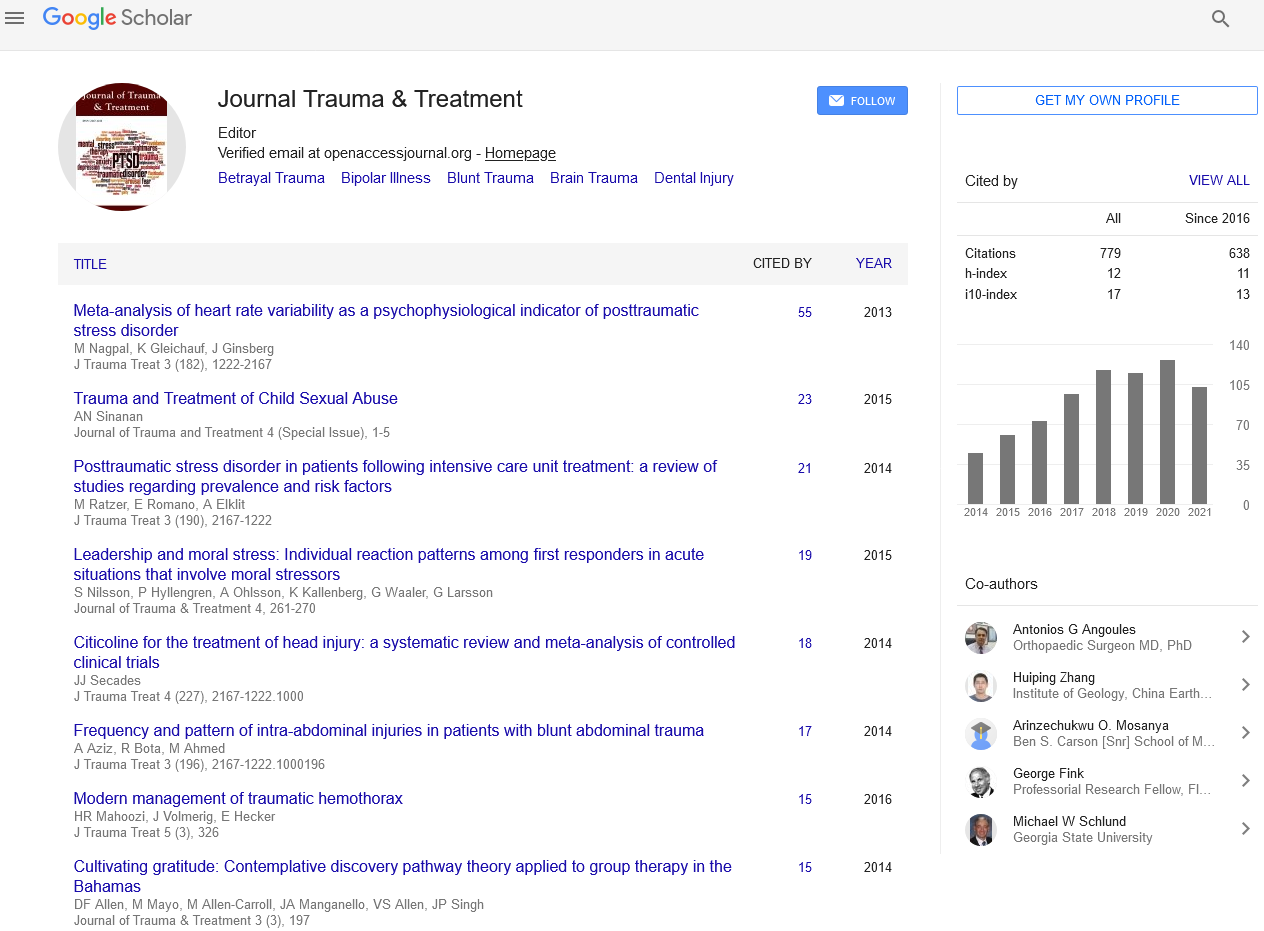
Journal of Trauma & Treatment received 1048 citations as per Google Scholar report