Short Communication - (127) Volume 14, Issue 5
Received: 01-Sep-2025, Manuscript No. jtm-26-186034;
Editor assigned: 03-Sep-2025, Pre QC No. P-186034;
Reviewed: 17-Sep-2025, QC No. Q-186034;
Revised: 22-Sep-2025, Manuscript No. R-186034;
Published:
29-Sep-2025
, DOI: 10.37421/2167-1222.2025.14.706
Citation: Khalil, Yara. ”Trauma Shock Management: Current, Emerging, and Future Directions.” J Trauma Treat 14 (2025):706.
Copyright: © 2025 Khalil Y. This is an open-access article distributed under the terms of the Creative Commons Attribution License, which permits unrestricted use, distribution and reproduction in any medium, provided the original author and source are credited.
Recent advancements in the management of shock following trauma are centered on prompt identification, aggressive fluid resuscitation, and precise interventions to restore adequate tissue perfusion. The integration of sophisticated hemodynamic monitoring, including less invasive methodologies, is pivotal for tailoring resuscitation strategies to individual patient needs. The utilization of vasopressors is evolving, with an increasing tendency towards earlier administration in specific shock phenotypes, guided by continuous physiological data. A thorough comprehension of the underlying pathophysiology of trauma-induced coagulopathy and its profound influence on shock is indispensable for effective clinical management, emphasizing the importance of balanced blood product ratios. Emerging research is actively exploring novel therapeutic agents and adjuncts with the potential to mitigate cellular damage and enhance organ recovery in the post-resuscitation phase [1].
The critical role of early and appropriate fluid resuscitation in the management of traumatic shock is undergoing continuous re-evaluation. While essential, the administration of excessive fluid volumes can inadvertently exacerbate coagulopathy and contribute to increased mortality. Current strategic approaches advocate for goal-directed resuscitation, predicated on physiological parameters such as lactate levels, base deficit, and hemodynamic monitoring, rather than adherence to fixed volume targets. The specific type of fluid employed also plays a significant role, with ongoing discussions surrounding the comparative benefits and risks of crystalloids versus colloids in trauma patient care [2].
Trauma-induced coagulopathy (TIC) represents a significant determinant of mortality in severely injured individuals. Advances in understanding the complex mechanisms of TIC involve the identification of key molecular pathways and the development of targeted therapeutic interventions. The early administration of balanced blood products, encompassing fresh frozen plasma, platelets, and cryoprecipitate, in ratios guided by viscoelastic hemostatic assays (VHAs) such as rotational thromboelastometry (ROTEM), is increasingly becoming the standard of care. This proactive approach aims to rapidly correct coagulopathy and ultimately improve patient survival rates [3].
The application of advanced hemodynamic monitoring technologies has profoundly transformed the landscape of shock management. Devices capable of providing continuous, real-time assessments of cardiac output, systemic vascular resistance, and fluid responsiveness empower clinicians to meticulously tailor resuscitation efforts. Technologies like pulse contour analysis and impedance cardiography offer less invasive alternatives to traditional monitoring methods, thereby facilitating earlier and more precise interventions to sustain adequate tissue perfusion [4].
Vasopressor therapy in the context of traumatic shock necessitates careful consideration to preclude detrimental effects. Although crucial for maintaining adequate blood pressure, the inappropriate or prolonged use of vasopressors can precipitate vasoconstriction, impair microcirculatory function, and exacerbate organ damage. Current clinical approaches favor the early introduction of vasopressors, particularly norepinephrine, when indicated by hemodynamic monitoring, to support perfusion pressure and effectively reverse shock states [5].
The elucidation of cellular and mitochondrial dysfunction in shock has paved the way for novel therapeutic avenues. Strategies aimed at preserving mitochondrial integrity, mitigating oxidative stress, and optimizing cellular energy metabolism are currently under extensive investigation. Although many of these promising therapies remain in preclinical stages, they hold considerable potential for reducing organ injury and improving outcomes in patients experiencing severe traumatic shock [6].
The utilization of viscoelastic hemostatic assays (VHAs), including ROTEM and TEG, has become increasingly vital in guiding hemostatic therapy in trauma patients. These assays offer a comprehensive evaluation of clot formation and lysis dynamics, enabling rapid, individualized assessment of coagulopathy and the targeted administration of blood products and pro-coagulant agents. This evidence-based approach is consistently associated with reduced blood product consumption and improved patient outcomes [7].
Adjunctive therapies for shock management are gaining significant momentum, with a primary focus on attenuating the systemic inflammatory response and minimizing organ damage. These therapeutic modalities include interventions designed to modulate inflammation, such as the judicious use of corticosteroids in specific shock states, and agents that support endothelial function. The precise role and optimal application of these adjuncts in the complex milieu of traumatic shock remain subjects of ongoing research and require further investigation [8].
The concept of permissive hypotension in trauma resuscitation continues to be an active area of scientific inquiry. This strategic approach involves tolerating a lower mean arterial pressure (MAP) during the initial phase of resuscitation to potentially prevent re-bleeding from injured tissues. While it may offer benefits in certain clinical scenarios, meticulous monitoring and a well-defined transition to more aggressive resuscitation strategies are paramount to avert hypoperfusion and subsequent end-organ damage [9].
Future directions in shock management are increasingly oriented towards personalized medicine paradigms. This encompasses the integration of genomics, proteomics, and advanced physiological modeling to accurately predict individual patient responses to interventions and to optimize treatment protocols. The development of novel biomarkers for early shock detection and prognostication, coupled with more targeted pharmacotherapies and regenerative medicine strategies, represents key frontiers in current and future research endeavors [10].
The management of shock following trauma has undergone significant evolution, with current approaches emphasizing early recognition and rapid, targeted interventions to restore tissue perfusion. Advanced hemodynamic monitoring, including less invasive techniques, enables more personalized resuscitation strategies. Vasopressor use is being refined, with earlier administration in specific shock phenotypes guided by real-time physiological data. Understanding trauma-induced coagulopathy and its impact on shock is crucial, highlighting the importance of balanced blood product ratios. Novel therapeutic agents and adjuncts are being investigated to mitigate cellular damage and improve organ recovery post-resuscitation [1].
Re-evaluation of early and appropriate fluid resuscitation in traumatic shock underscores the critical need for precise administration. Excessive fluid resuscitation can exacerbate coagulopathy and increase mortality. Current strategies advocate for goal-directed resuscitation based on physiological parameters and hemodynamic monitoring, moving away from fixed volume targets. The choice of fluid, be it crystalloids or colloids, remains a subject of ongoing debate regarding their respective benefits and risks in trauma patients [2].
Trauma-induced coagulopathy (TIC) is a major contributor to mortality in severely injured patients. Advances in understanding TIC have led to the development of targeted interventions. Early use of balanced blood products, guided by viscoelastic hemostatic assays (VHAs) like rotational thromboelastometry (ROTEM), is becoming standard practice, aiming to rapidly correct coagulopathy and improve survival [3].
Advanced hemodynamic monitoring technologies have revolutionized shock management by providing continuous, real-time assessment of key parameters. Devices utilizing pulse contour analysis and impedance cardiography offer less invasive alternatives, allowing for earlier and more precise interventions to maintain adequate tissue perfusion and guide resuscitation efforts [4].
Vasopressor therapy in traumatic shock requires careful management to avoid adverse effects such as vasoconstriction and impaired microcirculation. Current approaches advocate for the early use of vasopressors, particularly norepinephrine, when indicated by hemodynamic monitoring, to support perfusion pressure and reverse shock [5].
Research into cellular and mitochondrial dysfunction in shock has opened new therapeutic avenues. Strategies targeting mitochondrial protection, reduction of oxidative stress, and improvement of cellular energy metabolism are under investigation. These approaches hold promise for mitigating organ injury and improving outcomes in patients with severe traumatic shock [6].
The increasing use of viscoelastic hemostatic assays (VHAs) like ROTEM and TEG is crucial for guiding hemostatic therapy in trauma. These tests provide a comprehensive assessment of clot dynamics, allowing for individualized management of coagulopathy and targeted administration of blood products and pro-coagulant agents, leading to improved outcomes [7].
Adjunctive therapies for shock management are gaining traction, focusing on modulating the systemic inflammatory response and protecting organs. These include therapies that manage inflammation and support endothelial function. The optimal use of these adjuncts in traumatic shock requires further investigation [8].
The concept of permissive hypotension in trauma resuscitation, involving a lower initial mean arterial pressure, is an area of ongoing research. While potentially beneficial in specific situations, it necessitates careful monitoring and a clear transition to more aggressive resuscitation to prevent hypoperfusion and end-organ damage [9].
Future shock management strategies are moving towards personalized medicine, integrating advanced data and modeling to optimize treatment. The development of novel biomarkers for early detection and prognostication, alongside targeted pharmacotherapies and regenerative medicine, are key areas of future research [10].
Current shock management in trauma emphasizes early recognition, rapid fluid resuscitation, and targeted interventions to restore tissue perfusion. Advanced hemodynamic monitoring aids in personalized resuscitation, while vasopressor use is being refined with earlier administration guided by real-time data. Understanding trauma-induced coagulopathy and its impact is critical, leading to the adoption of balanced blood product ratios and viscoelastic hemostatic assays for guiding therapy. Emerging research focuses on mitigating cellular damage and improving organ recovery through novel agents and adjuncts. Fluid resuscitation strategies are evolving towards goal-directed approaches, and permissive hypotension is an area of ongoing investigation. Future directions involve personalized medicine, novel biomarkers, and regenerative strategies for enhanced shock management.
None
None
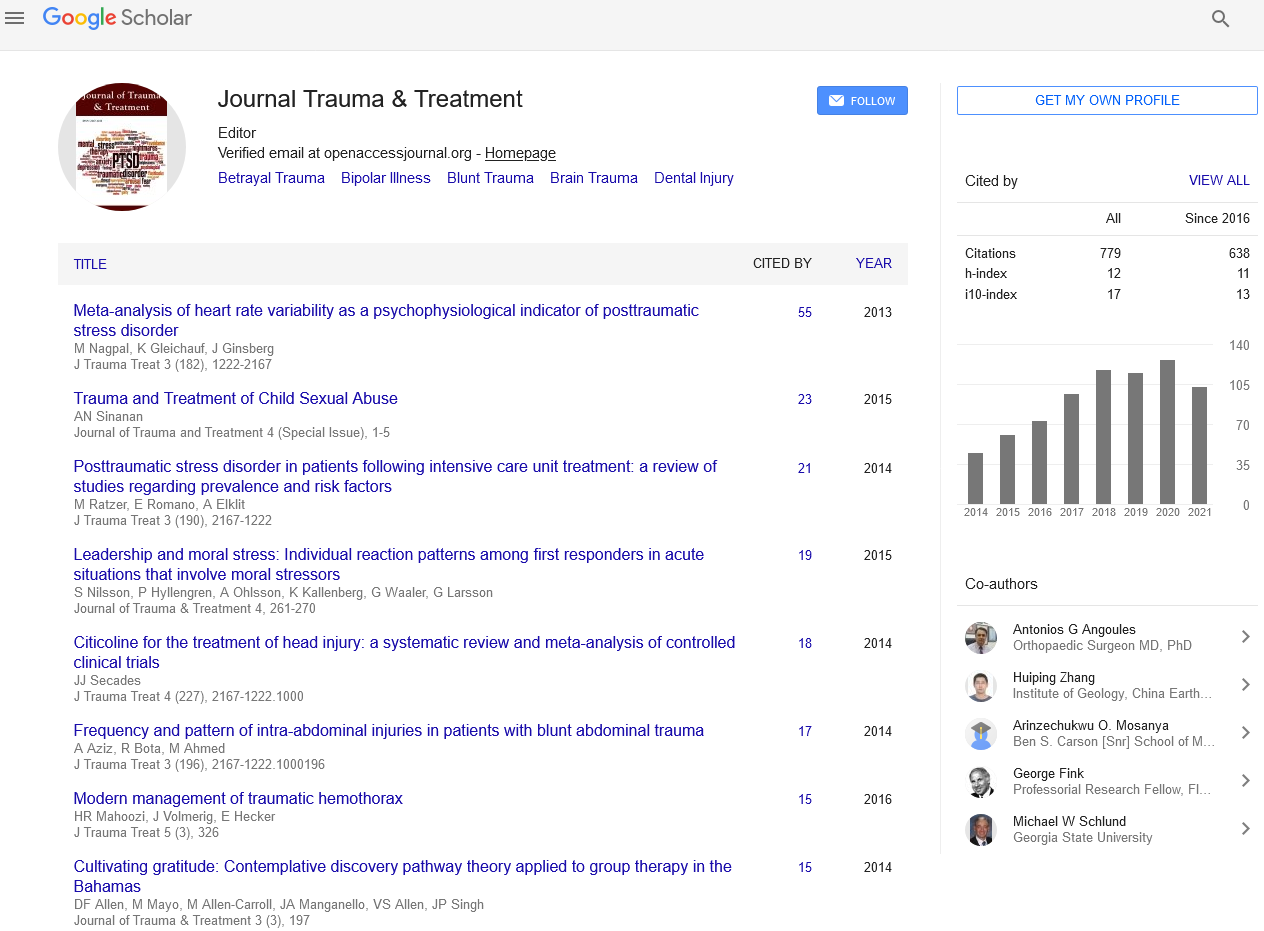
Journal of Trauma & Treatment received 1048 citations as per Google Scholar report