Short Communication - (2025) Volume 14, Issue 3
Received: 01-May-2025, Manuscript No. jtm-26-185741;
Editor assigned: 05-May-2025, Pre QC No. P-185741;
Reviewed: 19-May-2025, QC No. Q-185741;
Revised: 22-May-2025, Manuscript No. R-185741;
Published:
29-May-2025
, DOI: 10.37421/2167-1222.2025.14.685
Citation: Fischer, Hannah. ”Trauma Critical Care: Survival, Recovery, and Comprehensive Management.” J Trauma Treat 14 (2025):685.
Copyright: © 2025 Fischer H. This is an open-access article distributed under the terms of the Creative Commons Attribution License, which permits unrestricted use, distribution and reproduction in any medium, provided the original author and source are credited.
Critical care serves as a fundamental pillar in the comprehensive management and long-term rehabilitation of individuals who have experienced severe trauma. This multidisciplinary approach is instrumental in the immediate stabilization of patients, the provision of vital organ support, and the crucial prevention of secondary injuries, particularly in cases involving traumatic brain injury (TBI). The integration of advanced monitoring techniques, the implementation of prompt therapeutic interventions, and the seamless collaboration among various healthcare professionals are all indispensable elements for optimizing patient outcomes, thereby reducing mortality rates and minimizing the incidence of long-term disabilities. The scope of critical care in trauma management extends from the initial assessment and stabilization within the emergency department through to the intensive care unit, where complex physiological derangements are meticulously addressed to promote robust neurological recovery and overall patient healing [1].
Effective management of multi-organ dysfunction syndrome, a common and often severe consequence of major trauma, represents a cornerstone of modern critical care practice. This involves a profound understanding and strategic approach to managing sepsis and the systemic inflammatory response that frequently ensues following severe traumatic injuries. Key to improving survival and fostering better recovery trajectories is the emphasis on precise hemodynamic management, the timely and decisive control of infectious sources, and the judicious selection and administration of antibiotic therapies. These interventions are vital for stabilizing the patient's condition and mitigating further organ damage [2].
For patients sustaining traumatic brain injury (TBI), the implementation of specialized neurocritical care protocols is not merely beneficial but absolutely crucial for achieving optimal outcomes. Current guidelines and a growing body of evidence-based practices are systematically reviewed and applied to the management of critical neurological parameters. This includes vigilant monitoring and management of intracranial pressure (ICP) and cerebral perfusion pressure (CPP), alongside other vital neuromonitoring parameters, with the ultimate goal of mitigating secondary brain injury and significantly enhancing functional recovery in the post-trauma period [3].
Recognizing the profound impact of immobility and critical illness on trauma survivors, the initiation of early rehabilitation within critical care settings is increasingly acknowledged as a vital component of comprehensive recovery. This strategic approach emphasizes the significant benefits of commencing physical and occupational therapy interventions at the earliest possible opportunity following admission to the intensive care unit (ICU). The primary aims of this early mobilization are to counteract the detrimental effects of deconditioning and to accelerate the patient's journey towards regaining functional independence and improving their quality of life [4].
The management of severe hemorrhage and the associated coagulopathy are paramount concerns in the resuscitation and ongoing critical care of trauma patients. This area of management necessitates a deep understanding of evidence-based protocols for the administration of blood products. A balanced and timely approach, incorporating packed red blood cells, fresh frozen plasma, and platelet transfusions, is essential for achieving effective hemostasis and demonstrably improving survival rates in patients experiencing massive hemorrhage [5].
The systemic physiological response to severe trauma is characterized by complex alterations within the inflammatory and immune systems. Understanding the intricate dynamics of immune dysregulation that occurs in the aftermath of trauma is critical for predicting and managing its impact on subsequent organ failure and the overall recovery process. Critical care interventions play a pivotal role in modulating these aberrant immune responses, aiming to restore a more balanced physiological state [6].
Post-intensive care syndrome (PICS) presents a significant and often persistent challenge for trauma survivors, encompassing a constellation of physical, cognitive, and mental health impairments that can profoundly affect their long-term well-being. This critical review provides a comprehensive overview of PICS, detailing its specific contributing factors within the trauma population and outlining proactive strategies for both its prevention and effective management throughout the critical care phase and into the subsequent recovery trajectory [7].
Adequate nutritional support is indispensable for optimizing outcomes in trauma recovery, playing a crucial role in promoting wound healing, bolstering immune function, and actively preventing the detrimental process of catabolism. This area of critical care management addresses the specific nutritional requirements of critically ill trauma patients, acknowledges the inherent challenges in delivering adequate nutritional support, and reviews the compelling evidence that supports the implementation of early enteral feeding strategies [8].
Mechanical ventilation is a frequently required supportive measure for trauma patients admitted to the ICU, yet it carries the inherent risk of developing ventilator-associated pneumonia (VAP), a significant and potentially life-threatening complication. This article critically reviews established and emerging strategies aimed at preventing VAP, alongside optimizing ventilator settings, to facilitate successful weaning from mechanical support and thereby improve respiratory recovery outcomes [9].
The ethical landscape of critical care for trauma patients is inherently complex, presenting multifaceted challenges that demand careful consideration and skilled navigation. These ethical dilemmas often revolve around sensitive issues such as end-of-life decision-making, the equitable allocation of scarce resources, and the paramount importance of respecting patient autonomy. This paper systematically explores the intricate ethical challenges encountered by critical care teams and offers guidance to assist in navigating these difficult situations, ensuring that patient-centered care remains the guiding principle [10].
Critical care plays an indispensable role in the immediate management and long-term recovery of trauma patients, encompassing stabilization, organ support, and the prevention of secondary injury, especially in traumatic brain injury (TBI). Advanced monitoring, timely interventions, and multidisciplinary collaboration are vital for optimizing outcomes, reducing mortality, and mitigating long-term disability, extending from the emergency department through the intensive care unit to address complex physiological derangements and promote neurological recovery [1].
Effective management of multi-organ dysfunction following severe trauma is a central tenet of critical care. This involves addressing sepsis and inflammation, emphasizing precise hemodynamic management, early source control, and judicious antibiotic use to enhance survival and recovery trajectories [2].
The implementation of specialized neurocritical care protocols is essential for TBI patients. Current guidelines and evidence-based practices focus on managing intracranial pressure, cerebral perfusion pressure, and other neuromonitoring parameters to reduce secondary brain injury and improve functional recovery post-trauma [3].
Early rehabilitation in critical care settings is increasingly recognized as vital for trauma survivors. Initiating physical and occupational therapy soon after ICU admission helps prevent deconditioning and accelerates the return to functional independence [4].
The management of severe hemorrhage and coagulopathy is critical in trauma resuscitation. Evidence-based use of blood products in a balanced approach is crucial for achieving hemostasis and improving survival rates in massively bleeding trauma patients [5].
The physiological response to trauma involves significant inflammatory and immune system alterations. Understanding immune dysregulation post-trauma is key to managing organ failure and recovery, with critical care modulating these responses [6].
Post-intensive care syndrome (PICS) is a major concern for trauma survivors, affecting physical, cognitive, and mental health. This article outlines PICS, its contributing factors in trauma, and strategies for prevention and management within critical care and recovery phases [7].
Nutrition is critical for trauma recovery, influencing wound healing, immune function, and preventing catabolism. This reference discusses nutritional needs, challenges, and the evidence supporting early enteral feeding in critically ill trauma patients [8].
Mechanical ventilation is common in trauma ICUs, with ventilator-associated pneumonia (VAP) being a significant complication. Strategies to prevent VAP and optimize ventilator settings are reviewed to facilitate weaning and improve respiratory recovery [9].
Ethical considerations in trauma critical care are complex, particularly regarding end-of-life decisions, resource allocation, and patient autonomy. This paper explores these challenges and offers guidance for patient-centered care [10].
Critical care plays a pivotal role in the management and recovery of trauma patients, focusing on stabilization, organ support, and injury prevention, particularly for traumatic brain injury. Effective management of multi-organ dysfunction, including sepsis and inflammation, is crucial for improving survival. Specialized neurocritical care protocols are essential for TBI patients to manage intracranial and cerebral perfusion pressures. Early rehabilitation, including physical and occupational therapy, is vital for preventing deconditioning and restoring function. Managing severe hemorrhage and coagulopathy through timely blood product administration improves survival rates. Understanding and modulating the immune and inflammatory responses post-trauma is key to preventing organ failure. Post-intensive care syndrome (PICS) affects physical, cognitive, and mental health, requiring specific management strategies. Adequate nutrition is essential for wound healing and immune function, with early enteral feeding being beneficial. Preventing complications like ventilator-associated pneumonia (VAP) through optimized ventilation strategies is important. Ethical considerations, including end-of-life decisions and resource allocation, are complex and require careful navigation to ensure patient-centered care.
None
None
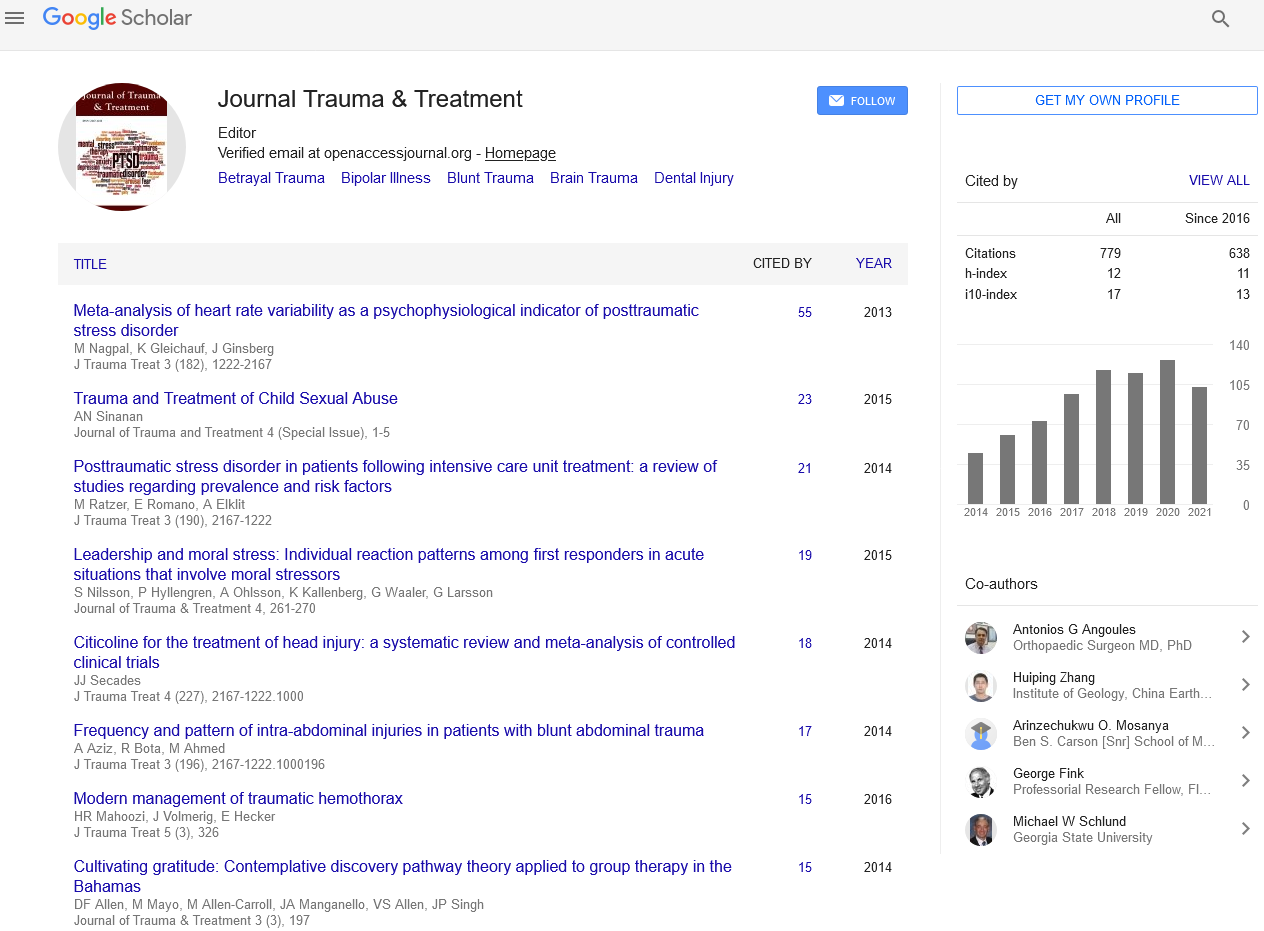
Journal of Trauma & Treatment received 1048 citations as per Google Scholar report