Commentary - (2025) Volume 14, Issue 5
Received: 02-Sep-2025, Manuscript No. pbt-25-173771;
Editor assigned: 04-Sep-2025, Pre QC No. P-173771;
Reviewed: 18-Sep-2025, QC No. Q-173771;
Revised: 23-Sep-2025, Manuscript No. R-173771;
Published:
30-Sep-2025
, DOI: 10.37421/2167-7689.2025.14.500
Citation: Klein, Tobias. ”Transforming Pharmacovigilance: AI, RWE, Global Challenges.” Pharmaceut Reg Affairs 14 (2025):500.
Copyright: © 2025 Klein T. This is an open-access article distributed under the terms of the Creative Commons Attribution License, which permits unrestricted use, distribution
and reproduction in any medium, provided the original author and source are credited.
This article explores the increasing adoption of Artificial Intelligence (AI) in pharmacovigilance, detailing how AI methods like machine learning and natural language processing enhance the identification, assessment, and prevention of adverse drug reactions during the post-marketing phase. It also looks ahead to future advancements and the transformative potential of AI in drug safety[1].
This review delves into the current state of post-market surveillance for medical devices, pinpointing significant challenges such as fragmented data collection, issues with data quality, and complexities within regulatory frameworks. It proposes forward-looking strategies designed to improve the effectiveness and safety oversight of medical devices[2].
This paper highlights the growing significance of real-world evidence in post-marketing surveillance and its increasing role in informing regulatory decisions. It explains how Real-World Evidence (RWE) can provide a more holistic understanding of drug safety and effectiveness across diverse patient populations, complementing traditional clinical trial data[3].
This review examines the dynamic field of pharmacovigilance, particularly in the context of emerging drug development. It identifies challenges posed by novel therapies and outlines opportunities for enhancing post-marketing surveillance through improved methodologies, data integration, and adaptive regulatory approaches to ensure patient safety[4].
This article offers a global perspective on the extensive post-marketing surveillance initiatives for COVID-19 vaccines. It details the rapid deployment of robust safety monitoring systems and the critical international collaboration among health agencies to detect and assess potential adverse events on an unprecedented scale[5].
This comparative analysis outlines the distinct regulatory frameworks governing post-marketing surveillance for pharmaceuticals in both Europe and the United States. It evaluates their respective strengths and weaknesses and identifies areas where harmonization could enhance global drug safety oversight and regulatory efficiency[6].
The article investigates the specific challenges associated with post-marketing surveillance for orphan drugs. Due to their small patient populations and limited pre-marketing data, these drugs require tailored methodologies and increased collaborative efforts to effectively monitor their safety and efficacy post-launch[7].
This piece discusses the significant opportunities that digital health technologies, like wearables and mobile applications, offer for enhancing post-marketing surveillance by enabling real-time, real-world data collection. It also addresses critical challenges, including data privacy, interoperability, and the evolving regulatory landscape for these technologies[8].
This article examines the integral role of Risk Management Plans within the European regulatory framework for post-marketing surveillance. It explains how these plans serve as a structured tool for systematic monitoring and mitigation of risks associated with medicinal products throughout their entire lifecycle[9].
This critical review discusses the specific considerations necessary for post-marketing surveillance and pharmacovigilance of biologics and biosimilars. It underscores the importance of robust traceability and the implementation of distinct safety monitoring strategies due to their complex nature and potential for immunogenicity[10].
This article explores the increasing adoption of artificial intelligence in pharmacovigilance, detailing how AI methods like machine learning and natural language processing enhance the identification, assessment, and prevention of adverse drug reactions during the post-marketing phase. It also looks ahead to future advancements and the transformative potential of AI in drug safety. [1]
This review delves into the current state of post-market surveillance for medical devices, pinpointing significant challenges such as fragmented data collection, issues with data quality, and complexities within regulatory frameworks. It proposes forward-looking strategies designed to improve the effectiveness and safety oversight of medical devices. [2]
This paper highlights the growing significance of real-world evidence in post-marketing surveillance and its increasing role in informing regulatory decisions. It explains how RWE can provide a more holistic understanding of drug safety and effectiveness across diverse patient populations, complementing traditional clinical trial data. [3]
This review examines the dynamic field of pharmacovigilance, particularly in the context of emerging drug development. It identifies challenges posed by novel therapies and outlines opportunities for enhancing post-marketing surveillance through improved methodologies, data integration, and adaptive regulatory approaches to ensure patient safety. [4]
This article offers a global perspective on the extensive post-marketing surveillance initiatives for COVID-19 vaccines. It details the rapid deployment of robust safety monitoring systems and the critical international collaboration among health agencies to detect and assess potential adverse events on an unprecedented scale. [5]
This comparative analysis outlines the distinct regulatory frameworks governing post-marketing surveillance for pharmaceuticals in both Europe and the United States. It evaluates their respective strengths and weaknesses and identifies areas where harmonization could enhance global drug safety oversight and regulatory efficiency. [6]
The article investigates the specific challenges associated with post-marketing surveillance for orphan drugs. Due to their small patient populations and limited pre-marketing data, these drugs require tailored methodologies and increased collaborative efforts to effectively monitor their safety and efficacy post-launch. [7]
This piece discusses the significant opportunities that digital health technologies, like wearables and mobile applications, offer for enhancing post-marketing surveillance by enabling real-time, real-world data collection. It also addresses critical challenges, including data privacy, interoperability, and the evolving regulatory landscape for these technologies. [8]
This article examines the integral role of Risk Management Plans within the European regulatory framework for post-marketing surveillance. It explains how these plans serve as a structured tool for systematic monitoring and mitigation of risks associated with medicinal products throughout their entire lifecycle. [9]
This critical review discusses the specific considerations necessary for post-marketing surveillance and pharmacovigilance of biologics and biosimilars. It underscores the importance of robust traceability and the implementation of distinct safety monitoring strategies due to their complex nature and potential for immunogenicity. [10]
Post-marketing surveillance and pharmacovigilance are vital for continuously monitoring the safety and efficacy of medical products once they reach the market. The field is evolving rapidly, with Artificial Intelligence (AI) methods such as machine learning and natural language processing increasingly adopted to enhance the identification, assessment, and prevention of adverse drug reactions during the post-marketing phase. This advancement promises to transform drug safety. However, challenges remain, particularly in medical device surveillance, where fragmented data collection, data quality issues, and complex regulatory frameworks impede effective oversight. Real-world evidence is becoming a cornerstone for informing regulatory decisions, providing a more holistic understanding of drug safety and effectiveness across diverse patient populations than traditional clinical trials alone. The landscape of pharmacovigilance is further complicated by emerging drug development, which presents new challenges and opportunities for enhanced surveillance through improved methodologies and data integration. Global initiatives, like the extensive post-marketing surveillance for COVID-19 vaccines, underscore the importance of rapid safety monitoring and international collaboration. Regulatory frameworks, such as those in Europe and the United States, exhibit distinct approaches, highlighting areas where harmonization could boost global drug safety. Specific considerations are also necessary for orphan drugs, which have small patient populations and limited pre-marketing data, demanding tailored monitoring. Similarly, biologics and biosimilars require robust traceability and unique safety strategies due to their inherent complexity and potential for immunogenicity. Furthermore, digital health technologies offer promising avenues for real-time data collection in surveillance but introduce challenges regarding data privacy and regulatory adaptation. Finally, structured tools like Risk Management Plans are crucial within regulatory frameworks, ensuring systematic monitoring and mitigation of risks throughout a medicinal product's lifecycle.
None
None
1. Simon R, Kevin BC, Matthew SPW. "Artificial intelligence for pharmacovigilance and drug safety: an overview of current approaches and future directions.".Expert Opin Drug Saf 22 (2023):651-660.
Indexed at, Google Scholar, Crossref
2. Jignesh P, Paul H, Roger EG. "Post-market surveillance of medical devices: current challenges and future directions.".Expert Rev Med Devices 19 (2022):447-456.
Indexed at, Google Scholar, Crossref
3. Lena H, Anja KH, Ann-Kristin W. "The Role of Real-World Evidence in Post-Marketing Surveillance and Regulatory Decision-Making.".Clin Pharmacol Ther 108 (2020):960-969.
Indexed at, Google Scholar, Crossref
4. Yousef MA, Mona MA, Reem SA. "Pharmacovigilance in the era of new drug development: Challenges and opportunities.".Saudi Pharm J 29 (2021):631-641.
Indexed at, Google Scholar, Crossref
5. Tom TS, Matthew KD, David KS. "Post-marketing surveillance of COVID-19 vaccines: a global perspective.".Vaccine 40 (2022):219-224.
Indexed at, Google Scholar, Crossref
6. Dieter VA, Veerle VdS, Lieven E. "Regulatory Frameworks for Post-Marketing Surveillance of Drugs in Europe and the United States.".Ther Innov Regul Sci 54 (2020):569-580.
Indexed at, Google Scholar, Crossref
7. Jean-Claude B, Marijn dL, Anke WBMdJ. "Post-marketing surveillance of orphan drugs: specificities and challenges.".Br J Clin Pharmacol 85 (2019):2005-2012.
Indexed at, Google Scholar, Crossref
8. Chiara M, Laura P, Ilaria Z. "Digital Health Technologies for Post-Marketing Surveillance: Opportunities and Challenges.".Front Digit Health 5 (2023):1112443.
Indexed at, Google Scholar, Crossref
9. Anna G, Sarah M, Richard GE. "Risk Management Plans as a Tool for Post-Marketing Surveillance: A European Perspective.".Drug Saf 42 (2019):1475-1484.
Indexed at, Google Scholar, Crossref
10. Salman KS, Mark JC, David JH. "Post-Marketing Surveillance and Pharmacovigilance for Biologics and Biosimilars: A Critical Review.".BioDrugs 35 (2021):1-13.
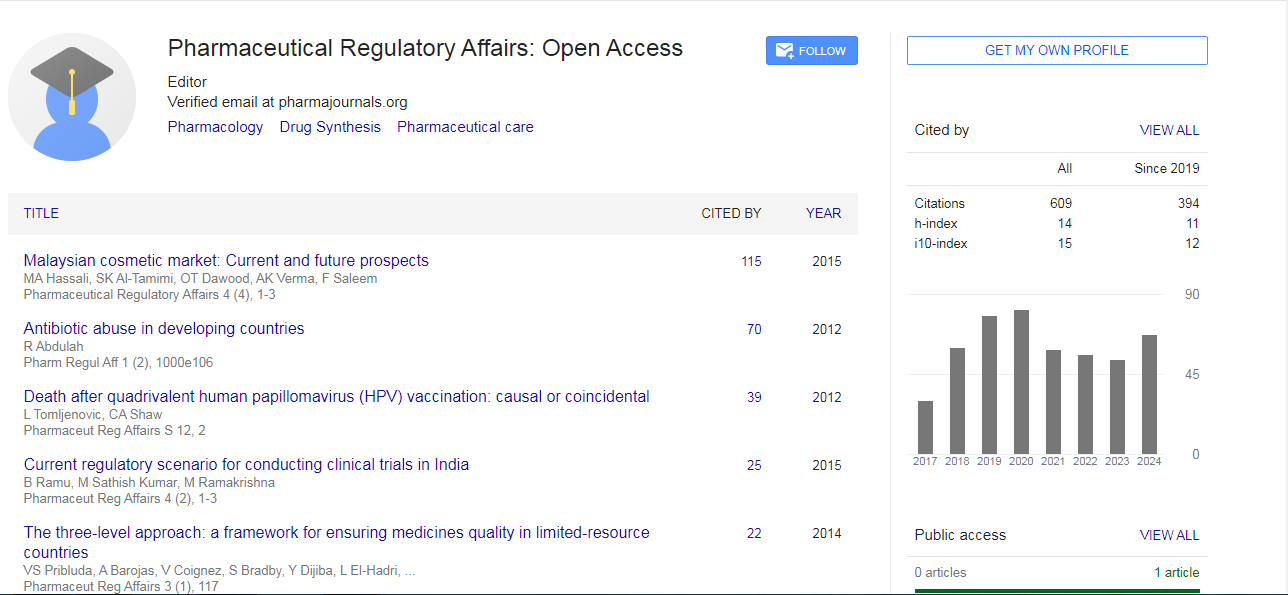
Pharmaceutical Regulatory Affairs: Open Access received 533 citations as per Google Scholar report