Brief Report - (2025) Volume 9, Issue 3
Received: 01-Sep-2025, Manuscript No. rrms-25-175064;
Editor assigned: 03-Sep-2025, Pre QC No. P-175064;
Reviewed: 17-Sep-2025, QC No. Q-175064;
Revised: 22-Sep-2025, Manuscript No. R-175064;
Published:
29-Sep-2025
, DOI: 10.37421/2952-8127.2025.9.226
Citation: Haddad, Omar. ”Transforming Medicine: Precision, Personalization, Progress.” Res Rep Med Sci 09 (2025):226.
Copyright: © 2025 Haddad O. This is an open-access article distributed under the terms of the Creative Commons Attribution License, which permits unrestricted use, distribution and reproduction in any medium, provided the original author and source are credited.
The landscape of modern healthcare is undergoing a profound transformation, driven by an array of technological advancements. One remarkable area is the progress of CRISPR-Cas9 gene editing technology, offering expanding therapeutic applications for genetic disorders and various diseases. Its power necessitates a thorough examination of significant ethical challenges and societal implications, underscoring the need for careful regulation and public discourse as these tools evolve[1].
Artificial Intelligence (AI) is fundamentally reshaping medical imaging. AI's role now spans from improving image acquisition and analysis to enhancing disease diagnosis and personalized treatment planning. The future promises more efficient and accurate diagnostic processes, ultimately leading to better patient outcomes[2].
Progress in regenerative medicine also presents exciting new possibilities. This field focuses on advancements in stem cell therapies and the development of organoids. These innovations are creating new avenues for repairing damaged tissues and organs, holding profound implications for treating chronic diseases and developing more accurate drug testing models[3].
Another transformative area is nanomedicine, actively revolutionizing drug delivery and precision therapy. Nanoscale technologies enable highly targeted drug administration, effectively minimizing side effects and improving treatment efficacy across various diseases. This field holds immense promise for future therapeutic strategies[4].
Wearable sensors are having a major impact on healthcare. Their evolution from simple health monitoring devices to sophisticated tools capable of predictive diagnostics is notable. These sensors empower individuals with real-time health data, enabling proactive disease management and fostering a more engaged approach to personal well-being[5].
Furthermore, mRNA vaccine technology, initially recognized for its success in combating infectious diseases, is now exploring burgeoning therapeutic applications. This platform shows exciting prospects in oncology, autoimmune disorders, and rare genetic conditions, signaling its potential to reshape future therapeutic approaches beyond conventional uses[6].
In surgical practice, robotics are playing an increasingly crucial role. These systems enhance precision and reduce invasiveness, while also addressing current operational challenges. Experts forecast the future evolution of surgical robotics to include increasingly autonomous systems, which will likely transform both surgical training and patient outcomes[7].
Personalized medicine stands as a cornerstone of future healthcare, built on the synergistic integration of genomics, big data, and Artificial Intelligence (AI). These technologies collectively enable tailored treatment plans for individual patients, moving healthcare beyond a generalized approach towards highly effective, individualized therapies that consider each patient's unique biological profile[8].
Innovative technologies like 'organ-on-a-chip' are critical in overcoming the limitations of traditional in vitro and in vivo models. These microfluidic devices are enhancing drug discovery, disease modeling, and toxicology testing by providing more physiologically relevant human-specific responses, thus accelerating the development of new treatments[9].
Finally, advancements in materials science are continuously improving biomedical implants. Research focuses on innovations that significantly enhance biocompatibility, improve mechanical properties, and introduce new functionalities. This leads to more effective and durable medical devices with better patient integration, signifying a future where implants are seamlessly incorporated and highly effective[10].
Across the spectrum of biomedical research, a suite of groundbreaking technologies is converging to redefine healthcare. Gene editing with CRISPR-Cas9 stands out, offering remarkable therapeutic potential for a range of genetic disorders and diseases. However, its advancement is thoughtfully coupled with a critical examination of ethical challenges and societal implications, stressing the need for careful oversight and public discussion as its capabilities expand[1]. This powerful tool is not only changing how we treat diseases at a fundamental level but also prompting vital conversations about the future of human intervention.
Artificial Intelligence (AI) concurrently plays a pivotal role in transforming medical imaging. Its applications are broad, enhancing everything from the precision of image acquisition and subsequent analysis to providing more accurate disease diagnoses. AI is also integral to personalized treatment planning, promising a future where diagnostic processes are not only more efficient but also significantly more accurate, thereby improving patient outcomes across the board[2]. This integration means faster, more reliable insights for clinicians and ultimately better care for patients.
Regenerative medicine continues to push boundaries with advancements in stem cell therapies and the development of intricate organoids. These innovations are creating new opportunities for repairing damaged tissues and organs, which holds profound implications for individuals suffering from chronic diseases[3]. Furthermore, these models are becoming indispensable for more accurate drug testing, offering a physiologically relevant alternative to traditional methods and accelerating therapeutic development. Similarly, the field of nanomedicine is actively revolutionizing drug delivery and precision therapy. By leveraging nanoscale technologies, drugs can be administered with unparalleled targeting, minimizing side effects and dramatically improving treatment efficacy for various conditions[4]. The promise here is highly specific interventions that spare healthy tissues.
Wearable sensors represent another significant shift in healthcare, evolving rapidly from basic health monitors to sophisticated tools capable of predictive diagnostics. These devices empower individuals by providing real-time health data, enabling them to engage in proactive disease management and fostering a more personalized approach to wellness[5]. This shift puts health data directly into the hands of patients, encouraging preventative care. Likewise, mRNA vaccine technology is expanding its therapeutic applications far beyond infectious diseases. Exciting prospects are emerging in areas such as oncology, autoimmune disorders, and rare genetic conditions, positioning this platform to reshape future therapeutic strategies significantly[6]. It highlights a versatile approach to treating complex diseases.
In surgical settings, robotics are continuously enhancing operations by improving precision and reducing invasiveness. The current state sees them overcoming operational challenges, but the future trajectory points towards increasingly autonomous systems. These advancements promise to transform surgical training and markedly improve patient outcomes[7]. This evolution signifies a move towards less invasive and more precise procedures. Concurrently, personalized medicine is being realized through the synergistic integration of genomics, big data, and Artificial Intelligence (AI). These technologies are foundational in enabling tailored treatment plans for individual patients, moving healthcare away from a one-size-fits-all approach toward highly effective, individualized therapies that are optimized for a patient's unique biological makeup[8].
Innovative "organ-on-a-chip" technology is bridging a crucial gap by overcoming the limitations of traditional in vitro and in vivo models. These microfluidic devices are enhancing drug discovery, disease modeling, and toxicology testing by providing more physiologically relevant human-specific responses[9]. This allows for faster and more accurate preclinical assessment. Lastly, materials science is delivering continuous advancements for biomedical implants. Innovations are focused on significantly enhancing biocompatibility, improving mechanical properties, and introducing new functionalities, leading to more effective and durable medical devices with better patient integration[10]. These advancements collectively point to a future where medical interventions are more precise, less invasive, and deeply personalized.
Recent innovations are reshaping the landscape of modern medicine across multiple domains. CRISPR-Cas9 gene editing technology shows remarkable progress, offering expanding therapeutic applications for genetic disorders and various diseases, while also necessitating a thorough examination of its ethical challenges and the need for careful regulation. Artificial Intelligence (AI) is fundamentally transforming medical imaging, from acquisition and analysis to disease diagnosis and personalized treatment planning, promising more efficient and accurate diagnostic processes. Regenerative medicine is making significant strides with stem cell therapies and the development of organoids, which are creating new possibilities for repairing damaged tissues and organs, impacting chronic disease treatment and drug testing models. Nanomedicine is actively revolutionizing drug delivery and precision therapy through nanoscale technologies, enabling highly targeted drug administration with minimized side effects. Wearable sensors have evolved from simple health monitors to sophisticated tools for predictive diagnostics, empowering individuals with real-time health data for proactive disease management. Beyond infectious diseases, mRNA vaccine technology is exploring burgeoning therapeutic applications in oncology, autoimmune disorders, and rare genetic conditions. Robotics are enhancing precision in modern surgery, reducing invasiveness, and are expected to evolve into increasingly autonomous systems. Personalized medicine is becoming a reality through the integration of genomics, big data, and AI, leading to tailored treatment plans. Organ-on-a-chip technology is bridging the gap between traditional in vitro and in vivo models, enhancing drug discovery and toxicology testing. Finally, advancements in materials science are improving biomedical implants, focusing on enhanced biocompatibility and functionality for more effective medical devices. These collective breakthroughs are driving healthcare towards more personalized, precise, and effective patient outcomes.
None
None
Shuo C, Jian L, Xiang W. "CRISPR-Cas9 Gene Editing: Advancements, Therapeutic Applications, and Ethical Considerations".Nat Biotechnol 41 (2023):757-770.
Indexed at, Google Scholar, Crossref
Jisoo K, Sanghun P, Hyo-Jung L. "Artificial Intelligence in Medical Imaging: A Comprehensive Review of Current Applications and Future Trends".Radiology 305 (2022):E1-E20.
Indexed at, Google Scholar, Crossref
Lin W, Yan C, Zheng L. "Advances in Regenerative Medicine: From Stem Cell Therapies to Organoids".Cell Stem Cell 28 (2021):1693-1709.
Indexed at, Google Scholar, Crossref
Xin L, Sheng Z, Jia W. "Nanomedicine for Targeted Drug Delivery and Precision Therapy: Current Status and Future Perspectives".Adv Drug Deliv Rev 196 (2023):114801.
Indexed at, Google Scholar, Crossref
Andrew J, Brian M, Carol D. "Wearable Sensors in Healthcare: From Monitoring to Predictive Diagnostics".Nat Electron 5 (2022):507-518.
Indexed at, Google Scholar, Crossref
Laura S, Kevin J, Rebecca B. "Therapeutic Potential of mRNA Vaccines Beyond Infectious Diseases".Sci Transl Med 16 (2024):eadf5198.
Indexed at, Google Scholar, Crossref
Maria G, Sofia R, Pedro M. "Robotics in Surgery: Current State, Challenges, and Future Directions".JAMA Surg 156 (2021):954-963.
Indexed at, Google Scholar, Crossref
Jian W, Guo C, Ming L. "Personalized Medicine: The Integration of Genomics, Big Data, and Artificial Intelligence".Clin Pharmacol Ther 114 (2023):25-35.
Indexed at, Google Scholar, Crossref
Wei C, Zhong L, Shu W. "Organ-on-a-Chip Technology: Bridging the Gap Between In Vitro and In Vivo Models".Trends Biotechnol 40 (2022):259-272.
Indexed at, Google Scholar, Crossref
Rakesh P, Neha S, Kamal D. "Advanced Materials for Biomedical Implants: Innovations in Biocompatibility and Functionality".Adv Healthc Mater 12 (2023):2203173.
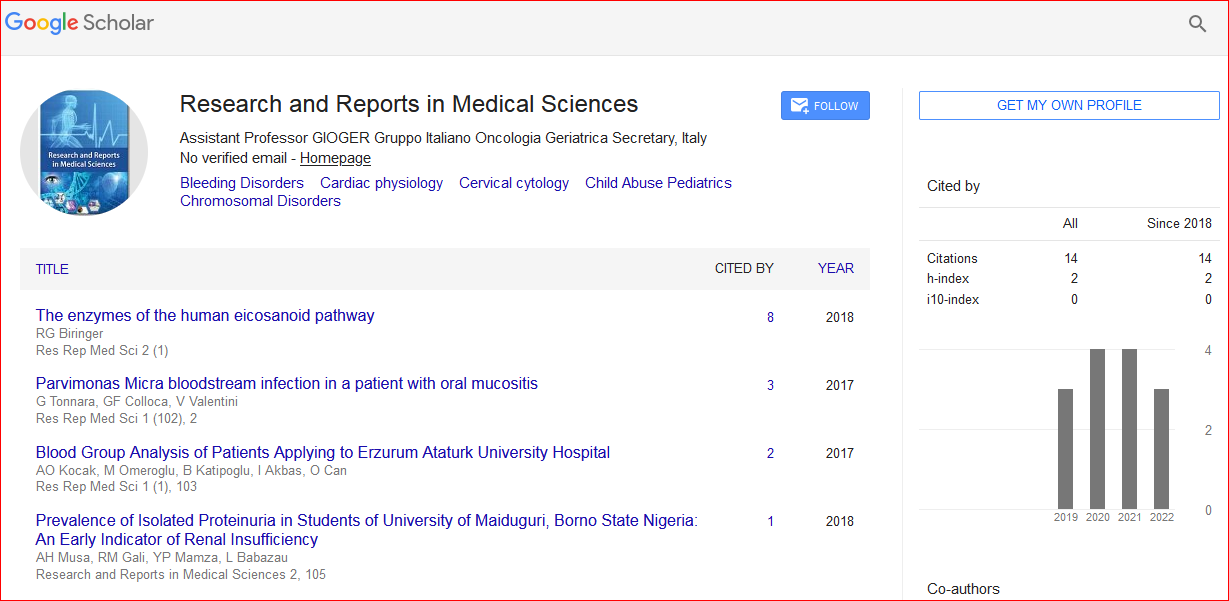
Research and Reports in Medical Sciences received 13 citations as per Google Scholar report