Brief Report - (2025) Volume 16, Issue 2
Received: 28-Mar-2025, Manuscript No. gjto-25-175354;
Editor assigned: 31-Mar-2025, Pre QC No. P-175354;
Reviewed: 14-Apr-2025, QC No. QC-175354;
Revised: 21-Apr-2025, Manuscript No. R-175354;
Published:
28-Apr-2025
, DOI: 10.37421/2229-8711.2025.16.434
Citation: Hale, Rowan. ”Transforming Industry with Smart Technologies.”
Global J Technol Optim 16 (2025):434.
Copyright: © 2025 Hale R. This is an open-access article distributed under the terms of the Creative Commons Attribution License, which permits unrestricted use, distribution
and reproduction in any medium, provided the original author and source are credited.
This paper explains how digital twin technology is changing industrial automation. It walks through the foundational concepts and practical steps for implementing digital twins in manufacturing settings. The authors highlight the benefits of using these virtual models for real-time monitoring, predictive maintenance, and optimizing production processes, making a clear case for their role in modern factories [1]. This review delves into the current state and future possibilities of artificial intelligence in industrial automation. It surveys how AI is being used in areas like robotics, process control, and predictive analytics, showing how these applications are boosting efficiency and flexibility in manufacturing. The authors also discuss emerging trends and the challenges that need to be addressed for broader adoption of AI in industrial settings [2].
Protecting industrial IoT systems from cyber threats is crucial, and this paper tackles that head-on. It outlines the specific cybersecurity challenges arising from integrating IoT devices into industrial automation, such as vulnerability to attacks and data integrity issues. The authors then propose and evaluate various solutions and strategies to enhance the security posture of these interconnected industrial environments [3]. This review explores human-robot collaboration, a key part of Industry 4.0, focusing on how humans and robots can work together effectively in industrial settings. It details the technologies that make this collaboration possible, like advanced sensing and control systems, and showcases various applications where cobots enhance safety, efficiency, and productivity. The paper highlights the shift towards more flexible and adaptive manufacturing processes [4].
Moving industrial automation systems towards full digitalization presents both great opportunities and significant hurdles. This paper unpacks how digital technologies can transform manufacturing by improving resource efficiency and reducing environmental impact. It also candidly discusses the challenges involved, such as integration complexities, data security, and the need for new skill sets, offering a balanced perspective on this transition [5]. Predictive maintenance, powered by machine learning, is revolutionizing industrial operations. This comprehensive review examines various machine learning techniques applied to predict equipment failures in automated industrial environments. It covers different models, data sources, and evaluation metrics, demonstrating how these methods enhance operational reliability, minimize downtime, and reduce maintenance costs across diverse industries [6]. Reducing energy consumption is a major focus in industrial automation, and this review looks at different control strategies aimed at achieving that. It explores various approaches, from advanced motor control to intelligent scheduling and process optimization, showing how they contribute to significant energy savings without compromising productivity. The paper highlights practical methods for improving sustainability in industrial operations [7].
Blockchain technology offers promising solutions for bolstering security and transparency within industrial automation and supply chains. This article explains how distributed ledger technology can create immutable records, improve data integrity, and streamline transactions in complex industrial ecosystems. It emphasizes the potential for increased trust and efficiency in operations, from manufacturing to logistics [8]. Edge computing is emerging as a critical enabler for real-time industrial automation and control systems. This survey explores how processing data closer to the source can reduce latency, improve response times, and enhance reliability in industrial operations. It discusses architectures, applications, and challenges associated with deploying edge computing solutions in demanding manufacturing and process control environments [9]. Virtual and augmented reality are transforming how humans interact with automated industrial systems. This paper explores how VR/AR technologies can provide immersive training, real-time operational overlays, and guided maintenance procedures, significantly improving human-machine interaction. It highlights the potential for increased efficiency, reduced errors, and enhanced safety in complex industrial tasks [10].
Digital twin technology is changing industrial automation, detailing foundational concepts and practical steps for implementation. It highlights benefits like real-time monitoring, predictive maintenance, and optimizing production processes [1]. Artificial Intelligence (AI) in industrial automation is reviewed for its current state and future possibilities, covering its use in robotics, process control, and predictive analytics to boost efficiency and flexibility [2]. Protecting industrial IoT systems from cyber threats is crucial, outlining specific challenges from IoT device integration such as vulnerabilities and data integrity issues, proposing solutions and strategies for enhanced security [3]. Human-robot collaboration, a key part of Industry 4.0, is explored, focusing on technologies like advanced sensing and control systems that enable cobots to enhance safety, efficiency, and productivity [4].
Moving industrial automation systems towards full digitalization presents opportunities for improved resource efficiency and reduced environmental impact, while also discussing integration complexities, data security, and new skill sets required [5]. Predictive maintenance, powered by machine learning, is revolutionizing industrial operations. This review examines various machine learning techniques applied to predict equipment failures, demonstrating how these methods enhance reliability and minimize downtime [6]. Reducing energy consumption is a major focus in industrial automation, with a review of different control strategies from advanced motor control to intelligent scheduling and process optimization, contributing to significant energy savings and sustainability [7]. Blockchain technology offers promising solutions for bolstering security and transparency within industrial automation and supply chains, explaining how distributed ledger technology creates immutable records and improves data integrity [8]. Edge computing is emerging as a critical enabler for real-time industrial automation and control systems. This survey explores how processing data closer to the source can reduce latency and improve response times in industrial operations [9]. Virtual and Augmented Reality (VR/AR) are transforming how humans interact with automated industrial systems. This paper explores how these technologies can provide immersive training, real-time operational overlays, and guided maintenance, enhancing human-machine interaction, efficiency, and safety [10].
Industrial automation is undergoing significant transformation through various advanced technologies. Digital twin technology enables real-time monitoring and predictive maintenance, enhancing production efficiency in factories [1]. Artificial Intelligence (AI) and Machine Learning (ML) are pivotal for robotics, process control, and predictive analytics, boosting operational flexibility and reliability while minimizing downtime [2, 6]. Securing these interconnected systems is paramount, as Industrial IoT (IIoT) faces cybersecurity threats requiring robust solutions [3]. Human-robot collaboration is advancing Industry 4.0, with cobots improving safety and productivity through advanced sensing [4]. The broader digitalization of industrial systems offers opportunities for resource efficiency and environmental impact reduction, though it brings integration and data security challenges [5]. Beyond efficiency, optimizing energy consumption through smart control strategies is a key focus for sustainability [7]. Blockchain technology offers solutions for security and transparency across industrial supply chains by creating immutable records [8]. Edge computing is crucial for real-time control by processing data closer to the source, reducing latency [9]. Virtual and Augmented Reality (VR/AR) are also enhancing human-machine interaction, providing immersive training and guided maintenance, ultimately improving safety and reducing errors [10]. These innovations collectively drive the evolution of modern industrial environments.
None
None
G. DT, G. LB, N. ET. "Digital Twin in Industrial Automation: From Concept to Implementation".IEEE Trans. Ind. Inform. 19 (2023):1146-1155.
Indexed at, Google Scholar, Crossref
A. MA, S. KA, B. LA. "Artificial Intelligence in Industrial Automation: A Review of Current Trends and Future Prospects".Sensors 22 (2022):5397.
Indexed at, Google Scholar, Crossref
D. S, A. K, P. KS. "Cybersecurity Challenges and Solutions in Industrial IoT Automation".IEEE Internet Things J. 8 (2021):110-120.
Indexed at, Google Scholar, Crossref
S. NV, R. PS, K. PY. "Human-Robot Collaboration in Industry 4.0: A Review of Enabling Technologies and Applications".IEEE Access 8 (2020):198901-198918.
Indexed at, Google Scholar, Crossref
L. AS, M. SS, T. PC. "Digitalization of industrial automation systems: opportunities and challenges".J. Cleaner Prod. 400 (2023):136701.
Indexed at, Google Scholar, Crossref
M. KA, S. BA, N. RH. "Machine Learning for Predictive Maintenance in Industrial Automation: A Comprehensive Review".IEEE Trans. Ind. Electron. 69 (2022):5690-5705.
Indexed at, Google Scholar, Crossref
H. SL, J. SP, D. KK. "Optimizing Energy Consumption in Industrial Automation Systems: A Review of Control Strategies".Appl. Energy 282 (2021):116172.
Indexed at, Google Scholar, Crossref
P. KD, A. KM, R. PS. "Blockchain Technology for Enhanced Security and Transparency in Industrial Automation and Supply Chains".Sensors 23 (2023):308.
Indexed at, Google Scholar, Crossref
J. MK, S. HL, H. JC. "Edge Computing for Real-Time Industrial Automation and Control Systems: A Survey".IEEE Internet Things J. 7 (2020):172-181.
Indexed at, Google Scholar, Crossref
C. RC, M. SW, P. LL. "Virtual and Augmented Reality in Industrial Automation: Enhancing Human-Machine Interaction and Maintenance".Autom. Constr. 157 (2024):105151.
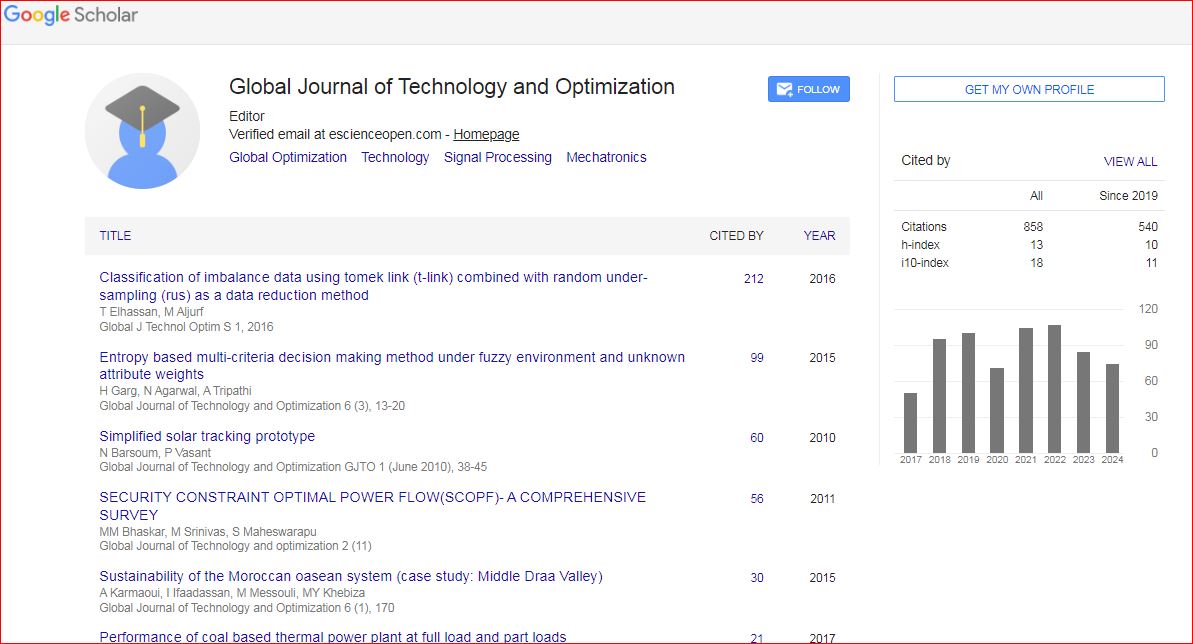
Global Journal of Technology and Optimization received 847 citations as per Google Scholar report