Perspective - (2025) Volume 15, Issue 5
Received: 01-Oct-2025, Manuscript No. jprm-25-174470;
Editor assigned: 03-Oct-2025, Pre QC No. P-174470;
Reviewed: 17-Oct-2025, QC No. Q-174470;
Revised: 22-Oct-2025, Manuscript No. R-174470;
Published:
29-Oct-2025
, DOI: 10.37421/2161-105X.2025.15.765
Citation: Clarke, Vivian. ”Transforming Asthma Care: Precision, Support, Equity.” J Pulm Respir Med 15 (2025):765.
Copyright: © 2025 Clarke V. This is an open-access article distributed under the terms of the Creative Commons Attribution License, which permits unrestricted use, distribution and reproduction in any medium, provided the original author and source are credited.
The landscape of asthma management is undergoing continuous evolution, driven by updated clinical guidelines and the emergence of advanced therapeutic strategies. For instance, the 2023 Global Initiative for Asthma (GINA) report underscores a pivotal shift in recommendations, emphasizing the critical role of inhaled corticosteroids for all adults and adolescents, including those with mild asthma, and reinforcing personalized treatment strategies. The report stresses the continued importance of assessing modifiable risk factors and tailoring approaches based on patient needs and disease severity [1].
For individuals with severe asthma, the advent of biologics has revolutionized care. These targeted therapies address specific inflammatory pathways, offering hope for patients unresponsive to conventional treatments. Approved biologics like omalizumab, mepolizumab, reslizumab, benralizumab, and dupilumab are examples, and clinicians often emphasize the importance of phenotyping patients to select the most appropriate treatment, making interventions much more precise [2].
This push towards personalized care extends into precision medicine, which aims to move from broad phenotypes to specific endotypes by understanding the underlying molecular mechanisms of asthma. Identifying these endotypes through biomarkers and diagnostic tools can guide more targeted therapies, particularly biologics, paving the way for truly individualized treatment plans [5].
Digital health solutions are also making their mark on asthma care. Telemedicine, in particular, has demonstrated significant effectiveness in managing asthma, improving control, reducing exacerbations, and enhancing patient adherence to treatment plans. This approach offers a viable and effective alternative for routine monitoring and education, particularly beneficial during times requiring reduced in-person contact [3].
Supporting this, improving medication adherence is fundamental to successful asthma management, as poor adherence remains a major barrier. Various interventions, including educational programs, self-management plans, reminder systems, and pharmacist involvement, have shown promise in enhancing adherence, highlighting the need for tailored, patient-centered approaches [4].
In fact, pharmacist-led interventions specifically, through education, medication reconciliation, adherence counseling, and device technique training, significantly improve asthma control, medication adherence, and quality of life for patients. Pharmacists are becoming increasingly valuable partners in helping people get the most out of their asthma treatment [10].
However, advancements also bring a need for careful consideration of existing therapies. Inhaled corticosteroids, while foundational for asthma control, carry potential systemic and local side effects. A critical examination of their safety profile underscores the importance of using the lowest effective dose and proper inhalation technique to minimize risks [6].
Unique challenges also exist in managing asthma in children. The treatment landscape for pediatric asthma is evolving, offering more precise and effective options, including biologic agents tailored for younger populations, while addressing difficulties in diagnosis and the need for age-appropriate delivery devices and education [7].
Beyond individual patient management, broader environmental and societal factors profoundly influence asthma outcomes. The significant impact of ambient air pollution on asthma exacerbations and overall management cannot be overstated. Exposure to pollutants can trigger symptoms and worsen disease severity, necessitating public health interventions and individual strategies to minimize exposure alongside pharmacological management [8].
Moreover, deep-seated health inequities in asthma care persist, with socioeconomic status, race, ethnicity, and geographic location significantly affecting disease prevalence, severity, and access to quality care. Tackling systemic barriers through policy changes, community-based interventions, and culturally competent care models is essential for achieving equitable asthma management [9].
The ongoing evolution in understanding and managing asthma points towards a holistic approach that integrates updated clinical guidelines, advanced precision therapies, supportive digital and human interventions, and a keen awareness of environmental and social determinants of health.
Recent advancements and updated guidelines continue to shape the approach to asthma care, emphasizing personalized strategies and early intervention. The 2023 GINA report, for example, marks a significant year of change, highlighting the crucial role of inhaled corticosteroids (ICS) for all adults and adolescents, including those with mild asthma. This update shifts the focus towards preventing exacerbations even in milder cases, reinforcing the importance of assessing modifiable risk factors and tailoring treatment based on individual patient needs and disease severity [1]. Despite their foundational role, careful consideration of ICS also involves understanding their potential adverse effects. A systematic review reveals that while ICS are highly effective, potential systemic and local side effects exist, underscoring the importance of using the lowest effective dose and proper inhalation technique to minimize risks [6].
For patients with severe asthma, the treatment landscape has been significantly transformed by the introduction of biologics. These therapies specifically target inflammatory pathways, offering crucial options for individuals unresponsive to conventional treatments. Understanding their mechanisms and efficacy, along with the importance of phenotyping patients to select the most appropriate biologic, has made treatment much more precise [2].
This concept of tailored therapy extends further into precision medicine, moving from broad phenotypes to specific endotypes of severe asthma. By delving into the underlying molecular mechanisms, clinicians can guide more targeted therapies, especially with biologics. Various biomarkers and diagnostic tools are key to characterizing a patient's specific type of asthma, paving the way for truly individualized treatment plans [5]. The evolving treatment landscape also extends to paediatric asthma, where current and emerging treatments, including biologic agents, are being tailored for younger populations, addressing unique diagnostic and delivery challenges [7].
Beyond medication, several interventions focus on improving patient engagement and adherence, which are critical for effective asthma control. Telemedicine, as demonstrated by a systematic review and meta-analysis, is proving its worth by significantly improving asthma control, reducing exacerbations, and enhancing patient adherence. Virtual care offers a viable and effective alternative for routine monitoring and education, particularly when in-person contact is limited [3]. A major barrier to effective asthma control is poor medication adherence. To counter this, various strategies, such as educational programs, self-management plans, reminder systems, and pharmacist involvement, have shown promise in improving how people take their medication, which is fundamental to successful asthma management [4]. Pharmacist-led interventions, in particular, have a substantial impact on asthma management outcomes. Through patient education, medication reconciliation, adherence counseling, and training on device technique, pharmacists can significantly enhance asthma control, medication adherence, and overall quality of life for patients, making them valuable partners in the asthma care team [10].
However, the comprehensive management of asthma also requires acknowledging and addressing external and systemic factors. Ambient air pollution, encompassing particulate matter, ozone, and nitrogen dioxide, significantly impacts asthma exacerbations and overall management. Exposure to these pollutants can trigger symptoms, worsen disease severity, and reduce treatment effectiveness, highlighting that managing asthma is also about the air people breathe and requiring public health interventions to minimize exposure [8]. Furthermore, pervasive health inequities exist in asthma care, influenced by socioeconomic status, race, ethnicity, and geographic location. These factors can profoundly affect asthma prevalence, severity, and access to quality care. Achieving equitable asthma management necessitates tackling these systemic barriers through policy changes, community-based interventions, and culturally competent care models, rather than just medical ones [9].
Optimal asthma care is dynamic, constantly adapting to new research and clinical understanding. Recent updates from the 2023 Global Initiative for Asthma (GINA) highlight the universal importance of inhaled corticosteroids for adults and adolescents, even in mild cases, signaling a shift towards proactive exacerbation prevention. For those with severe asthma, the landscape of biologics has transformed treatment, offering targeted therapies that address specific inflammatory pathways, emphasizing the need for patient phenotyping to select the most effective agent. This move towards personalized care is further advanced by precision medicine, which seeks to identify specific molecular endotypes of asthma to guide individualized treatment plans using biomarkers. Beyond pharmacological interventions, supportive strategies play a significant role. Telemedicine is proving effective in improving asthma control and adherence, especially in situations requiring remote care. Medication adherence remains a major challenge, but various interventions, including educational programs and reminder systems, show promise in enhancing patients' consistent use of treatments. Pharmacists are also emerging as key partners in asthma management, providing education, adherence counseling, and device technique training to improve patient outcomes. However, challenges persist. Understanding and mitigating the potential adverse effects of inhaled corticosteroids is essential, requiring careful dose selection and proper technique. Managing asthma in children presents unique difficulties, demanding age-appropriate therapies and delivery methods. External factors, like ambient air pollution, significantly impact disease severity, underscoring the need for public health strategies. Finally, addressing profound health inequities in asthma care, influenced by socioeconomic status and access to care, is paramount for achieving truly equitable and effective management across all populations.
None
None
1. Helen KR, J. MF, Mark LL. "2023 GINA report: a year of change".Eur Respir J 62 (2023):2301825.
Indexed at, Google Scholar, Crossref
2. Caterina P, Giuseppina P, Giovanni P. "Biologics for severe asthma: A review of current options and future perspectives".Clin Mol Allergy 18 (2020):5.
Indexed at, Google Scholar, Crossref
3. Wee T, Andrew N, Kenneth L. "Effectiveness of telemedicine in the management of asthma: A systematic review and meta-analysis".Thorax 76 (2021):1014-1022.
Indexed at, Google Scholar, Crossref
4. Federico L, Omar SU, Nicola AH. "Improving adherence to asthma medication: A systematic review of interventions".Pulm Pharmacol Ther 59 (2019):101851.
Indexed at, Google Scholar, Crossref
5. Kian FC, Sally EW, Ian MA. "Precision Medicine in Severe Asthma: From Phenotypes to Endotypes".J Allergy Clin Immunol 146 (2020):759-762.
Indexed at, Google Scholar, Crossref
6. Brian JL, Christine MJ, Sheryl DL. "Inhaled corticosteroids and adverse effects in asthma: a systematic review".Clin Exp Allergy 49 (2019):1406-1418.
Indexed at, Google Scholar, Crossref
7. Louise F, Arindam G, Robert G. "Current and emerging treatments for paediatric asthma".Lancet Respir Med 11 (2023):658-670.
Indexed at, Google Scholar, Crossref
8. Gennaro D, Lisa C, Maria D. "Impact of ambient air pollution on asthma exacerbations and management".Curr Opin Allergy Clin Immunol 20 (2020):345-350.
Indexed at, Google Scholar, Crossref
9. Adam DF, Samuel JAJ, Robert AW. "Health inequities in asthma: Current landscape and future directions".Curr Opin Allergy Clin Immunol 22 (2022):208-216.
Indexed at, Google Scholar, Crossref
10. Andrea MSC, Ling MW, Lee XL. "The impact of pharmacist-led interventions on asthma management: A systematic review and meta-analysis".J Asthma 58 (2021):1640-1650.
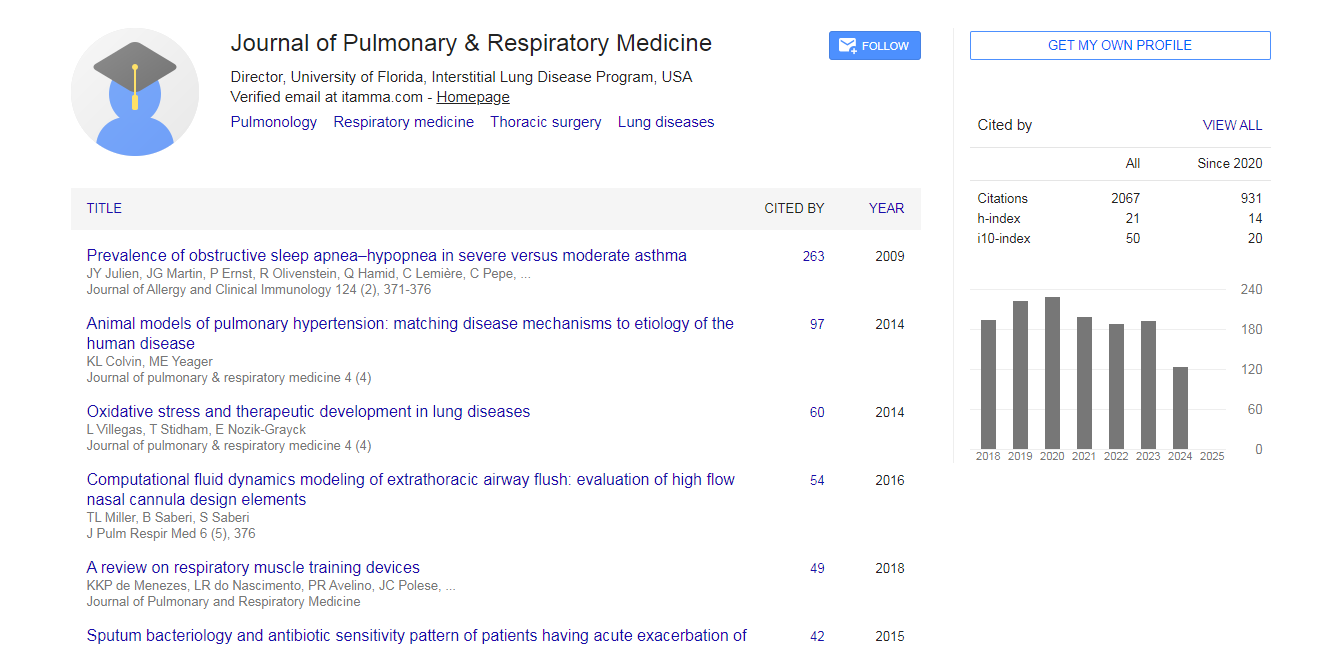
Pulmonary & Respiratory Medicine received 1690 citations as per Google Scholar report