Opinion - (2025) Volume 16, Issue 6
Received: 28-Nov-2025, Manuscript No. gjto-25-176211;
Editor assigned: 01-Dec-2025, Pre QC No. P-176211;
Reviewed: 15-Dec-2025, QC No. QC-176211;
Revised: 22-Dec-2025, Manuscript No. R-176211;
Published:
29-Dec-2025
, DOI: 10.37421/2229-8711.2025.16.480
Citation: Zielińska, Agnieszka. ”Transformative GANs: Evolution and Diverse Applications.” Global J Technol Optim 16 (2025):480.
Copyright: © 2025 Zielińska A. This is an open-access article distributed under the terms of the Creative Commons Attribution License, which permits unrestricted use, distribution and reproduction in any medium, provided the original author and source are credited.
Generative Adversarial Networks (GANs) represent a significant advancement in machine learning, offering a powerful framework for generating synthetic data. This paper provides a comprehensive overview of GANs, detailing the various architectural advancements that have emerged since their initial conception. It thoroughly explores techniques designed to improve training stability, which has historically been a common hurdle for GANs, and effectively showcases their diverse applications across multiple domains, highlighting both their successes and the remaining challenges in their widespread adoption and refinement [1].
The application of Generative Adversarial Networks extends significantly into specialized fields, particularly medical image analysis. This review specifically highlights the growing and crucial role of GANs in this domain. It delves into how these networks are utilized for essential tasks such as data augmentation, creating more robust datasets; image synthesis, including complex cross-modality translation; noise reduction to improve image clarity; and precise anomaly detection within medical contexts. This underscores their immense potential to address critical issues like data scarcity in healthcare and to profoundly enhance existing diagnostic tools [2].
Furthering their impact in healthcare, another paper systematically reviews the application of Generative Adversarial Networks for creating synthetic data specifically within the healthcare sector. The emphasis here is on how GANs can generate highly realistic, yet privacy-preserving, patient data. This capability is crucial for research and development, especially in situations where access to real patient data is either scarce or highly sensitive due to ethical and privacy concerns. The review also thoroughly discusses methods for assessing the quality and overall utility of such generated synthetic datasets, ensuring their applicability and trustworthiness [3].
Beyond healthcare, GANs have made substantial strides in fundamental generative tasks, particularly image generation. This survey offers a focused examination of Generative Adversarial Networks specifically for image generation applications. It meticulously covers the evolution of GAN architectures that have been meticulously tailored for creating highly realistic images, tracing their development from foundational models to more sophisticated and advanced variants. The discussion also includes critical metrics for effectively evaluating the quality of generated images and addresses the persistent challenges in generating diverse, coherent, and visually compelling content [4].
For those seeking a broad understanding, a general overview of Generative Adversarial Networks is also available. This paper breaks down their core architectures, elucidates the intricate details of their adversarial training process, and explores their broad spectrum of applications. It serves as an accessible and foundational guide for understanding the fundamental principles of how GANs function and their far-reaching impact across various fields, ranging from complex image synthesis to diverse data generation tasks [5].
Building on the advancements in image generation, another survey meticulously examines advanced architectural designs within Generative Adversarial Networks, with a specific focus on their utility for enhancing image generation capabilities. It comprehensively discusses significant innovations, including conditional GANs, the highly influential StyleGAN architecture, and various regularization techniques. These innovations are critical for improving output quality, increasing diversity, and providing finer control over the attributes of generated images, pushing the boundaries of what is possible in synthetic image creation [6].
The utility of Generative Adversarial Networks extends into critical infrastructure domains, such as smart grids. This systematic review explores the diverse applications of GANs within this domain, covering essential areas like load forecasting, which predicts future energy demands; anomaly detection in grid operations, identifying unusual and potentially problematic patterns; the generation of synthetic power data for simulation and testing; and crucial cybersecurity applications. This highlights GANs' significant potential to substantially improve the resilience, efficiency, and security of modern power systems [7].
Revisiting medical applications, another article provides a detailed look into Generative Adversarial Networks, beginning with their fundamental concepts and diverse architectural forms. It then specifically narrows its focus to their significant applications in medical imaging. These applications encompass tasks such as image enhancement, reconstructing images from incomplete data, segmentation for identifying specific structures, and generating synthetic training data. This demonstrates their transformative potential in fields like radiology and diagnostics, offering new tools for medical professionals [8].
Furthermore, GANs are proving instrumental in the development of smart cities. This comprehensive survey meticulously details the broad spectrum of Generative Adversarial Network applications within the context of smart cities. It covers vital areas such as intelligent transportation systems, urban planning initiatives, environmental monitoring, and robust security frameworks. The survey showcases how GANs can generate realistic simulations of urban environments, predict complex urban phenomena, and effectively aid in resource management, ultimately contributing to more efficient, sustainable, and livable smart cities [9].
Finally, Generative Adversarial Networks offer considerable utility in the challenging field of anomaly detection. This survey provides an in-depth exploration of GANs’ role in identifying unusual patterns. It discusses various GAN-based methods tailored for detecting anomalies across different data types, underscoring their unique ability to learn complex data distributions and precisely detect deviations from these norms. The paper also outlines current research trends and critically important future directions in this essential and evolving field [10].
Generative Adversarial Networks (GANs) have rapidly become a cornerstone in the field of Artificial Intelligence, offering powerful capabilities for synthetic data generation across numerous domains. Early work provides comprehensive overviews of GANs, meticulously detailing architectural advancements that have emerged since their initial conception [1]. These foundational papers also delve into crucial techniques aimed at improving training stability, which is often a significant challenge in GAN implementation, while showcasing their diverse applications and highlighting both their successes and remaining limitations. Another accessible guide further breaks down their core architectures, explains the intricacies of their adversarial training processes, and surveys their broad spectrum of applications, from image synthesis to general data generation, illustrating their wide-ranging impact [5].
A significant area where GANs demonstrate transformative potential is in medical image analysis and healthcare. Reviews highlight their growing role, exploring how GANs are utilized for tasks such as data augmentation, essential for bolstering limited medical datasets; image synthesis, including advanced cross-modality translation; noise reduction; and anomaly detection within medical contexts [2]. This capability is particularly vital for addressing data scarcity and enhancing diagnostic tools. Specifically, GANs can generate realistic, privacy-preserving patient data, which is crucial for medical research and development, especially when real patient data is either sensitive or difficult to acquire [3]. The quality and utility of these synthetic datasets are also rigorously discussed, emphasizing their practical application. Further detailed analyses show GANs applying to image enhancement, reconstruction, segmentation, and the generation of synthetic training data in medical imaging, demonstrating their potential in radiology and diagnostics [8].
When it comes to image generation, GANs have seen remarkable architectural evolution. Surveys provide a focused look at GANs specifically for these tasks, covering the progression from foundational models to more advanced variants designed to create highly realistic images [4]. This includes discussions on critical metrics used for evaluating image quality and the ongoing challenges in generating diverse and coherent visual content. Complementary research meticulously examines advanced architectural designs within GANs, concentrating on their utility for enhancing image generation capabilities. Innovations such as conditional GANs, the widely recognized StyleGAN, and various regularization techniques are discussed for their role in improving output quality, increasing diversity, and providing finer control over generated images [6]. These developments continuously push the boundaries of synthetic image creation, enabling increasingly sophisticated visual outputs.
Beyond traditional image generation and medical applications, GANs are also applied to complex systems and critical infrastructure. A systematic review explores their utility in smart grids, covering areas like load forecasting, anomaly detection in grid operations, generation of synthetic power data, and cybersecurity applications. This demonstrates GANs' potential to improve the resilience and efficiency of modern power systems [7]. Similarly, a comprehensive survey details the broad spectrum of GAN applications within the context of smart cities. It includes intelligent transportation, urban planning, environmental monitoring, and security, showcasing how GANs can generate realistic simulations, predict urban phenomena, and aid in resource management for more efficient and livable urban environments [9]. Finally, GANs are particularly effective in anomaly detection, with surveys offering in-depth explorations of various GAN-based methods. These methods are adept at identifying unusual patterns across different data types, leveraging GANs’ ability to learn complex data distributions and detect significant deviations, outlining current research trends and future directions in this crucial field [10].
Generative Adversarial Networks (GANs) are a transformative technology, widely reviewed for their architectural evolution and diverse applications. Initial studies provide thorough overviews, detailing advancements since their inception and techniques for improving training stability, a common challenge [1]. These networks have a broad spectrum of applications, from image synthesis to general data generation, illustrating their foundational role and impact across various fields [5]. Within specialized domains, GANs significantly contribute to medical image analysis, used for data augmentation, image synthesis like cross-modality translation, noise reduction, and anomaly detection. They address data scarcity and enhance diagnostic tools in medical contexts [2]. Specifically, GANs generate realistic, privacy-preserving synthetic patient data, crucial for healthcare research when real data is sensitive or limited [3]. In medical imaging, their applications extend to image enhancement, reconstruction, segmentation, and synthetic training data generation, showing transformative potential in radiology and diagnostics [8]. For image generation, surveys focus on architectural evolution to create highly realistic images, covering foundational models to advanced variants, and evaluating quality metrics [4]. Advanced designs, including conditional GANs and StyleGAN, further enhance image generation capabilities, improving output quality, diversity, and control [6]. Beyond imaging, GANs find utility in smart grids for load forecasting, anomaly detection, synthetic power data generation, and cybersecurity, boosting resilience and efficiency [7]. They also play a role in smart cities, generating simulations, predicting urban phenomena, and aiding resource management for improved urban living [9]. Furthermore, GANs are extensively explored for anomaly detection, learning complex data distributions to identify unusual patterns across various data types, with ongoing research trends and future directions outlined [10].
None
None
Jian Z, Weizhen H, Qingfeng X. "Generative adversarial networks: A comprehensive review of architectural improvements, stability, and applications".Information Fusion 75 (2021):137-172.
Indexed at, Google Scholar, Crossref
Haigang L, Jingyu W, Ming Y. "Generative adversarial networks for medical image analysis: A review".Knowledge-Based Systems 237 (2022):107771.
Indexed at, Google Scholar, Crossref
Fatih A, Daniel CP, Nima K. "Generative adversarial networks (GANs) for synthetic data generation in healthcare: A systematic review".Medical Image Analysis 81 (2022):102553.
Indexed at, Google Scholar, Crossref
Zhaokun W, Wanying X, Weiwei G. "A survey on image generation with generative adversarial networks".Artificial Intelligence Review 54 (2021):3501-3532.
Indexed at, Google Scholar, Crossref
Mehdi SMSK, R. LRCR, Ashutosh K. "Generative adversarial networks: an overview of the architectures, training, and applications".Artificial Intelligence Review 56 (2023):11623-11663.
Indexed at, Google Scholar, Crossref
Paritosh S, Parmeet K, Sarthak S. "Survey on advanced architectures of Generative Adversarial Networks for image generation".Computer Science Review 48 (2023):100588.
Indexed at, Google Scholar, Crossref
Zhaoliang H, Hongrui W, Xiaodan P. "Application of generative adversarial networks in smart grids: A systematic review".Applied Energy 346 (2023):121356.
Indexed at, Google Scholar, Crossref
Mohammad H, Maryam S, Amir A. "Generative adversarial networks: Concepts, architectures, and applications in medical imaging".Medical Engineering & Physics 120 (2023):103980.
Indexed at, Google Scholar, Crossref
Shuxin Z, Zhibin Y, Lei X. "A comprehensive survey on the application of generative adversarial networks in smart cities".Applied Energy 337 (2023):120908.
Indexed at, Google Scholar, Crossref
Jiaxi L, Xiang L, Xiaofei Z. "GAN applications and research trends in anomaly detection: a comprehensive survey".Pattern Recognition 145 (2024):109960.
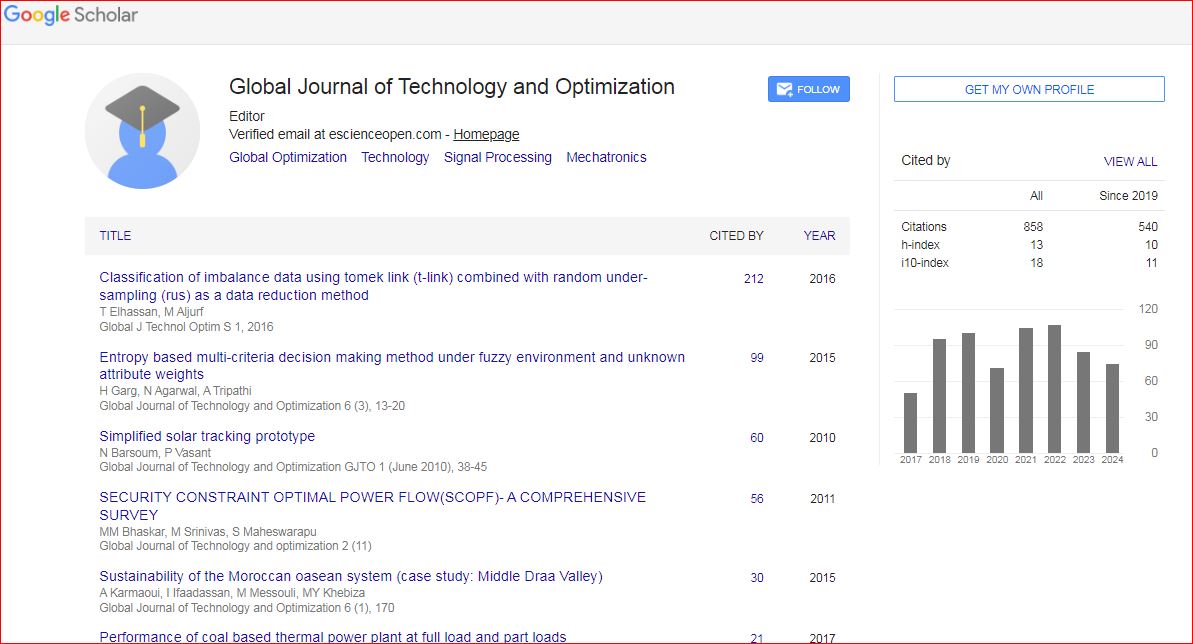
Global Journal of Technology and Optimization received 847 citations as per Google Scholar report