Brief Report - (2025) Volume 13, Issue 5
Received: 01-Sep-2025, Manuscript No. economics-26-186065;
Editor assigned: 03-Sep-2025, Pre QC No. P-186065;
Reviewed: 17-Sep-2025, QC No. Q-186065;
Revised: 22-Sep-2025, Manuscript No. R-186065;
Published:
29-Sep-2025
, DOI: 10.37421/2375-4389.2025.13.541
Citation: Petrov, Victor. ”Trade Liberalization: Opportunities,
Challenges, and Inclusive Growth.” J Glob Econ 13 (2025):541.
Copyright: © 2025 Petrov V. This is an open-access article distributed under the terms of the Creative Commons Attribution License, which permits unrestricted use, distribution
and reproduction in any medium, provided the original author and source are credited.
The impact of trade liberalization on economic development in low-income countries is a multifaceted issue, attracting considerable scholarly attention and policy debate. This body of research seeks to elucidate the complex mechanisms through which openness to international trade influences aggregate growth, poverty reduction, and the performance of specific economic sectors. It is generally understood that while trade liberalization can unlock significant opportunities, such as expanded export markets and increased foreign direct investment, its success is not guaranteed and is highly dependent on the presence of robust domestic policies that bolster institutional quality, enhance infrastructure, and invest in human capital. The literature suggests a nuanced relationship, where the net benefits of trade openness are not automatic and can vary significantly based on a country's existing economic conditions and its capacity to adapt to the dynamics of the global marketplace [1].
Furthermore, an important dimension of this discussion revolves around the heterogeneous effects of trade liberalization across different income groups within developing economies. Research indicates that while aggregate economic gains may be observed, the distributional consequences can be quite pronounced. Studies employing household survey data have demonstrated that certain segments of the population, particularly those employed in sectors that face competition from imports or those who lack the necessary skills to participate effectively in export-oriented industries, may experience adverse outcomes. Consequently, the importance of targeted social safety nets and proactive labor market policies is underscored as crucial for mitigating negative impacts and fostering more inclusive patterns of development [2].
A critical factor mediating the relationship between trade liberalization and economic development in low-income countries is the quality of their institutions. This perspective posits that strong governance structures, transparent legal frameworks, and efficient administrative processes are indispensable for countries to fully leverage the benefits associated with greater trade openness. Nations with weaker institutional foundations are found to be more vulnerable to corruption, rent-seeking behaviors, and inefficient resource allocation, which collectively can impede their development trajectories, even in the presence of trade reforms [3].
Within the agricultural sector of low-income countries, the effects of trade liberalization are also subject to careful examination. While enhanced access to imported inputs and modern technologies can potentially boost agricultural productivity, local farming sectors frequently struggle to compete with subsidized imports without appropriate support mechanisms. This highlights the imperative for policies designed to facilitate technology adoption, improve market access for smallholder farmers, and provide essential risk management tools to bolster resilience, thereby ensuring that trade liberalization contributes positively to food security and rural economic advancement [4].
The intricate connection between trade liberalization, foreign direct investment (FDI), and overall economic development in low-income nations forms another significant area of inquiry. It is theorized that increased trade openness can serve as a catalyst for attracting FDI, which in turn can introduce vital capital, advanced technology, and managerial expertise, ultimately stimulating economic growth. However, the quality of these FDI inflows and their seamless integration with the domestic economy are paramount. Consequently, policies aimed at enhancing the investment climate and fostering robust linkages between foreign and domestic firms are deemed essential for maximizing the developmental impact of FDI stimulated by trade liberalization [5].
The manufacturing sector in low-income economies is also considerably influenced by trade liberalization. While export-oriented manufacturing can be a significant source of job creation, many countries encounter challenges in advancing up the value chain and effectively competing with more established global manufacturing hubs. Research in this area points to the necessity of well-designed industrial policies that actively support diversification, foster innovation, and promote skills development within the manufacturing sector to ensure sustainable growth and long-term job creation [6].
An examination of trade liberalization's impact on income inequality in low-income countries, particularly through the lens of skilled versus unskilled labor, reveals a potential for exacerbation of existing disparities. Trade reforms can widen inequality if they lead to a disproportionate increase in the demand for skilled labor, thereby creating wage premiums for educated workers. This underscores the critical need for strategic investments in education and vocational training programs to equip the workforce with the skills requisite for navigating an open economy, ultimately promoting a more equitable distribution of income [7].
The fiscal implications of trade liberalization for low-income countries are also a subject of considerable interest. While tariff revenues may decline following trade reforms, increased economic activity spurred by trade openness can lead to substantial growth in indirect tax revenues, such as Value Added Tax (VAT) and excise taxes, as well as corporate income tax revenues. This dynamic highlights the importance of concurrent reforms to tax systems and the diversification of revenue sources to maintain fiscal stability and ensure governments can adequately fund essential public services and development initiatives amidst reduced trade barriers [8].
Trade liberalization plays a pivotal role in driving structural transformation within low-income countries. By exposing domestic industries to international competition and granting access to new markets and technologies, trade reforms can effectively incentivize a necessary shift of resources from the agricultural sector to manufacturing and services. Nevertheless, the success of this transformation is contingent upon the availability and implementation of complementary policies, including substantial investments in education, infrastructure development, and the cultivation of a supportive business environment, to facilitate efficient resource reallocation and enhance productivity across various economic sectors [9].
Finally, the environmental consequences of trade liberalization in low-income countries warrant careful consideration, encompassing both the potential for increased pollution and the benefits derived from technological advancements. While an expansion of production and trade activities can contribute to higher emission levels, the transfer of cleaner technologies through international trade offers potential mitigation benefits. This research emphasizes the critical importance of integrating environmental considerations into trade policy frameworks and reinforcing domestic environmental regulations to prevent environmental degradation resulting from trade liberalization [10].
The economic development trajectory of low-income countries is significantly influenced by trade liberalization, a process that involves reducing barriers to international trade. Research indicates that while such liberalization can create avenues for increased exports and attract foreign direct investment, its successful implementation is contingent upon complementary domestic policies. These policies are crucial for strengthening institutions, improving infrastructure, and enhancing human capital, thereby ensuring that the benefits of trade openness are realized. The impact is not uniform, and depends heavily on a country's initial economic conditions and its adaptability to global market shifts [1].
Furthermore, the distributional effects of trade liberalization within low-income economies are a critical area of study. While aggregate economic gains might be observed, there can be significant disparities in who benefits and who experiences adverse consequences. Studies utilizing household data reveal that specific population segments, particularly those in sectors facing import competition or lacking the requisite skills for export markets, may suffer negative outcomes. This underscores the necessity of targeted social safety nets and active labor market policies to ensure inclusive development and mitigate potential inequalities [2].
The quality of institutions plays a pivotal role in mediating the effects of trade liberalization on economic development. Strong governance, transparent legal systems, and efficient bureaucracy are essential for low-income countries to fully harness the advantages of trade openness. Countries with weaker institutional frameworks are more susceptible to corruption and inefficient resource allocation, which can undermine their development prospects despite the implementation of trade reforms [3].
In the agricultural sector of low-income countries, trade liberalization presents a mixed bag of effects. While access to imported inputs and advanced technologies can boost productivity, local agricultural industries often struggle to compete with subsidized imports without adequate support. Policies that facilitate technology adoption, improve market access for smallholder farmers, and offer risk management tools are vital for ensuring that trade liberalization contributes positively to food security and rural development [4].
The interplay between trade liberalization and foreign direct investment (FDI) is a key driver of economic development in low-income nations. Trade openness can attract FDI, bringing capital, technology, and managerial expertise that stimulate growth. However, the effectiveness of FDI depends on its quality and integration with the domestic economy. Policies aimed at improving the investment climate and fostering linkages between foreign and domestic firms are crucial for maximizing the developmental impact of trade-induced FDI [5].
The manufacturing sector in low-income countries experiences significant transformation due to trade liberalization. While export-oriented manufacturing can create jobs, moving up the value chain and competing globally remain challenges. Industrial policies that support diversification, innovation, and skills development are crucial for achieving sustainable growth and job creation in the long run within this sector [6].
Trade liberalization can also impact income inequality, particularly concerning the demand for skilled versus unskilled labor in low-income countries. Reforms that disproportionately increase the demand for skilled labor can lead to wage premiums for educated workers, thus exacerbating inequality. Investments in education and vocational training are therefore essential to equip the workforce with the skills needed in an open economy, promoting more equitable income distribution [7].
The fiscal landscape of low-income countries is affected by trade liberalization. Although tariff revenues may decline, increased economic activity stimulated by trade can lead to higher indirect tax revenues (e.g., VAT) and corporate income tax revenues. Tax system reforms and revenue diversification are vital for fiscal stability and the government's ability to fund public services in the context of reduced trade barriers [8].
Trade liberalization is instrumental in promoting structural transformation in low-income economies by encouraging a shift from agriculture to manufacturing and services. This transformation is facilitated by exposure to international competition, access to new markets, and technological advancements. However, its success hinges on complementary policies, such as investments in education, infrastructure, and a supportive business environment, to enable resource reallocation and enhance productivity [9].
Environmental quality in low-income countries is another area impacted by trade liberalization. While increased trade can lead to higher emissions, the transfer of cleaner technologies can offer mitigation benefits. Integrating environmental considerations into trade policies and strengthening domestic environmental regulations are crucial to ensure that trade liberalization does not result in environmental degradation [10].
Trade liberalization in low-income countries presents a complex interplay of opportunities and challenges. While it can boost aggregate growth, attract foreign direct investment, and drive structural transformation towards manufacturing and services, its benefits are not automatic. Success hinges on strong domestic policies that enhance institutions, infrastructure, and human capital. Moreover, trade liberalization can lead to distributional consequences, potentially exacerbating income inequality and affecting specific sectors like agriculture and manufacturing differently. Governments must implement targeted social safety nets, invest in skills development, and reform tax systems to ensure inclusive and sustainable development. Environmental impacts also need careful management, balancing potential degradation with the benefits of cleaner technology transfer. Ultimately, a holistic approach integrating trade policy with domestic reforms is crucial for low-income countries to harness the full potential of global economic integration.
None
None
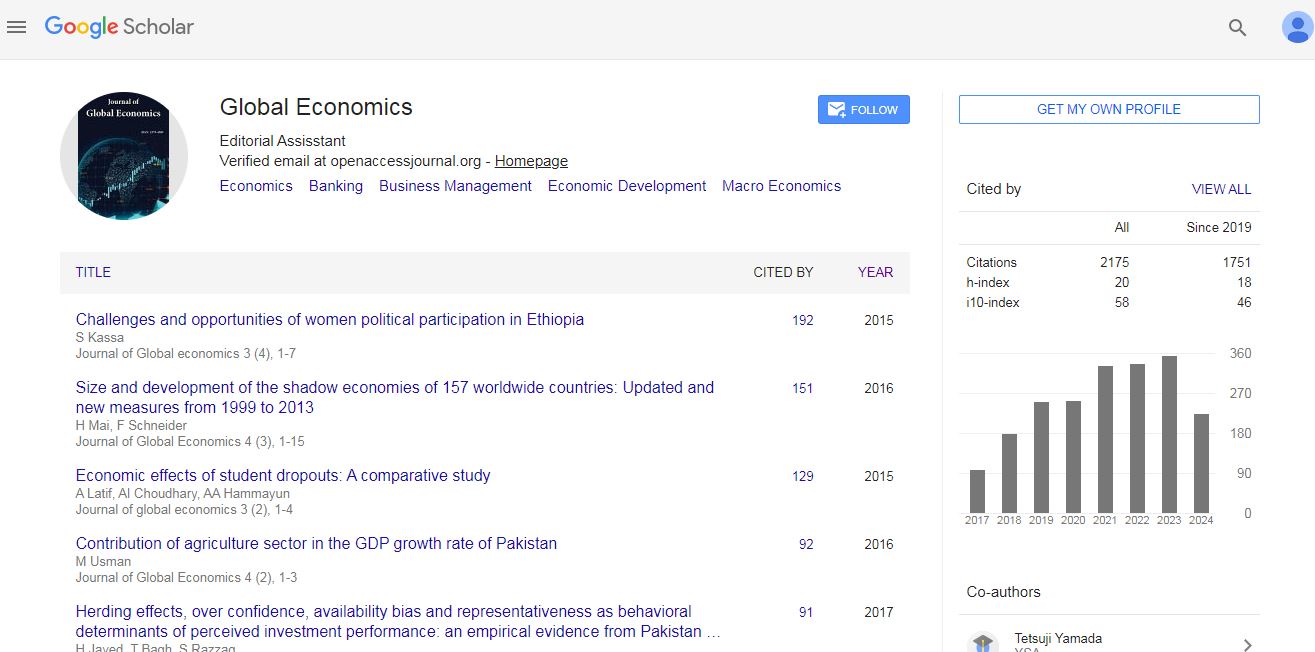
Journal of Global Economics received 2175 citations as per Google Scholar report