Brief Report - (127) Volume 16, Issue 3
Received: 01-May-2025, Manuscript No. jch-26-178757;
Editor assigned: 05-May-2025, Pre QC No. P-178757;
Reviewed: 19-May-2025, QC No. Q-178757;
Revised: 24-May-2025, Manuscript No. R-178757;
Published:
29-May-2025
, DOI: 10.37421/2157-7099.2025.16.795
Citation: Moreau, Jean-Paul. ”Thyroid Nodule Evaluation: Advanced Techniques for Precise Diagnosis.” J Cytol Histol 16 (2025):795.
Copyright: © 2025 Moreau J. This is an open-access article distributed under the terms of the Creative Commons Attribution License, which permits unrestricted use, distribution and reproduction in any medium, provided the original author and source are credited.
The field of cytological evaluation for thyroid nodules is undergoing a significant transformation, driven by advancements in molecular diagnostics and artificial intelligence, which are instrumental in enhancing diagnostic accuracy and refining patient management strategies. These innovative tools are increasingly integrated to stratify risk and guide the interpretation of fine-needle aspiration (FNA) biopsy findings, aiming for more precise diagnoses and reducing the necessity for unnecessary surgical interventions. The growing emphasis is on achieving personalized treatment strategies that align with the specific characteristics of each nodule [1].
The established framework for reporting thyroid cytopathology, known as the Bethesda System for Reporting Thyroid Cytopathology (TBSRTC), is subject to critical review, acknowledging its strengths while identifying areas that benefit from refinement. The integration of molecular testing, when applied thoughtfully within the TBSRTC guidelines, demonstrably impacts clinical decision-making, particularly for nodules with indeterminate diagnoses. This approach underscores the vital importance of collaborative efforts among cytopathologists, endocrinologists, and surgeons to achieve optimal patient outcomes [2].
The utility of ancillary testing, encompassing immunohistochemistry and molecular markers, in the diagnostic process for thyroid nodules is a subject of ongoing examination. Practical guidance is provided on the judicious application of these techniques to resolve diagnostic uncertainties, especially in cases involving follicular neoplasms. The focus remains on evidence-based recommendations designed to optimize FNA sample adequacy and the selection of appropriate ancillary tests [3].
The integration of artificial intelligence (AI) within thyroid nodule cytology is being explored with a specific focus on its capacity to aid in image analysis and risk stratification. Current AI algorithms, their performance metrics, and the inherent challenges associated with their widespread clinical adoption are discussed. AI is anticipated to augment the capabilities of pathologists, potentially leading to faster and more consistent diagnostic assessments [4].
A significant paradigm shift is occurring in the management of indeterminate thyroid nodules (AUS/FLUS) through the application of molecular testing. This review provides an overview of available molecular assays, their diagnostic accuracy, and their profound impact on surgical decision-making. The advocacy is for a personalized approach, where molecular information is incorporated to prevent unnecessary surgeries and to guide the appropriate extent of resection [5].
Advancements in ultrasound-guided fine-needle aspiration (FNA) biopsy for thyroid nodules are being detailed, with a particular emphasis on methods to improve sample quality and diagnostic yield. The discussion encompasses the crucial roles of operator skill, appropriate needle selection, and meticulous specimen preparation. The overarching goal is to minimize the need for repeat FNA procedures and to enhance initial diagnostic accuracy [6].
This review meticulously examines the cytological features associated with rare thyroid tumors, highlighting the inherent diagnostic challenges. Illustrative examples are presented, stressing the critical importance of recognizing subtle morphological cues and leveraging ancillary studies to achieve a correct diagnosis. Differentiating these rare entities from more common thyroid lesions is a primary objective [7].
The evolving role of molecular diagnostics in the precise subtyping of thyroid cancers, especially papillary thyroid carcinoma variants, is a key area of discussion. The article emphasizes how specific genetic alterations can significantly influence prognosis and response to treatment, thereby facilitating the development of more personalized oncological management strategies. The implications for both initial cytological assessment and subsequent surgical interventions are thoroughly explored [8].
The critical issue of sample adequacy in thyroid FNA cytology is addressed, outlining established criteria for assessing adequacy and discussing strategies aimed at improving specimen quality. This includes the valuable role of on-site evaluation and immediate smearing techniques. Ensuring that samples are adequate is fundamental to achieving accurate cytological interpretation and ultimately, effective patient management [9].
An update on the management of follicular and Hürthle cell lesions of the thyroid is provided, discussing cytomorphological features that may indicate malignancy. The increasing significance of molecular markers in distinguishing benign from malignant follicular proliferations is highlighted, contributing to the optimization of surgical interventions and overall patient care [10].
The cytological evaluation of thyroid nodules is a rapidly advancing field, with significant progress being made in improving diagnostic accuracy and patient outcomes through the integration of novel technologies such as molecular diagnostics and artificial intelligence. These advancements are crucial for overcoming the limitations of traditional cytomorphology and for more effectively stratifying risk, guiding fine-needle aspiration (FNA) biopsy interpretation, and ultimately reducing the incidence of unnecessary surgeries, leading to more personalized treatment strategies [1].
The Bethesda System for Reporting Thyroid Cytopathology (TBSRTC) continues to be a cornerstone in the classification of thyroid fine-needle aspirates. However, this article critically reviews its current utility, identifying its strengths and areas where further refinement could enhance its practical application. The judicious use of molecular testing within the TBSRTC framework is highlighted as a powerful tool for improving diagnostic certainty, particularly for indeterminate nodules, and emphasizes the indispensable role of multidisciplinary collaboration in achieving optimal patient care [2].
The application of ancillary testing, including immunohistochemistry and molecular markers, is gaining prominence in the diagnosis of thyroid nodules. This paper offers practical insights into when and how these techniques should be employed to resolve diagnostic ambiguities, especially in cases of follicular neoplasms. The focus is on providing evidence-based recommendations to ensure optimal FNA sample quality and informed selection of ancillary tests for improved diagnostic yield [3].
Artificial intelligence (AI) is emerging as a transformative technology in thyroid nodule cytology, with its potential to significantly assist in image analysis and risk stratification. The article delves into the current landscape of AI algorithms, their evaluation metrics, and the practical challenges hindering their widespread clinical implementation. It envisions AI as a complementary tool that will enhance the capabilities of pathologists, leading to more efficient and consistent diagnostic processes [4].
Molecular testing has become a pivotal strategy in the management of indeterminate thyroid nodules, often categorized as AUS/FLUS. This review surveys the available molecular assays, detailing their diagnostic precision and their influence on surgical decision-making. The article champions a personalized treatment paradigm, where molecular profiling guides surgical intervention to avoid unnecessary procedures and determine the optimal extent of resection [5].
Technological advancements in ultrasound-guided fine-needle aspiration (FNA) biopsy are crucial for maximizing the diagnostic yield of thyroid nodule samples. This article concentrates on techniques that enhance sample quality, underscoring the importance of operator expertise, appropriate needle selection, and meticulous specimen handling. The objective is to reduce the frequency of repeat FNAs and improve the initial diagnostic accuracy of thyroid lesions [6].
Diagnosing rare thyroid tumors presents unique cytopathological challenges. This review provides a comprehensive overview of these entities, illustrating key cytological features and emphasizing the importance of recognizing subtle morphological clues. The article highlights the critical role of ancillary studies in differentiating rare tumors from more common thyroid lesions, ensuring accurate diagnosis and appropriate patient management [7].
The application of molecular diagnostics is increasingly vital for precisely subtyping thyroid cancers, particularly variants of papillary thyroid carcinoma. The article underscores how specific genetic alterations can profoundly impact patient prognosis and therapeutic response, thereby paving the way for highly personalized cancer management. The implications of these molecular findings for both cytopathological assessment and subsequent surgical treatment are thoroughly examined [8].
Ensuring the adequacy of samples obtained from thyroid fine-needle aspiration (FNA) cytology is a fundamental prerequisite for accurate diagnosis. This publication outlines the essential criteria for evaluating sample adequacy and proposes strategies to enhance specimen quality. The role of on-site evaluation and rapid smearing techniques is discussed as valuable methods for improving diagnostic reliability and patient care [9].
An updated perspective on the cytopathological evaluation of follicular and Hürthle cell lesions of the thyroid is presented. The article discusses specific cytomorphological features that can suggest malignancy and details the growing influence of molecular markers in distinguishing benign from malignant proliferations. This integration aids in optimizing surgical interventions and improving overall patient management [10].
This collection of articles explores the evolving landscape of thyroid nodule evaluation, emphasizing the integration of advanced techniques to improve diagnostic accuracy and patient care. The introduction of molecular diagnostics and artificial intelligence is revolutionizing traditional cytomorphology, leading to better risk stratification and more precise diagnoses. The Bethesda System for Reporting Thyroid Cytopathology (TBSRTC) is being refined with the judicious use of molecular testing, especially for indeterminate nodules. Ancillary tests, including immunohistochemistry, are highlighted for resolving diagnostic uncertainties. AI's role in image analysis and risk stratification is discussed, alongside its potential to augment pathologist capabilities. Molecular testing is presented as a paradigm shift in managing indeterminate nodules, guiding surgical decisions to avoid unnecessary procedures. Advancements in ultrasound-guided FNA aim to enhance sample quality and diagnostic yield. The diagnosis of rare thyroid tumors and the molecular subtyping of thyroid cancers are also addressed, emphasizing their implications for prognosis and personalized treatment. Ensuring sample adequacy remains a critical focus, with strategies for improving specimen quality. Finally, the cytopathological perspective on follicular and Hürthle cell lesions is updated, highlighting the role of molecular markers in differentiating benign from malignant proliferations.
None
None
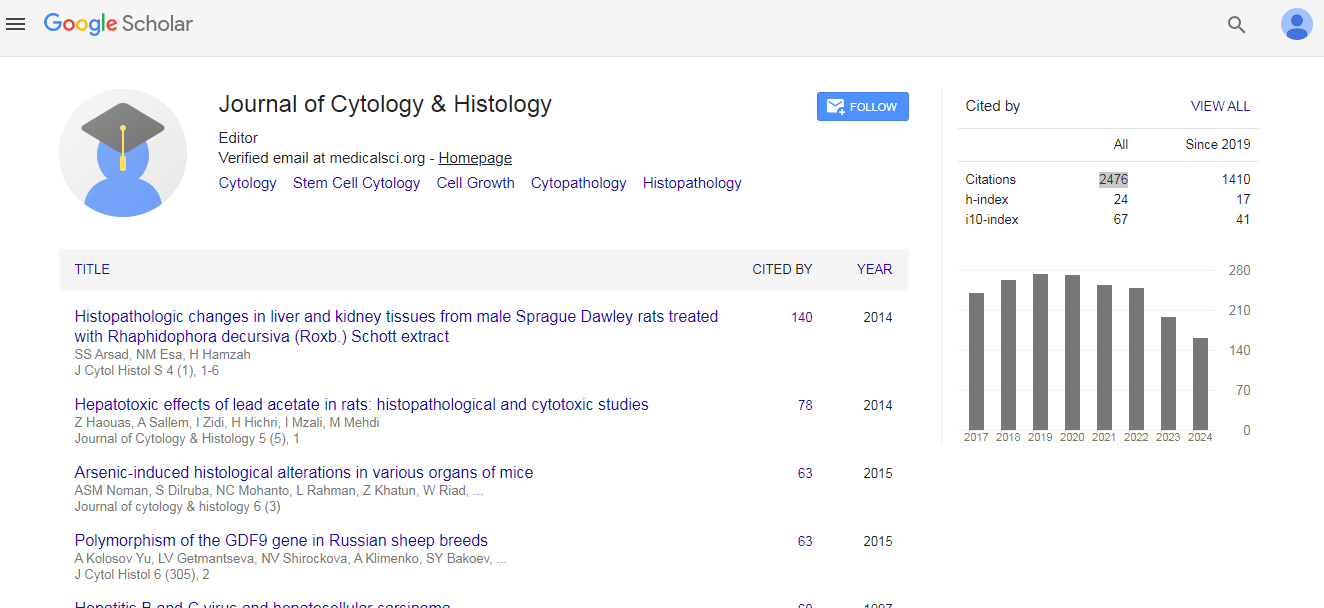
Journal of Cytology & Histology received 2476 citations as per Google Scholar report