Opinion - (2025) Volume 10, Issue 1
Received: 01-Feb-2025, Manuscript No. arwm-25-165529;
Editor assigned: 03-Feb-2025, Pre QC No. P-165529;
Reviewed: 14-Feb-2025, QC No. Q-165529;
Revised: 19-Feb-2025, Manuscript No. R-165529;
Published:
26-Feb-2025
, DOI: 10.37421/2475-7675.2025.10.382
Citation: Zou, Boles. “The Power of Resource Efficiency in Reducing Waste.’’ Adv Recycling Waste Manag 10 (2025): 382.
Copyright: © 2025 Zou B. This is an open-access article distributed under the terms of the Creative Commons Attribution License, which permits unrestricted use, distribution and reproduction in any medium, provided the original author and source are credited.
In todayâ??s world, the growing pressure of overconsumption and waste production has become an increasingly pressing issue. As industries expand, technology advances, and populations grow, human activity is producing more waste than ever before. While weâ??ve become adept at producing goods at a fast pace, there has been a lack of focus on how to use the resources efficiently to reduce the waste generated during production and consumption. In this context, resource efficiency is emerging as a powerful strategy to minimize waste, conserve valuable resources, and mitigate the detrimental environmental impacts caused by inefficient use of natural materials.
Resource efficiency refers to the sustainable management and optimization of the materials and energy used in the creation and consumption of products and services. It aims to maximize the value we extract from the resources consumed, whether in the form of raw materials, energy, or water, and minimize the amount of waste produced in the process. Resource efficiency is a concept that not only seeks to reduce the volume of waste but also to encourage businesses and individuals to rethink their practices, shifting from a linear model of consumption to a circular economy model. This transition emphasizes reuse, recycling, and repurposing of materials, creating a system where the life cycle of a product is extended and resources are continuously cycled back into the economy rather than discarded as waste [1].
At the heart of resource efficiency lies the idea of reducing waste at every stage of production and consumption. The manufacturing process often generates large amounts of waste in the form of scraps, off-cuts, and defective products. By implementing resource-efficient practices, manufacturers can reduce the amount of raw materials required and minimize the waste produced during production [2]. This can be achieved through various strategies, such as optimizing processes, investing in new technologies, and adopting practices that reduce material consumption. For example, in the production of clothing, the textile industry often experiences significant waste from unused fabric, dye runoff, and off-cuts. By utilizing more efficient design techniques, reducing the waste produced during cutting, and exploring alternatives such as fabric recycling, companies can drastically reduce the environmental impact of their operations [3].
Moreover, product design plays a crucial role in the pursuit of resource efficiency. When products are designed with resource efficiency in mind, their impact on the environment can be minimized throughout their entire life cycle [4]. The design phase is the starting point for how a product will be made, used, and disposed of. By making conscious decisions regarding the choice of materials, manufacturing processes, and product longevity, businesses can ensure that the product generates less waste during its use and disposal. For example, designing products that are easy to disassemble at the end of their life can facilitate recycling and repurposing, which reduces waste and prevents valuable materials from ending up in landfills.
In addition to the benefits of reducing waste during production, resource efficiency also plays a key role in reducing waste during consumption. In many industries, consumers often discard products prematurely due to planned obsolescence or poor design. In the tech industry, for instance, many electronic devices are built with limited lifespans, requiring users to replace them more frequently. By designing products that are more durable, repairable, and upgradable, manufacturers can extend the useful life of their products, which helps to reduce the amount of e-waste generated. Encouraging consumers to make responsible purchasing decisions, repair and upgrade products, and recycle old devices can help prevent the unnecessary accumulation of waste in landfills and reduce the strain on natural resources [5]. Resource efficiency is also a critical factor in the management of waste. The waste management sector has long struggled with the challenge of disposing of the enormous amounts of waste generated by human activity.
Landfills, incinerators, and other disposal methods have become unsustainable, both environmentally and economically. However, by focusing on resource efficiency, we can reduce the overall amount of waste that needs to be managed. For example, reducing the amount of packaging used in products or shifting towards biodegradable or recyclable materials can significantly decrease the burden on waste management systems. The introduction of deposit return schemes for bottles and cans, or the widespread adoption of composting and recycling programs, helps ensure that waste is diverted from landfills and instead returned to the production cycle.
The importance of resource efficiency extends beyond the industrial and consumer sectors. Governments, businesses, and civil society all play critical roles in shaping policies and practices that promote resource efficiency and waste reduction. By setting clear regulatory standards for waste management, providing incentives for companies to adopt resource-efficient practices, and raising awareness about the environmental impacts of waste, stakeholders can create an environment where resource efficiency becomes the norm. For instance, policies that encourage the recycling of materials, the use of renewable energy sources, and the reduction of carbon emissions can all help foster a culture of resource efficiency. Through collaborative efforts, governments and businesses can create a sustainable and circular economy where waste is minimized, and resources are used in the most efficient way possible.
Google Scholar Cross Ref Indexed at
Google Scholar Cross Ref Indexed at
Google Scholar Cross Ref Indexed at
Google Scholar Cross Ref Indexed at
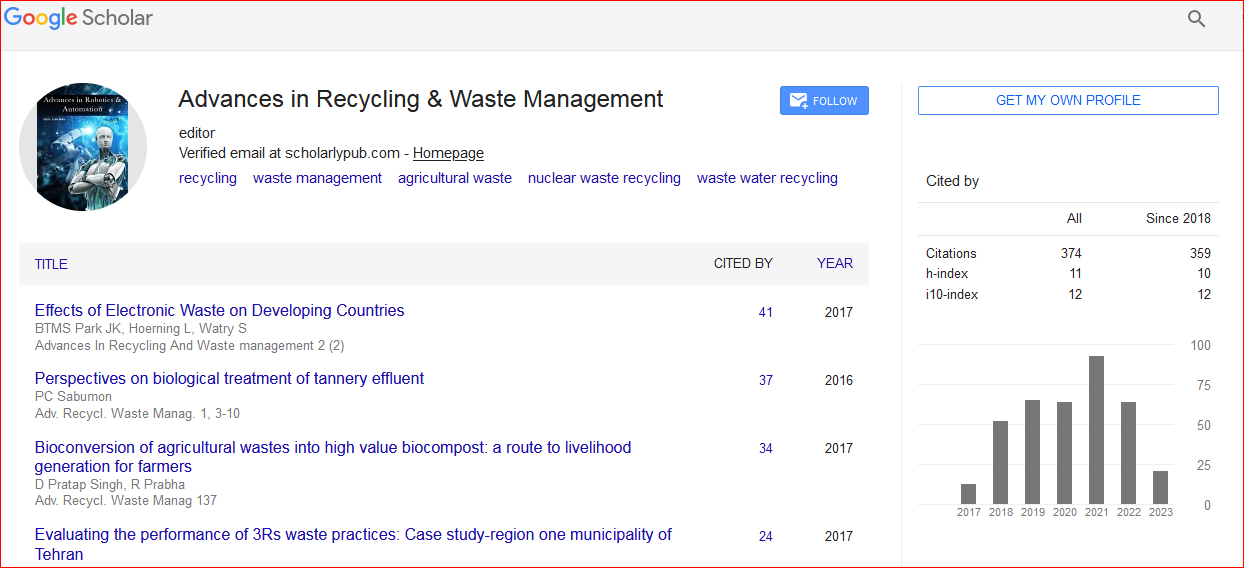
Advances in Recycling & Waste Management received 438 citations as per Google Scholar report