Brief Report - (2025) Volume 15, Issue 5
Received: 01-Sep-2025, Manuscript No. jtese-26-184245;
Editor assigned: 03-Sep-2025, Pre QC No. P-184245;
Reviewed: 17-Sep-2025, QC No. Q-184245;
Revised: 22-Sep-2025, Manuscript No. R-184245;
Published:
29-Sep-2025
, DOI: 10.37421/2165-8064.2025.15.669
Citation: Alvarez, Ricardo. ”Textile Finishing: Wrinkle Resistance, Easy Care, And Comfort.” J Textile Sci Eng 15 (2025):669.
Copyright: © 2025 Alvarez R. This is an open-access article distributed under the terms of the Creative Commons Attribution License, which permits unrestricted use, distribution and reproduction in any medium, provided the original author and source are credited.
The advancement of textile finishing technologies has led to the development of numerous treatments aimed at enhancing fabric properties and user satisfaction. Among these, wrinkle-resistant and easy-care finishes have gained significant attention from both researchers and consumers due to their ability to simplify garment maintenance and improve aesthetics. This area of research explores innovative chemical and physical methods to impart desirable characteristics to fabrics, often focusing on durability, comfort, and environmental sustainability. The performance of wrinkle-resistant and easy-care finishes on cotton fabrics has been a subject of ongoing investigation. Studies have concentrated on evaluating various finishing agents and application techniques to achieve optimal outcomes, considering factors such as durability, comfort, and visual appeal. Key parameters influencing fabric behavior after laundering and wear are identified, with a particular emphasis on the balance between wrinkle resistance and fabric hand to enhance wearer satisfaction [1].
Novel cross-linking agents have emerged as a promising avenue for imparting durable press properties to cellulosic fabrics. Research in this domain examines the impact of these finishes on essential fabric attributes, including strength, tear resistance, and color fastness, while simultaneously assessing their efficacy in wrinkle recovery. The findings often demonstrate that specific chemical modifications can elevate easy-care characteristics without substantially compromising other crucial textile performance indicators [2].
The integration of advanced materials, such as nanocellulose, with traditional finishing chemicals is also being explored to enhance the wrinkle resistance and handle of blended fabrics. Such studies assess the contribution of these novel materials to the durability of the finish and their influence on fabric breathability and moisture management, suggesting potential synergistic effects for improved overall comfort and performance [3].
Sustainability has become a critical consideration in the development of textile finishes. Research is increasingly focused on the environmental impact and performance of formaldehyde-free cross-linking agents for durable press finishes. This involves comparing the efficacy of various bio-based and synthetic alternatives in terms of wrinkle recovery, wash durability, and potential allergenic properties, aiming to provide insights into more sustainable approaches for easy-care textiles [4].
A deeper understanding of the mechanisms behind wrinkle-resistant finishes is being pursued through detailed surface characterization. Studies employing advanced spectroscopic and microscopic techniques examine the surface morphology and chemical changes induced by these treatments on fabrics like cotton. The correlation of these surface modifications with observable improvements in wrinkle recovery and fabric hand offers valuable insights into how these finishes function [5].
The impact of durable press finishing treatments on the mechanical properties of various fabric types, such as linen, is also under scrutiny. Investigations aim to optimize finishes that not only enhance wrinkle resistance but also avoid excessive fabric stiffening or strength loss, thereby preserving the fabric's comfort and wearability. This involves a careful balance of chemical treatments and their effects on physical attributes [6].
Innovative physical treatment methods, such as plasma treatment, are being explored as environmentally friendly alternatives for imparting easy-care properties to fabrics. Plasma treatment can be used as a pre-treatment or finishing step to modify the surface of synthetic fabrics like polyester, contributing to enhanced wrinkle recovery and water repellency. This offers a greener approach compared to conventional chemical methods [7].
Combinations of different finishing agents are also being investigated to achieve multifaceted improvements in fabric properties. For instance, the assessment of new generation silicone-based softeners combined with cross-linking agents for wrinkle-resistant finishes on cotton aims to enhance fabric hand and wrinkle recovery while maintaining durability to multiple wash cycles, seeking a balance between softness and high performance [8].
Optimizing finishing processes, including the sequences and concentrations of specific agents, is crucial for achieving desired fabric characteristics. For lyocell fabrics, studies focus on formaldehyde-free cross-linking agents to improve dimensional stability and wrinkle recovery. This research provides quantitative data on the effectiveness of such processes and their impact on structural integrity and aesthetic appeal [9].
The evaluation of wrinkle-resistant and easy-care finishes on cotton fabrics is a central theme in textile science, aiming to optimize durability, comfort, and aesthetic properties. This involves scrutinizing diverse finishing agents and application methods to discern the key factors that govern a fabric's performance post-laundering and wear. A significant aspect of this research is the identification of trade-offs between wrinkle resistance and the fabric's tactile quality, leading to the development of improved formulations for enhanced wearer satisfaction [1].
Research into novel cross-linking agents has demonstrated their efficacy in conferring durable press characteristics onto cellulosic fabrics. This line of inquiry meticulously examines the influence of these finishes on fundamental fabric attributes such as strength, resistance to tearing, and color fastness, in addition to their primary function of improving wrinkle recovery. The outcomes underscore the capability of specific chemical modifications to boost easy-care properties without detrimentally affecting other vital performance metrics of the textile [2].
The incorporation of advanced nanomaterials, like nanocellulose, alongside conventional finishing chemicals represents a progressive approach to improving the wrinkle resistance and overall handle of polyester-cotton blends. Investigations in this area systematically assess how nanocellulose contributes to the longevity of the finish and affects critical fabric properties such as breathability and moisture management, with findings often indicating synergistic effects that elevate both comfort and performance [3].
In response to growing environmental concerns, considerable research effort is directed towards the development and assessment of sustainable, formaldehyde-free cross-linking agents for durable press applications. This involves a comparative analysis of various bio-based and synthetic alternatives, evaluating their effectiveness in terms of wrinkle recovery, wash durability, and potential for causing allergic reactions, thereby paving the way for greener textile finishing solutions [4].
Surface characterization techniques, utilizing advanced spectroscopy and microscopy, are instrumental in understanding the micro-level changes induced by wrinkle-resistant finishes on cotton fabrics. By correlating these observed surface modifications with tangible improvements in wrinkle recovery and fabric hand, researchers gain a profound insight into the intricate mechanisms driving the performance of these finishing treatments [5].
The influence of distinct durable press finishing sequences on the mechanical integrity of fabrics, such as linen, is a subject of detailed investigation. The primary objective is to fine-tune finishing processes to achieve superior wrinkle resistance without compromising tensile strength, elongation, or inducing excessive stiffness, thus ensuring the fabric remains comfortable and wearable [6].
Plasma treatment is emerging as an environmentally conscious alternative for imparting easy-care properties, particularly to synthetic fabrics like polyester. This physical treatment method, applied either as a pre-treatment or a final finishing step, modifies the fabric surface to enhance wrinkle recovery and water repellency, presenting a greener substitute for traditional chemical finishing approaches [7].
The synergistic application of different finishing agents is being explored to achieve comprehensive fabric enhancements. For cotton fabrics, the combination of advanced silicone-based softeners with cross-linking agents for wrinkle resistance aims to concurrently improve the fabric's tactile feel and wrinkle recovery, while ensuring robust durability through multiple wash cycles [8].
Optimizing the application parameters of finishing agents, including the specific sequence of treatments and their concentrations, is crucial for maximizing desired outcomes. In the case of lyocell fabrics, research focuses on fine-tuning formaldehyde-free cross-linking processes to achieve superior wrinkle recovery and dimensional stability, providing quantitative data that validates the effectiveness of these refined finishing strategies [9].
Finally, the overall wear performance and comfort attributes of garments treated with durable press finishes are meticulously assessed through a combination of laboratory evaluations and user feedback. This comprehensive approach quantifies the interplay between wrinkle resistance, air permeability, moisture transport, and the wearer's perception of comfort, thereby informing the design of high-performance, easy-care apparel [10].
This collection of research focuses on improving textile properties through various finishing techniques, primarily targeting wrinkle resistance and easy-care characteristics. Studies explore the effectiveness of different chemical agents, including novel cross-linking agents and sustainable formaldehyde-free alternatives, as well as physical methods like plasma treatment. The research also investigates the integration of advanced materials like nanocellulose and the impact of finishing on fabric hand, durability, mechanical properties, and surface morphology. Furthermore, the wear performance and comfort of treated textiles are assessed, highlighting the importance of balancing functional improvements with wearer satisfaction and environmental considerations.
None
None
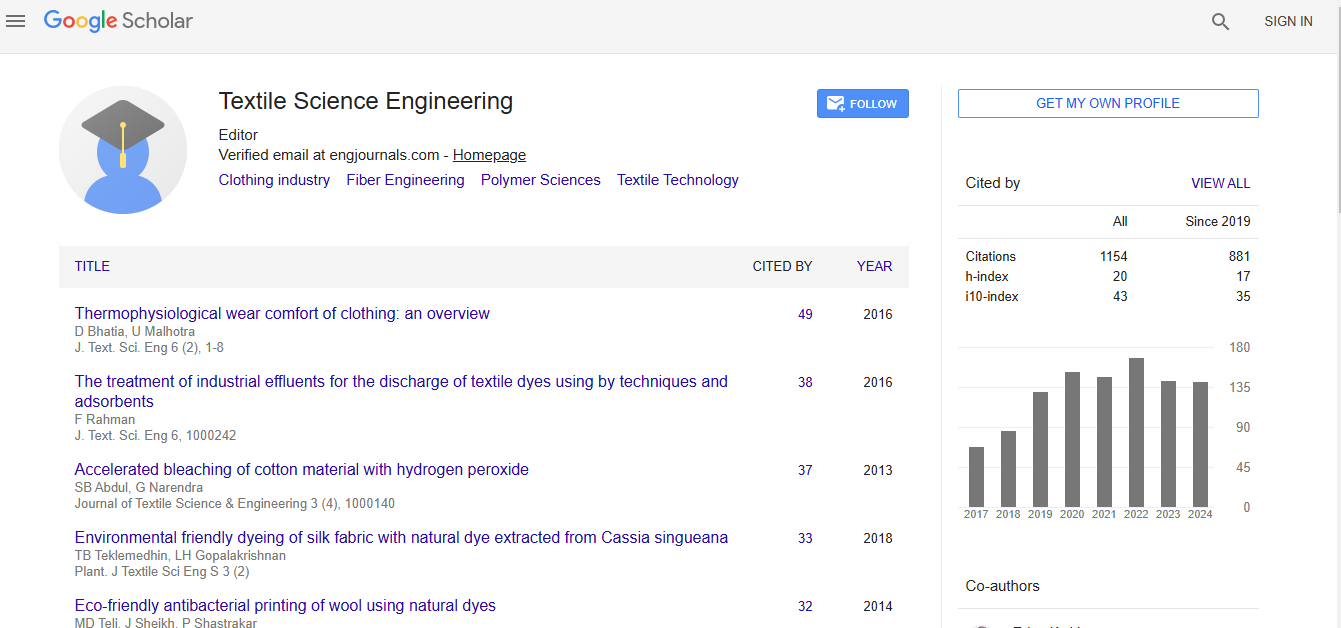
Journal of Textile Science & Engineering received 1008 citations as per Google Scholar report