Opinion - (2025) Volume 7, Issue 5
Received: 13-Sep-2024, Manuscript No. JSPD-24-147918;
Editor assigned: 16-Sep-2024, Pre QC No. JSPD-24-147918 (PQ);
Reviewed: 01-Oct-2024, QC No. JSPD-24-147918;
Revised: 14-Oct-2025, Manuscript No. JSPD-24-147918 (R);
Published:
21-Oct-2025
, DOI: 10.37421/2684-4575.2025.7.173
Citation: Igor, Kretov. "Telepathology in Global Health: Expanding Access to Expert Diagnosis." J Surg Path Diag 7 (2025): 173.
Copyright: © 2025 Igor K. This is an open-access article distributed under the terms of the creative commons attribution license which permits unrestricted use, distribution and reproduction in any medium, provided the original author and source are credited.
In the landscape of modern healthcare, access to accurate and timely diagnostic services remains a significant challenge, particularly in low-resource settings. The disparity in the availability of expert pathology services is a critical barrier to effective healthcare delivery. Telepathology, the practice of transmitting pathology data over long distances for diagnosis, research, and education, has emerged as a promising solution to bridge this gap. By leveraging digital technology, telepathology enables remote analysis of pathology images, bringing expert diagnosis to regions where specialized pathologists are scarce or non-existent.
The role of telepathology in global health
Telepathology has the potential to revolutionize global health by providing a means to deliver high-quality diagnostic services to underserved populations. In many parts of the world, particularly in Low and Middle-Income Countries (LMICs), there is a severe shortage of pathologists. According to the World Health Organization (WHO), there is approximately one pathologist for every 1 million people in some regions, compared to 5-6 per 100,000 in high-income countries. This stark contrast highlights the urgent need for innovative solutions like telepathology to ensure equitable healthcare access.
Telepathology facilitates the remote diagnosis of various conditions, from cancer to infectious diseases, by allowing digital images of tissue samples to be shared with expert pathologists anywhere in the world. This capability is crucial in LMICs, where local expertise may be limited, and the transportation of physical slides for external consultation can be slow and expensive. By eliminating geographical barriers, telepathology enables faster diagnosis, which is essential for timely treatment and improved patient outcomes.
Technological advancements driving telepathology
The effectiveness of telepathology has been significantly enhanced by advancements in digital imaging, internet connectivity, and data storage. High-resolution Whole-Slide Imaging (WSI) allows pathologists to view entire slides digitally, replicating the experience of traditional microscopy. These images can be transmitted in real-time or stored and reviewed asynchronously, offering flexibility in consultation and collaboration.
Cloud-based platforms have further expanded the reach of telepathology by providing secure and scalable solutions for image storage and sharing. These platforms facilitate collaboration among pathologists globally, enabling peer reviews and second opinions that improve diagnostic accuracy. Additionally, the integration of Artificial Intelligence (AI) in telepathology is an emerging trend that promises to enhance diagnostic precision and efficiency. AI algorithms can assist in the identification of pathological features, reducing the workload on pathologists and increasing the speed of diagnosis.
Challenges and barriers to implementation
Despite its potential, telepathology faces several challenges that must be addressed to maximize its impact on global health. One of the primary barriers is the lack of infrastructure in many low-resource settings. Reliable internet connectivity, high-quality imaging equipment, and trained personnel are essential for the successful implementation of telepathology. In regions where these resources are scarce, the deployment of telepathology systems can be challenging.
Another significant challenge is the issue of data security and patient confidentiality. The transmission of medical images over the internet raises concerns about data privacy, particularly in countries with limited regulations on digital health information. Ensuring compliance with international standards for data protection is crucial for the ethical practice of telepathology.
Moreover, there is a need for standardization in telepathology practices. Variations in imaging protocols, file formats, and diagnostic criteria can lead to inconsistencies in diagnosis. Establishing global standards and guidelines for telepathology is essential to ensure the reliability and accuracy of remote consultations.
Success stories and case studies
Several successful implementations of telepathology in global health have demonstrated its potential to improve healthcare outcomes. For example, the African Telepathology Network (AFRONET) has been instrumental in providing diagnostic services to several countries in sub-Saharan Africa. Through partnerships with institutions in high-income countries, AFRONET has facilitated the remote diagnosis of complex cases, reducing the need for patients to travel long distances for specialized care.
Similarly, in India, the Institute of Pathology and Microbiology (IPM) has implemented a telepathology network that connects rural healthcare centers with expert pathologists in urban areas. This initiative has significantly reduced the turnaround time for diagnostic results, enabling quicker treatment decisions for patients in remote regions.
The future of telepathology in global health
Looking ahead, the future of telepathology in global health is promising, with several trends expected to shape its evolution. The continued advancement of AI and machine learning will likely play a pivotal role in enhancing the diagnostic capabilities of telepathology systems. AI-powered tools can assist in the detection of subtle pathological features, reducing diagnostic errors and supporting pathologists in making more informed decisions.
Additionally, the expansion of mobile Health (mHealth) technologies will further extend the reach of telepathology. Mobile devices equipped with high-resolution cameras and cloud-based applications can enable the capture and transmission of pathology images from even the most remote locations. This capability will be particularly valuable in disaster response scenarios and in regions with limited access to healthcare facilities.
Telepathology holds immense potential to expand access to expert diagnosis and improve healthcare outcomes in underserved regions around the world. By leveraging digital technology, telepathology can overcome the geographical and resource-related barriers that have long hindered the delivery of quality healthcare in low and middleincome countries. However, to fully realize its potential, it is essential to address the challenges related to infrastructure, data security, and standardization. With continued investment and collaboration, telepathology can become a cornerstone of global health, ensuring that every patient, regardless of location, has access to timely and accurate diagnosis.
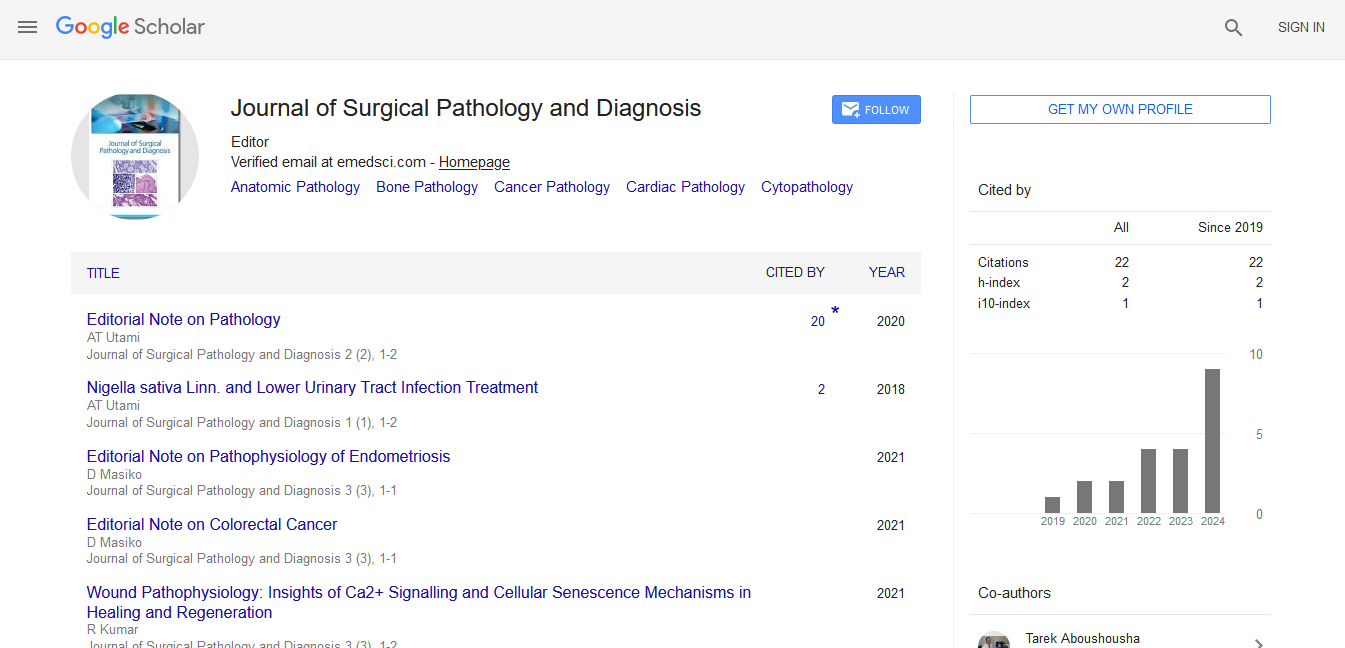
Journal of Surgical Pathology and Diagnosis received 15 citations as per Google Scholar report