Perspective - (2025) Volume 7, Issue 5
Received: 13-Sep-2024, Manuscript No. JSPD-24-147903;
Editor assigned: 16-Sep-2024, Pre QC No. JSPD-24-147903 (PQ);
Reviewed: 01-Oct-2024, QC No. JSPD-24-147903;
Revised: 14-Oct-2025, Manuscript No. JSPD-24-147903 (R);
Published:
21-Oct-2025
, DOI: 10.37421/2684-4575.2025.7.169
Citation: Dautermann, Somin. "Telepathology and Patient Outcomes: A Review of Recent Studies." J Surg Path Diag 7 (2025): 169.
Copyright: © 2025 Dautermann S. This is an open-access article distributed under the terms of the creative commons attribution license which permits unrestricted use, distribution and reproduction in any medium, provided the original author and source are credited.
Telepathology, the remote transmission of pathological data for diagnosis and consultation, has emerged as a transformative technology in the field of medicine. With advancements in digital imaging and telecommunications, telepathology offers the potential to enhance diagnostic accuracy, reduce turnaround times, and improve patient outcomes. This review examines recent studies on telepathology and its impact on patient care, highlighting key findings and implications for the future of pathology.
Recent advancements in telepathology have been driven by improvements in digital imaging, data transmission, and software. High-resolution digital scanners allow for the creation of detailed virtual slides, while sophisticated telecommunication networks facilitate rapid sharing of these images between healthcare providers. Furthermore, artificial intelligence (AI) and machine learning algorithms are increasingly being integrated into telepathology systems, offering enhanced diagnostic support and potentially increasing accuracy.
Several studies have evaluated the impact of telepathology on diagnostic accuracy. Research has demonstrated that telepathology can achieve diagnostic concordance rates comparable to those of traditional, in-person consultations. For example, a study published in the Journal of Pathology Informatics found that telepathology achieved a diagnostic agreement rate of 97% when compared to conventional microscopy. Additionally, telepathology has been shown to be particularly effective in remote or underserved areas where access to expert pathologists is limited.
One of the key advantages of telepathology is its potential to reduce turnaround times for diagnostic results. Studies have reported that telepathology can significantly decrease the time required to obtain diagnostic results compared to traditional methods. For instance, a study in the American Journal of Clinical Pathology found that telepathology reduced average turnaround times from 48 hours to 24 hours, leading to faster patient management and treatment decisions.
The impact of telepathology on overall patient care has been a focal point of recent research. Telepathology has been associated with improved patient outcomes due to timely and accurate diagnoses. A study published in telemedicine and e-Health found that telepathology facilitated timely diagnoses and allowed for more efficient treatment planning, ultimately contributing to better patient outcomes. Additionally, telepathology can enhance collaboration among multidisciplinary teams, ensuring that patients receive comprehensive care from various specialists. Despite its advantages, telepathology is not without challenges. Issues related to data security, image quality, and the need for standardization across systems have been identified as potential barriers. Studies have highlighted concerns about the potential for data breaches and the need for robust cybersecurity measures. Additionally, ensuring consistent image quality and establishing universal protocols for telepathology remain important areas of ongoing research.
Looking ahead, the integration of AI and machine learning into telepathology holds promise for further enhancing diagnostic accuracy and efficiency. Research into these technologies is ongoing, with the potential to develop advanced diagnostic tools and predictive algorithms. Additionally, expanding access to telepathology in underserved regions and addressing challenges related to data security and standardization will be crucial for the continued growth and success of this technology. Telepathology has demonstrated significant potential to improve patient outcomes through enhanced diagnostic accuracy, reduced turnaround times, and improved quality of care. While challenges remain, ongoing research and technological advancements are likely to address these issues and further solidify telepathology's role in modern medicine. As the field continues to evolve, telepathology promises to be a valuable tool in advancing patient care and bridging gaps in healthcare access.
Comparative studies assessing telepathology's effectiveness across different regions have yielded insightful results. Research comparing telepathology practices in developed versus developing countries has highlighted its transformative potential in resourcelimited settings. A study published in Global Health Action showed that telepathology significantly improved diagnostic capabilities in remote areas of sub-Saharan Africa, where traditional pathology services were scarce. This shift not only enhanced diagnostic accuracy but also led to a reduction in diagnostic delays, improving overall patient management in these regions.
Conversely, studies in developed countries, such as those in The Lancet Oncology, emphasize how telepathology can streamline pathology services in high-volume settings, such as large hospitals and cancer centers. By integrating telepathology into their workflow, these institutions have achieved greater efficiency and have optimized the allocation of pathologists' time, allowing for a more focused approach to complex cases. Patient and provider satisfaction with telepathology services have been subject to various evaluations. Surveys and feedback mechanisms indicate generally high satisfaction rates among patients, particularly regarding the timeliness of results and the convenience of remote consultations. A study published in Journal of Telemedicine and Telecare reported that patients appreciated the reduced wait times and the ability to access expert opinions without the need for extensive travel.
For healthcare providers, telepathology has often been associated with increased job satisfaction due to the enhanced collaboration and reduced administrative burden. However, some studies, such as those found in Pathology Research and Practice, have noted that there can be an initial learning curve associated with new technology, and ongoing training and support are necessary to fully integrate telepathology into existing practices.
The economic impact of telepathology is another critical area of study. Research indicates that telepathology can lead to cost savings for healthcare systems by reducing the need for physical infrastructure and associated overheads. A cost-benefit analysis published in Health Economics Review found that telepathology implementation led to a reduction in overall diagnostic costs, particularly through decreased travel expenses and reduced physical storage requirements for slides. Additionally, by improving diagnostic efficiency and reducing turnaround times, telepathology can contribute to more effective and timely patient management, potentially reducing the need for costly follow-up interventions.
The integration of telepathology with Electronic Health Records (EHR) systems is an area of growing interest. Seamless integration can enhance the accessibility of pathology results within a patient's comprehensive medical record, facilitating better-coordinated care. A study in Journal of Biomedical Informatics highlighted the benefits of linking telepathology results with EHRs, noting that it improved clinical decision-making and enhanced communication between pathologists and clinicians. Future developments in this area are likely to further streamline the workflow and enhance the overall effectiveness of telepathology.
Telepathology represents a significant advancement in medical technology, with the potential to transform pathology practices and improve patient outcomes across diverse settings. While challenges remain, ongoing research and technological innovations are addressing these issues and expanding the capabilities of telepathology. As the field continues to evolve, it holds promise for advancing the quality and accessibility of pathological care, ultimately benefiting patients and healthcare systems globally.
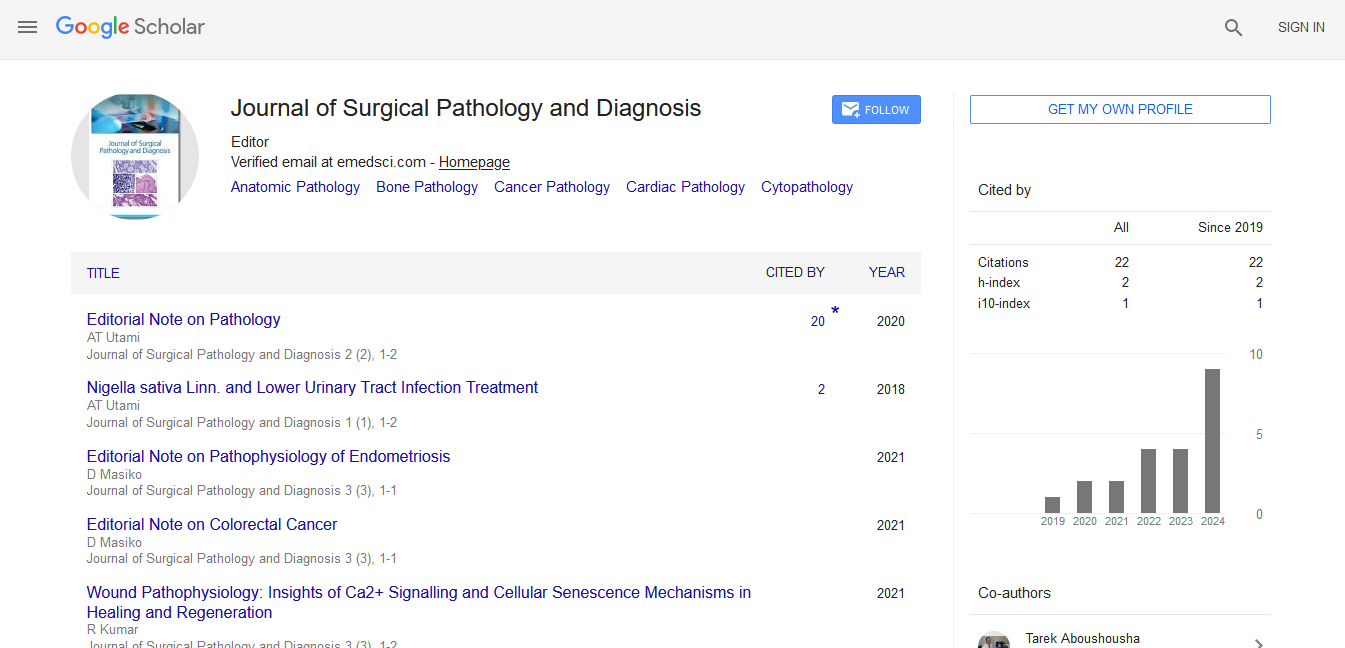
Journal of Surgical Pathology and Diagnosis received 15 citations as per Google Scholar report