Opinion - (2025) Volume 16, Issue 2
Received: 01-Mar-2025, Manuscript No. jhmi-26-178822;
Editor assigned: 03-Mar-2025, Pre QC No. P-178822;
Reviewed: 17-Mar-2025, QC No. Q-178822;
Revised: 24-Mar-2025, Manuscript No. R-178822;
Published:
31-Mar-2025
, DOI: 10.37421/2157-7420.2025.16.583
Citation: Hernández, Sofia L.. ”Telemedicine: Transforming Healthcare Access, Delivery and Outcomes.” J Health Med Informat 16 (2025):583.
Copyright: © 2025 Hernández L. Sofia This is an open-access article distributed under the terms of the Creative Commons Attribution License, which permits unrestricted use, distribution and reproduction in any medium, provided the original author and source are credited.
Telemedicine platforms are fundamentally transforming the landscape of healthcare delivery, significantly enhancing access to medical services, particularly for individuals residing in remote or underserved regions. These innovative digital tools facilitate timely medical consultations, thereby alleviating the burden of travel for patients and enabling continuous health monitoring, which collectively contributes to improved patient outcomes and greater operational efficiency within healthcare systems. The inherent capability of these platforms to bridge geographical divides and overcome resource limitations is instrumental in fostering a more equitable distribution of healthcare [1].
The ongoing digital transformation, spearheaded by the widespread adoption of telemedicine, is fundamentally reshaping the dynamics of both healthcare provision and patient engagement. This profound shift necessitates not only the technological implementation of these platforms but also a deep understanding and adaptation of patient behaviors, established provider workflows, and evolving regulatory frameworks. Comprehending these intricate, multifaceted impacts is absolutely critical for maximizing the extensive benefits that telemedicine can offer across a diverse spectrum of healthcare settings and patient populations [2].
Telemedicine has unequivocally proven its value as an indispensable tool in broadening access to specialized medical care, with a particular emphasis on its impact in rural and geographically isolated areas. By leveraging virtual means to connect patients directly with specialists, these platforms effectively dismantle geographical barriers and significantly diminish the necessity for arduous and often costly travel. This advancement plays a pivotal role in democratizing access to high-quality healthcare services for those who might otherwise be excluded [3].
The successful widespread adoption and sustained positive impact of telemedicine platforms on healthcare accessibility are intrinsically linked to their fundamental usability and the prevailing digital literacy levels among both patients and healthcare providers. To ensure these platforms achieve their full potential, it is imperative to actively address these critical factors through comprehensive training initiatives and the development of intuitively designed user interfaces that are accessible to all [4].
Telemedicine platforms are proving to be exceptionally instrumental in the effective management of chronic diseases, primarily through their capacity to facilitate consistent patient monitoring and enable prompt, targeted interventions. This ongoing engagement fosters better patient adherence to prescribed treatment plans and demonstrably leads to improved health outcomes, especially for individuals who experience limited mobility or reside at significant distances from healthcare facilities [5].
The strategic integration of advanced artificial intelligence (AI) technologies within telemedicine platforms represents a significant leap forward in enhancing diagnostic accuracy and enabling the personalization of treatment recommendations. AI-powered tools possess the remarkable ability to analyze vast amounts of patient data with unprecedented efficiency, thereby providing invaluable assistance to clinicians in making more informed and precise decisions, ultimately elevating the overall quality of remote care delivery [6].
Telemedicine platforms are playing a crucial role in expanding the availability of essential mental health services, especially in geographical areas that suffer from a pronounced scarcity of accessible psychiatrists and psychologists. These virtual consultation modalities offer individuals a discreet, convenient, and stigma-free pathway to seek necessary support, thereby substantially broadening the reach and impact of vital mental healthcare services to previously underserved populations [7].
The global COVID-19 pandemic served as a powerful catalyst, dramatically accelerating the widespread adoption and acceptance of telemedicine. This unprecedented event underscored the profound potential of these platforms to ensure the uninterrupted continuity of essential healthcare services, particularly during periods of public health crises. Adaptable and scalable telemedicine solutions proved to be exceptionally invaluable in maintaining critical healthcare operations while simultaneously minimizing the risks associated with physical contact [8].
Patient satisfaction levels with telemedicine services are consistently reported as high, largely attributable to the inherent convenience, significantly reduced waiting times, and the markedly improved access to care that these platforms provide. Nevertheless, achieving truly equitable access necessitates a dedicated effort to address the pervasive digital divide and to ensure that adequate support systems are in place for all patient demographics, irrespective of their technological proficiency or socioeconomic status [9].
The development of telemedicine platforms that are both highly secure and interoperable is of paramount importance for safeguarding sensitive patient data and ensuring seamless integration with existing electronic health record (EHR) systems. The implementation of robust cybersecurity measures and strict adherence to all relevant privacy regulations are absolutely critical elements for building essential trust among users and facilitating the widespread, sustainable adoption of telemedicine technologies [10].
Telemedicine platforms are at the forefront of revolutionizing healthcare access, offering a lifeline particularly to remote and underserved communities. They facilitate prompt consultations, reduce the burden of travel, and allow for continuous patient monitoring, leading to enhanced health outcomes and improved efficiency in healthcare systems. By dismantling geographical barriers and addressing resource constraints, these platforms are making healthcare more accessible and equitable for all [1].
The digital evolution driven by telemedicine is fundamentally reshaping how healthcare is both delivered and received. This transformation encompasses not only the successful implementation of new technologies but also significant adjustments in patient behavior, established provider workflows, and the evolving regulatory landscape. A comprehensive understanding of these diverse impacts is crucial for optimizing the benefits telemedicine brings to various healthcare settings [2].
Telemedicine has emerged as a critical tool for extending access to specialized medical services, especially in rural and remote areas. Through virtual connections between patients and specialists, these platforms overcome significant geographical obstacles and reduce the need for time-consuming and expensive travel, thereby making quality healthcare more attainable for a broader population [3].
The successful implementation and enduring effectiveness of telemedicine platforms are critically dependent on their user-friendliness and the digital literacy of both patients and healthcare providers. To ensure widespread adoption and maximize their impact on healthcare accessibility, it is essential to address these factors through targeted training programs and the design of intuitive interfaces [4].
Telemedicine platforms play a vital role in the effective management of chronic diseases by enabling regular patient monitoring and facilitating timely interventions. This continuous engagement can lead to better adherence to treatment regimens and improved health outcomes, particularly for individuals with mobility issues or those living far from medical facilities [5].
The integration of artificial intelligence (AI) into telemedicine platforms is a significant advancement, enhancing diagnostic accuracy and allowing for personalized treatment plans. AI-driven tools can process patient data more efficiently, aiding clinicians in making better-informed decisions and improving the quality of care provided remotely [6].
Telemedicine platforms are essential for delivering mental health services, especially in areas with a shortage of psychiatrists and psychologists. These virtual consultations provide a private and convenient way for individuals to seek support, thereby greatly expanding the reach of mental healthcare services [7].
The COVID-19 pandemic dramatically accelerated the adoption of telemedicine, proving its potential to maintain healthcare continuity during public health emergencies. Platforms that are adaptable and scalable were invaluable in sustaining healthcare services while minimizing physical contact between individuals [8].
Patient satisfaction with telemedicine services is generally high, attributed to convenience, shorter wait times, and improved access to care. However, ensuring equitable access requires concerted efforts to bridge the digital divide and offer adequate support for all patient demographics [9].
The development of secure and interoperable telemedicine platforms is crucial for protecting patient data and ensuring smooth integration with existing electronic health records. Strong cybersecurity measures and adherence to privacy regulations are fundamental for building trust and promoting the widespread adoption of these platforms [10].
Telemedicine platforms are significantly improving healthcare access, especially for remote and underserved populations, by enabling timely consultations, reducing travel burdens, and offering continuous monitoring. This digital transformation is reshaping healthcare delivery, requiring adaptations in patient behavior, provider workflows, and regulations. Telemedicine effectively bridges geographical gaps for specialized care and chronic disease management, leading to better outcomes. Usability and digital literacy are key to successful adoption, while AI integration enhances diagnostics and personalization. Virtual mental health services are expanding significantly. The COVID-19 pandemic accelerated telemedicine adoption, highlighting its role in healthcare continuity. Patient satisfaction is high due to convenience and access, though equity concerns related to the digital divide persist. Cybersecurity and data privacy are paramount for trust and widespread adoption.
None
None
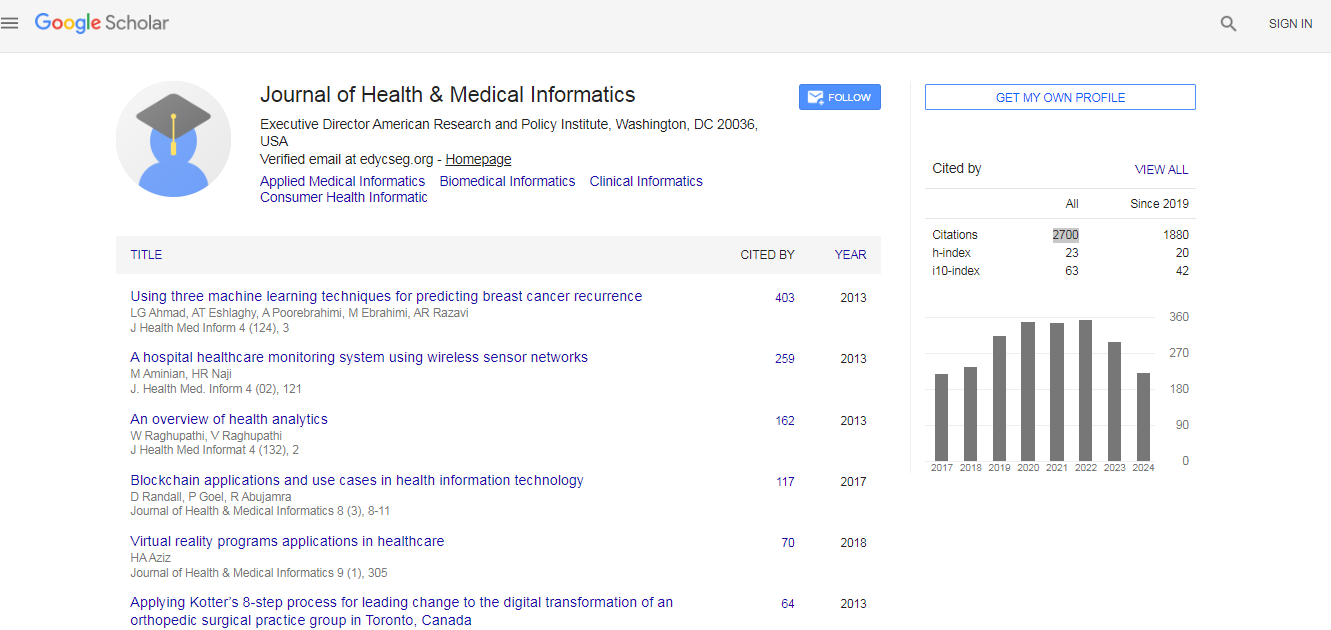
Journal of Health & Medical Informatics received 2700 citations as per Google Scholar report