Commentary - (2025) Volume 14, Issue 3
Received: 02-Jun-2025, Manuscript No. jhoa-26-187803;
Editor assigned: 04-Jun-2025, Pre QC No. P-187803;
Reviewed: 18-Jun-2025, QC No. Q-187803;
Revised: 23-Jun-2025, Manuscript No. R-187803;
Published:
30-Jun-2025
, DOI: 10.37421/2167-1095.2025.14.525
Citation: Rahman, Noor. ”Telemedicine: Revolutionizing Hypertension Management And Patient Outcomes.” J Hypertens 14 (2025):525.
Copyright: © 2025 Rahman N. This is an open-access article distributed under the terms of the Creative Commons Attribution License, which permits unrestricted use, distribution and reproduction in any medium, provided the original author and source are credited.
Telemedicine has emerged as a transformative modality in the management of hypertension, offering a paradigm shift in how healthcare providers engage with patients and monitor their cardiovascular health. Its ability to facilitate frequent remote monitoring of blood pressure is a cornerstone of its efficacy, allowing for timely interventions and significantly improving patient adherence to prescribed treatment regimens. This technological integration empowers healthcare providers to meticulously track blood pressure readings, make necessary adjustments to medications, and offer essential lifestyle advice, all without the necessity of in-person visits, thereby contributing to a reduction in overall healthcare costs and an expansion of access to care, particularly for individuals residing in rural or underserved geographical areas. This innovative approach fosters a more collaborative and dynamic patient-provider relationship, crucially empowering individuals to assume a more active and informed role in the diligent management of their chronic hypertension condition [1].
Remote Patient Monitoring (RPM) specifically for hypertension has demonstrably proven its efficacy in achieving and maintaining optimal blood pressure control, especially when these technological interventions are thoughtfully integrated within comprehensive and well-coordinated care programs. Numerous studies meticulously highlight that the consistent and reliable collection of physiological data via RPM devices, when coupled with regular, constructive feedback provided by dedicated clinicians, invariably leads to significant and clinically meaningful reductions in both systolic and diastolic blood pressure levels. Moreover, this advanced technology plays an undeniably crucial role in the early and accurate identification of less common yet significant hypertensive conditions such as masked hypertension and nocturnal hypertension patterns, which might otherwise be inadvertently overlooked or missed during standard, infrequent clinic visits [2].
The thoughtful and strategic integration of modern telehealth platforms into the routine fabric of hypertension management offers profound and substantial benefits for enhancing patient engagement levels and bolstering their sense of self-efficacy concerning their condition. Patients who actively utilize telemedicine services consistently report higher levels of overall satisfaction with their care and express a significantly greater sense of personal control and empowerment over their hypertension. The inherent convenience offered by virtual consultations and the ability to conduct monitoring from the comfort of one's home actively encourages more regular and consistent engagement with healthcare professionals. This improved engagement, in turn, directly leads to better medication adherence and a more proactive adoption of healthier lifestyle choices, ultimately contributing to demonstrably improved long-term health outcomes for these individuals [3].
Telemedicine is instrumental in facilitating the development and implementation of highly personalized hypertension treatment plans. This personalization is made possible through its capacity for continuous data collection and sophisticated analysis of individual patient responses. This capability allows for more precise and individualized medication titration, carefully tailored to specific blood pressure patterns and the unique response of each patient to their therapy. Furthermore, telemedicine platforms adeptly support the seamless integration of diverse data streams, including vital information from activity trackers and detailed dietary logs, thereby providing clinicians with a comprehensive, holistic view necessary to design and implement highly tailored and effective interventions, ultimately leading to optimized blood pressure control and a significant reduction in overall cardiovascular risk [4].
The significant aspect of cost-effectiveness associated with the implementation of telemedicine in the realm of hypertension management stands as a crucial consideration for healthcare systems worldwide. By substantially reducing the logistical and financial burden associated with frequent in-person clinical visits, by effectively lowering hospitalization rates through improved blood pressure control, and by facilitating the optimized and judicious use of antihypertensive medications, telemedicine-based models demonstrably lead to considerable financial savings for both the healthcare systems themselves and the patients receiving care. This compelling economic advantage firmly establishes telemedicine as a financially sustainable and highly viable solution for the widespread and equitable delivery of effective hypertension care [5].
Telemedicine serves as a critical and effective bridge, successfully overcoming the significant geographical barriers that often impede healthcare access for individuals living with hypertension. Patients who reside in remote, rural, or otherwise underserved areas can now receive consistent, reliable, and high-quality medical attention, continuous monitoring, and essential guidance, challenges that have historically presented a major obstacle to the effective management of their condition. This invaluable expansion of healthcare service reach is absolutely crucial for the global pursuit and eventual achievement of equitable and effective hypertension control across diverse and often disparate populations [6].
The innovative utilization of advanced wearable devices and sophisticated mobile health applications, when thoughtfully integrated with established telemedicine platforms, significantly enhances the granularity and the frequency of hypertension data collection. These powerful tools not only empower patients to diligently monitor their own blood pressure, heart rate, and daily activity levels in real-time but also provide healthcare providers with exceptionally rich and detailed datasets for their analysis. This continuous and abundant influx of objective patient-generated information permits the adoption and implementation of proactive, preventative, rather than purely reactive, management strategies for hypertension [7].
Telemedicine platforms inherently offer a highly scalable solution perfectly suited for the effective management of large and ever-growing hypertensive patient populations. By strategically automating specific aspects of routine patient monitoring and essential follow-up care processes, healthcare systems can significantly extend their operational reach and demonstrably improve the overall efficiency of care delivery without any discernible compromise in the quality of care provided. This inherent scalability is of particular and profound relevance and importance in the current global context, characterized by a persistently rising prevalence of hypertension across many nations [8].
Telemedicine proves to be exceptionally effective in enhancing the intricate management of resistant hypertension, a particularly challenging subset of the condition. It achieves this by enabling closer, more frequent, and more detailed monitoring of patients and facilitating more agile and timely adjustments to complex, multi-drug antihypertensive medication regimens. The crucial ability to remotely and accurately track patient adherence to their medication schedules and objectively monitor their physiological response to various antihypertensive drugs is absolutely critical for achieving target blood pressure goals in these particularly challenging and often complex clinical cases [9].
While the implementation of telemedicine for routine hypertension care presents numerous advantages, it is imperative to acknowledge and proactively address potential challenges that may arise. These hurdles can include variations in digital literacy among patient populations, disparities in access to necessary technology, and crucial concerns regarding the robust security of sensitive patient data. However, with the provision of appropriate and comprehensive training, dedicated technical support, and the implementation of stringent and effective security measures, these potential obstacles can be effectively overcome, thereby paving the successful way for widespread adoption and the ultimate realization of significantly improved hypertension outcomes on a broader scale [10].
Telemedicine significantly enhances hypertension management through its capacity for frequent remote blood pressure monitoring, which facilitates timely interventions and improves patient adherence to treatment. This approach allows healthcare providers to track readings, adjust medications, and offer lifestyle advice without requiring in-person visits, leading to reduced healthcare costs and improved access to care, especially for those in rural or underserved areas. It fosters a more collaborative patient-provider relationship and empowers patients to take a more active role in managing their condition [1].
Remote patient monitoring (RPM) for hypertension has proven effective in improving blood pressure control, particularly when integrated into comprehensive care programs. Consistent data collection via RPM devices, combined with regular clinician feedback, results in significant reductions in both systolic and diastolic blood pressure. This technology is also vital for identifying masked and nocturnal hypertension patterns that might be missed during standard clinic visits [2].
The integration of telehealth platforms for hypertension management offers substantial benefits in patient engagement and self-efficacy. Patients using telemedicine report higher satisfaction and a greater sense of control over their condition. The convenience of virtual consultations and home-based monitoring encourages regular healthcare engagement, leading to improved medication adherence and the adoption of healthier lifestyle choices, ultimately contributing to better long-term outcomes [3].
Telemedicine enables personalized hypertension treatment plans through continuous data collection and analysis. This allows for more precise medication titration based on individual blood pressure patterns and response to therapy. It also supports the integration of various data streams, such as activity trackers and diet logs, providing clinicians with a holistic view to tailor interventions effectively, optimizing blood pressure control and reducing cardiovascular risk [4].
The cost-effectiveness of telemedicine in hypertension management is a key advantage. By reducing the need for frequent in-person visits, lowering hospitalization rates through better control, and optimizing medication use, telemedicine models generate substantial savings for healthcare systems and patients. This economic benefit makes it a sustainable solution for widespread hypertension care [5].
Telemedicine effectively bridges the geographical gap in healthcare access for individuals with hypertension. Patients in remote or underserved areas can receive consistent medical attention, monitoring, and guidance, overcoming a major barrier to effective management. This expansion of care reach is crucial for achieving equitable hypertension control across diverse populations [6].
The use of wearable devices and mobile health applications integrated with telemedicine platforms enhances the granularity and frequency of hypertension data collection. These tools empower patients to monitor their blood pressure, heart rate, and activity levels in real-time, providing rich datasets for healthcare providers. This continuous data flow allows for proactive rather than reactive management strategies [7].
Telemedicine platforms provide a scalable solution for managing large hypertensive patient populations. By automating aspects of monitoring and follow-up, healthcare systems can extend their reach and improve care delivery efficiency without compromising quality. This scalability is particularly relevant given the rising global prevalence of hypertension [8].
Telemedicine enhances the management of resistant hypertension by enabling closer monitoring and more frequent adjustments to complex medication regimens. The ability to remotely track patient adherence and response to multiple antihypertensive drugs is critical for achieving blood pressure targets in these challenging cases [9].
Implementing telemedicine for hypertension care requires addressing potential challenges like digital literacy, technology access, and data security. However, with appropriate training, support, and robust security measures, these hurdles can be overcome, facilitating widespread adoption and improved hypertension outcomes [10].
Telemedicine offers significant advantages in hypertension management by enabling remote monitoring, improving patient adherence, and facilitating timely interventions. It enhances blood pressure control through consistent data collection and clinician feedback, and improves patient engagement and self-efficacy via convenient virtual consultations. Personalized treatment plans are possible through continuous data analysis, while cost-effectiveness is achieved by reducing in-person visits and hospitalizations. Telemedicine also bridges geographical gaps in healthcare access, particularly for rural populations, and leverages wearable technology for detailed data collection. Its scalability supports managing large patient groups, and it proves effective in treating resistant hypertension. While challenges like digital literacy and data security exist, they can be overcome with proper support and measures, paving the way for wider adoption and better patient outcomes.
None
None
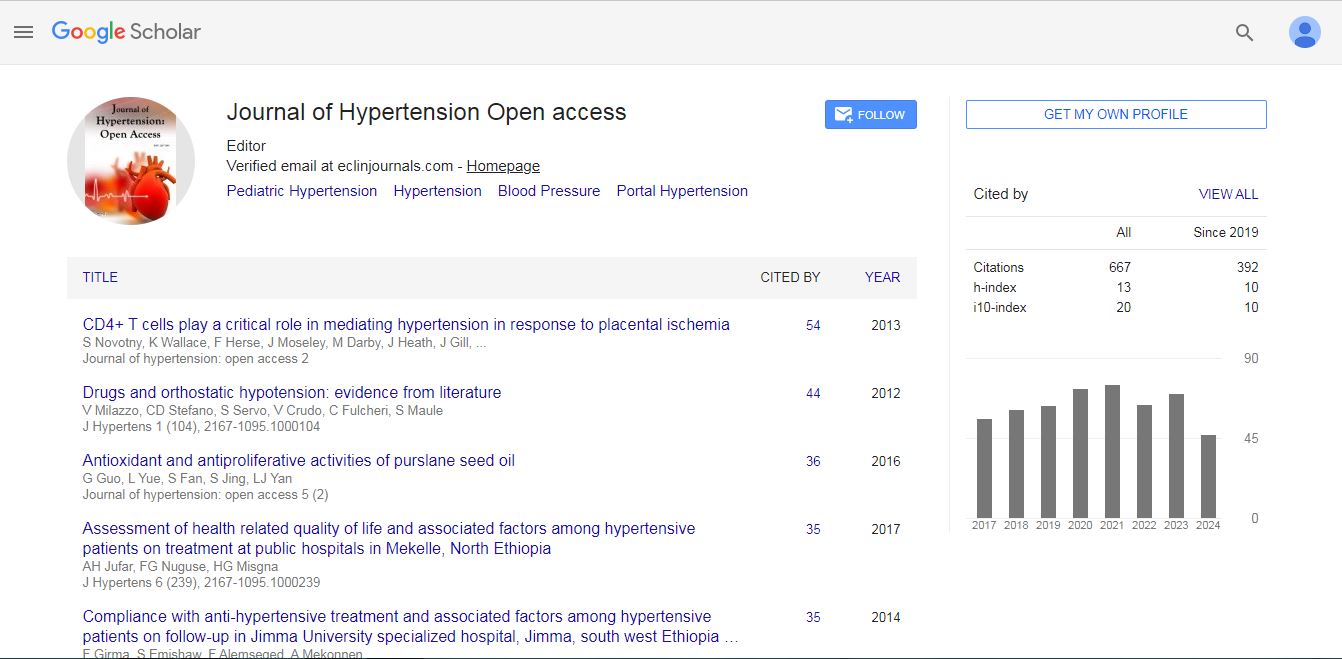
Journal of Hypertension: Open Access received 614 citations as per Google Scholar report