Short Communication - (2025) Volume 14, Issue 3
Received: 01-May-2025, Manuscript No. jtsm-26-179533;
Editor assigned: 05-May-2025, Pre QC No. P-179533;
Reviewed: 19-May-2025, QC No. Q-179533;
Revised: 22-May-2025, Manuscript No. R-179533;
Published:
29-May-2025
, DOI: 10.37421/2167-0919.2025.14.505
Citation: Okoye, Daniel. ”Telecommunications: Evolving Strategies for Digital Revenue.” J Telecommun Syst Manage 14 (2025):505.
Copyright: © 2025 Okoye D. This is an open-access article distributed under the terms of the Creative Commons Attribution License, which permits unrestricted use, distribution and reproduction in any medium, provided the original author and source are credited.
The telecommunications sector is undergoing a profound transformation, necessitating adaptive strategies for business models and revenue management. Companies are shifting from traditional voice and data services to integrated digital solutions, underscoring the critical role of data analytics, personalized offerings, and flexible pricing to maximize revenue and customer lifetime value. Emerging technologies such as 5G and the Internet of Things (IoT) are significantly impacting these evolving strategies [1].
The complexities of revenue assurance are amplified by sophisticated service offerings and intensifying competition. Advanced analytical techniques and robust system architectures are indispensable for identifying revenue leakage and optimizing revenue streams. A proactive approach to revenue management, deeply integrated into operational processes, is therefore recommended to navigate these challenges effectively [2].
The deployment of 5G technology presents a significant catalyst for change in telecommunications business models and revenue generation. Enhanced capabilities of 5G, including ultra-low latency and massive connectivity, open new service avenues that require strategic monetization. Consequently, strategic partnerships and innovative service packaging are essential to fully capitalize on the opportunities presented by the 5G era [3].
Optimizing customer lifetime value (CLV) stands out as a pivotal revenue management strategy within the telecommunications landscape. Developing frameworks to predict CLV and design targeted marketing campaigns and service bundles is crucial for bolstering customer retention and increasing Average Revenue Per User (ARPU). A data-driven understanding of customer behavior is paramount to achieving these objectives [4].
Navigating the competitive telecommunications market demands sophisticated pricing strategies. Dynamic pricing, bundled offers, and personalized discounts are key instruments for attracting and retaining subscribers while concurrently maximizing profitability. Effective price management is contingent upon robust market segmentation and competitive intelligence [5].
The telecommunications business model is increasingly embracing an ecosystem approach, extending services beyond core connectivity. Telcos are forging partnerships with content providers, cloud services, and IoT platforms to cultivate novel revenue streams and enrich customer value propositions. Agile platform development and effective ecosystem governance are vital for success in this domain [6].
Artificial intelligence (AI) and machine learning (ML) are emerging as critical enablers for advanced revenue management in telecommunications. Applications range from predictive churn analysis and personalized recommendations to fraud detection and network optimization, all contributing to enhanced service delivery and revenue generation. AI/ML tools are becoming indispensable for maintaining a competitive edge [7].
Regulatory frameworks exert a substantial influence on telecommunications business models and revenue management strategies. Policy decisions concerning spectrum allocation, market competition, and data privacy directly shape strategic choices and revenue-generating potential. Fostering regulatory environments that champion innovation while ensuring fair competition is a key consideration [8].
The Internet of Things (IoT) presents a significant strategic frontier for telecommunications business models and revenue management. New service opportunities, including connectivity management, data analytics platforms, and vertical-specific solutions, can be leveraged by telcos. Developing tailored IoT strategies is crucial for capturing these emerging revenue streams [9].
Over-The-Top (OTT) services pose considerable challenges and opportunities for traditional telecommunications revenue. Telcos must devise strategies to compete with or collaborate with OTT players, develop convergent services, and utilize their network infrastructure to create new value. Adaptive business models that embrace digital transformation are essential for navigating this evolving landscape [10].
Telecommunications companies are actively engaged in evolving their business models and revenue management practices to adapt to a dynamic market environment. This involves a strategic pivot from traditional voice and data services towards more integrated digital solutions. The emphasis is placed on leveraging data analytics, tailoring personalized offerings, and implementing flexible pricing structures to achieve optimal revenue generation and enhance customer lifetime value. Furthermore, the influence of burgeoning technologies like 5G and IoT on these strategic adaptations is a key area of focus [1].
Revenue assurance within the telecommunications sector faces significant challenges and opportunities, especially with the proliferation of complex service offerings and heightened market competition. The implementation of advanced analytical techniques and the establishment of robust system architectures are identified as crucial components for effectively detecting revenue leakage and optimizing revenue streams. A proactive stance on revenue management, deeply embedded within operational workflows, is suggested as a best practice [2].
The substantial impact of 5G deployment on the business models and revenue generation capabilities of telecommunications operators is a subject of ongoing investigation. The research explores the novel service opportunities that arise from 5G's advanced capabilities, such as ultra-low latency and extensive connectivity, and how these can be effectively monetized. The importance of cultivating strategic partnerships and developing innovative service packages is highlighted as essential for harnessing the full potential of the 5G era [3].
Customer lifetime value (CLV) optimization is presented as a cornerstone revenue management strategy for telecommunications firms. The development and application of a framework for predicting CLV, coupled with the design of targeted marketing campaigns and service bundles, are critical for improving customer retention rates and increasing Average Revenue Per User (ARPU). The findings strongly advocate for a data-driven approach to understanding customer behavior as the primary driver for success [4].
Examining strategic pricing is crucial for driving revenue growth within the highly competitive telecommunications industry. Analysis reveals that dynamic pricing models, comprehensive bundled offers, and personalized discount schemes can be effectively utilized to attract and retain subscribers, thereby maximizing overall profitability. Market segmentation and diligent competitive intelligence play vital roles in the efficacy of price management strategies [5].
The telecommunications sector is witnessing a trend towards transforming business models to incorporate an ecosystem approach, integrating services that extend beyond fundamental connectivity. Telecommunication companies are actively partnering with content providers, cloud service providers, and IoT platforms to unlock new revenue streams and enhance their customer value propositions. The development of agile platforms and robust ecosystem governance are emphasized as critical factors for this transformation [6].
Artificial intelligence (AI) and machine learning (ML) are increasingly vital tools for enhancing revenue management strategies in telecommunications. Their applications span predictive churn analysis, personalized product recommendations, sophisticated fraud detection, and optimized network performance, all contributing to improved service delivery and increased revenue. The research underscores AI/ML as indispensable assets for gaining a competitive advantage [7].
The influence of regulatory frameworks on the business models and revenue management strategies within the telecommunications industry is a critical area of study. Policy decisions related to spectrum allocation, competitive market dynamics, and data privacy significantly affect strategic decision-making and revenue generation prospects. The authors support regulatory environments that promote innovation while ensuring a level playing field for all participants [8].
This article investigates the strategic implications of the Internet of Things (IoT) for telecommunications business models and revenue management. It identifies a range of new service opportunities, including sophisticated connectivity management, data analytics platforms, and sector-specific solutions, that telecommunications providers can capitalize on. The research stresses the necessity of formulating tailored IoT strategies to effectively capture these emerging revenue streams [9].
The impact of Over-The-Top (OTT) services on traditional telecommunications revenue streams presents both challenges and opportunities. The study analyzes various strategies telecommunications companies can adopt, including competition or collaboration with OTT players, the development of convergent services, and leveraging existing network infrastructure to create new value propositions. The need for adaptive business models that embrace digital transformation is highlighted [10].
Telecommunications companies are adapting their business models and revenue management strategies to navigate a changing market, shifting towards integrated digital solutions driven by data analytics, personalization, and flexible pricing. Emerging technologies like 5G and IoT are reshaping these strategies. Revenue assurance is crucial due to complex services and competition, requiring advanced analytics and proactive management. 5G offers new monetization opportunities through enhanced capabilities, necessitating strategic partnerships. Optimizing customer lifetime value (CLV) is key to retention and ARPU growth, driven by a data-centric understanding of customer behavior. Strategic pricing, dynamic offers, and market segmentation are vital for profitability. An ecosystem approach, integrating services beyond connectivity, is transforming business models. AI and ML are essential for advanced revenue management, including churn prediction and personalization. Regulatory frameworks significantly influence strategic choices, with a need for innovation-friendly policies. IoT presents new service opportunities for revenue generation, requiring tailored strategies. The challenge of OTT services demands adaptive business models and collaboration or competition strategies.
None
None
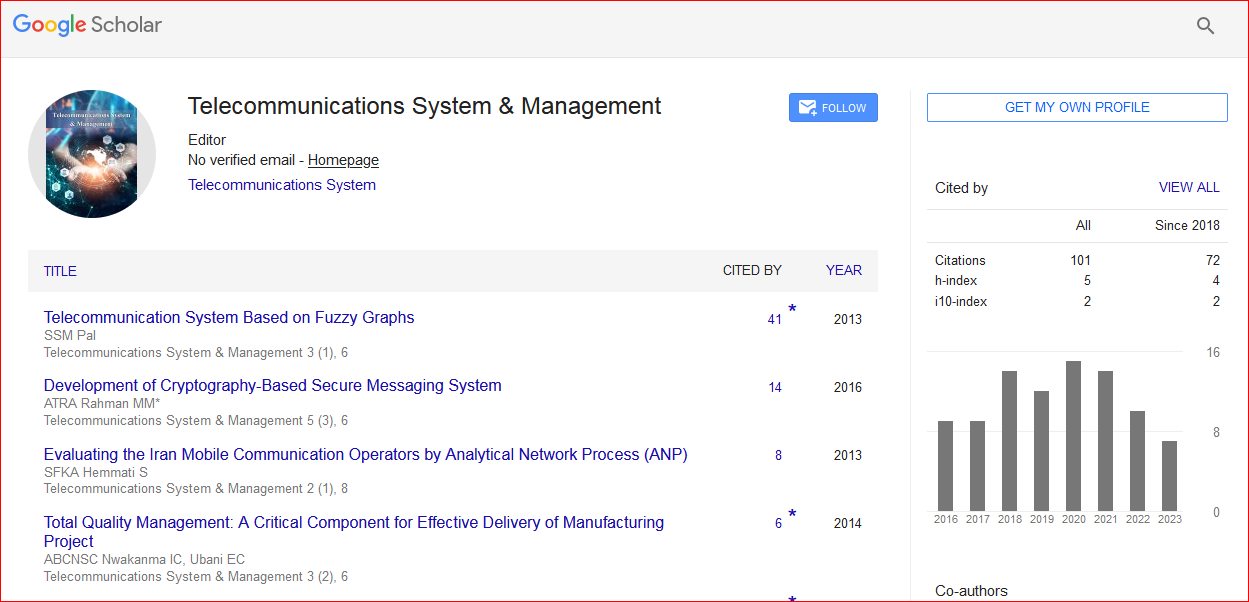
Telecommunications System & Management received 109 citations as per Google Scholar report