Brief Report - (2025) Volume 14, Issue 6
Received: 01-Nov-2025, Manuscript No. jtsm-26-179595;
Editor assigned: 03-Nov-2025, Pre QC No. P-179595;
Reviewed: 17-Nov-2025, QC No. Q-179595;
Revised: 24-Nov-2025, Manuscript No. R-179595;
Published:
29-Nov-2025
, DOI: 10.37421/2167-0919.2025.14.525
Citation: Ibrahim, Sara. ”Telecom OSS/BSS: Modernization, AI, and Digital Transformation.” J Telecommun Syst Manage 14 (2025):525.
Copyright: © 2025 Ibrahim S. This is an open-access article distributed under the terms of the Creative Commons Attribution License, which permits unrestricted use,
distribution and reproduction in any medium, provided the original author and source are credited.
The telecommunications industry is undergoing a profound transformation, driven by the relentless pursuit of enhanced service agility, operational efficiency, and superior customer experiences. At the heart of this evolution lies the critical integration and modernization of Operations Support Systems (OSS) and Business Support Systems (BSS) [1].
The strategic imperatives for telecommunication companies to modernize their OSS/BSS infrastructure are increasingly evident as they aim to support novel service offerings such as the Internet of Things (IoT) and edge computing, which demand greater flexibility and responsiveness [2].
Artificial intelligence and machine learning are emerging as pivotal technologies for the automation of telecom operations, offering unprecedented capabilities in optimizing network performance and predicting failures within OSS/BSS frameworks [3].
Cloud computing is fundamentally reshaping the OSS/BSS landscape, providing the essential flexibility and scalability required for modern telecommunications services through cloud-native architectures and microservices [4].
Furthermore, the strategic utilization of data analytics within modern OSS/BSS is paramount, enabling telecommunication operators to derive actionable insights from vast amounts of network and customer data for service improvement and business growth [5].
A unified approach to OSS and BSS is crucial for establishing a cohesive operational and business view, facilitating effective end-to-end service lifecycle management from initial provisioning through to billing and customer care [6].
The adoption of Agile and DevOps principles is accelerating the development and operational efficiency of OSS/BSS, leading to faster release cycles and enhanced responsiveness to evolving business demands [7].
Digital transformation is inextricably linked to the evolution of OSS/BSS, necessitating the embrace of digital technologies, data-driven decision-making, and a customer-centric mindset to maintain competitiveness [8].
Service orchestration plays a vital role in modern OSS/BSS architectures, enabling dynamic service provisioning and management by integrating diverse network functions and business processes [9].
Finally, the integration of legacy OSS/BSS systems with new digital platforms presents significant challenges, requiring carefully crafted strategies for gradual migration, data harmonization, and ensuring business continuity during this critical transition [10].
The evolving landscape of Telecom Operations Support Systems (OSS) and Business Support Systems (BSS) necessitates a focus on their integration and modernization to empower telecommunication operators. This includes enhancing service agility, improving operational efficiency, and elevating the overall customer experience through a strategic shift towards cloud-native architectures, AI-driven automation, and advanced data analytics for proactive issue resolution and personalized service delivery in complex network environments [1].
Telecommunication companies face strategic imperatives to update their OSS/BSS infrastructure to effectively support emerging services like IoT and edge computing. Overcoming challenges associated with legacy systems, data silos, and the need for agile development practices is crucial for the rapid deployment and management of these innovative services [2].
Research highlights the profound impact of artificial intelligence and machine learning on automating telecom operations. These technologies enable optimization of network performance, predictive failure analysis, enhanced customer service via intelligent chatbots, and streamlined business processes within existing OSS/BSS frameworks [3].
The role of cloud computing in bolstering the flexibility and scalability of OSS/BSS solutions is significant. Cloud-native architectures, microservices, and DevOps practices empower telecommunication companies to adapt swiftly to market dynamics and achieve reductions in operational costs [4].
The application of big data analytics within modern OSS/BSS frameworks is critical for telecommunication operators. By leveraging data from network operations and customer interactions, companies can gain valuable insights to improve service quality and stimulate business growth [5].
A unified approach to OSS and BSS functions is essential for creating a singular perspective on operations and business activities. This cohesive strategy is vital for effective management of the entire service lifecycle, encompassing provisioning, activation, billing, and customer support [6].
DevOps principles and agile methodologies are instrumental in the development and operation of OSS/BSS. Their implementation leads to accelerated release cycles, fostering better collaboration between development and operations teams and increasing responsiveness to diverse business needs [7].
Digital transformation profoundly influences the evolution of OSS/BSS. Telecommunication companies must actively embrace digital technologies, adopt data-driven decision-making processes, and prioritize customer-centric strategies to thrive in a competitive market [8].
Service orchestration stands out as a key enabler within contemporary OSS/BSS architectures. It facilitates dynamic service provisioning and management through sophisticated orchestration layers that seamlessly integrate various network functions and business processes [9].
Integrating legacy OSS/BSS systems with newer digital platforms presents considerable challenges, but also opportunities. Successful integration strategies involve gradual migration, effective data harmonization, and robust measures to ensure business continuity throughout the transition process [10].
This collection of research explores the critical advancements and transformations occurring within Telecom Operations Support Systems (OSS) and Business Support Systems (BSS). Key themes include the integration of OSS and BSS for enhanced agility and customer experience, the modernization of these systems to support new services like IoT, and the significant role of Artificial Intelligence and Machine Learning in automating operations. The adoption of cloud-native architectures and microservices is highlighted for improving flexibility and scalability, while data analytics is crucial for deriving actionable insights. The importance of a unified OSS/BSS approach for end-to-end service lifecycle management is emphasized, alongside the benefits of Agile and DevOps practices in development and operations. Digital transformation and service orchestration are also identified as key drivers for competitive telecommunication companies. Finally, strategies for integrating legacy systems with modern digital platforms are discussed, addressing the associated challenges.
None
None
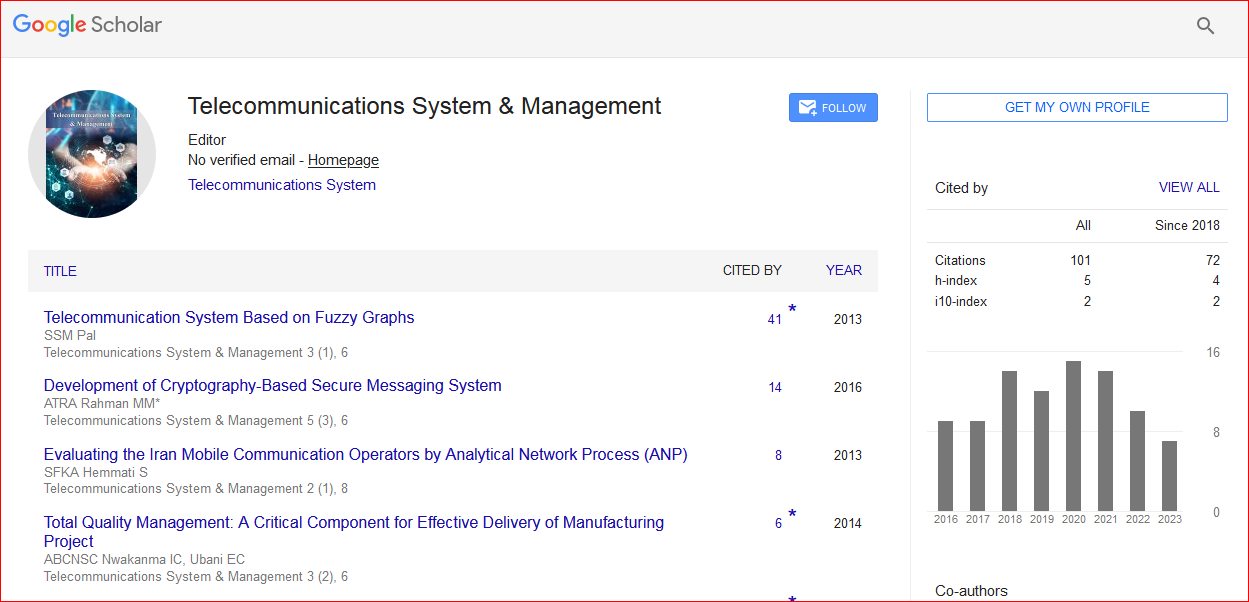
Telecommunications System & Management received 109 citations as per Google Scholar report