Commentary - (2025) Volume 14, Issue 6
Received: 01-Nov-2025, Manuscript No. jtsm-26-179599;
Editor assigned: 03-Nov-2025, Pre QC No. P-179599;
Reviewed: 17-Nov-2025, QC No. Q-179599;
Revised: 24-Nov-2025, Manuscript No. R-179599;
Published:
29-Nov-2025
, DOI: 10.37421/2167-0919.2025.14.529
Citation: Moyo, Tawanda. ”Telecom Governance: Navigating Regulations, Privacy, and Innovation.” J Telecommun Syst Manage 14 (2025):529.
Copyright: © 2025 Moyo T. This is an open-access article distributed under the terms of the Creative Commons Attribution License, which permits unrestricted use, distribution
and reproduction in any medium, provided the original author and source are credited.
The telecommunications sector operates within an increasingly intricate and dynamic environment, necessitating robust governance and compliance frameworks to ensure operational integrity and public trust. These structures are paramount for navigating the complex regulatory landscape, safeguarding data privacy, and upholding service quality amidst evolving technological advancements. The imperative for adaptive policies is thus undeniable, especially as new technologies introduce novel challenges and opportunities [1].
Data protection regulations, exemplified by GDPR, have profoundly reshaped the operational strategies of telecommunications providers. The adoption of best practices in data anonymization, diligent consent management, and swift incident response is not merely a legal obligation but a strategic advantage, fostering customer confidence and mitigating significant legal risks in this digital era [2].
In parallel, the escalating threat landscape demands a proactive approach to cybersecurity governance within telecommunications networks. Implementing multi-layered security strategies and leveraging regulatory frameworks are crucial for driving essential investments in resilience and adapting to emerging threats effectively [3].
The evolution of telecommunications infrastructure is intrinsically linked to the regulatory frameworks that govern it. Policies concerning spectrum management, net neutrality, and market competition significantly influence the pace of innovation, the accessibility of markets, and the successful deployment of advanced services [4].
Ethical considerations are increasingly central to responsible telecommunications management. Issues surrounding privacy, surveillance, and equitable accessibility require a deep integration of ethical principles into corporate governance to ensure that service provision is not only compliant but also morally sound and trustworthy [5].
The rapid advancements in 5G technology and the proliferation of the Internet of Things (IoT) present telecommunications companies with new compliance frontiers. Adapting strategies to address novel challenges in data security, network resilience, and regulatory alignment for these emerging technologies is a critical undertaking [6].
Within telecommunications organizations, internal audit functions play a pivotal role in reinforcing governance and compliance. Through systematic risk assessment, control testing, and transparent reporting, these functions enhance accountability and drive operational efficiencies throughout the organization [7].
The advent of artificial intelligence (AI) introduces a new paradigm for governance and compliance in telecommunications. Addressing AI ethics, mitigating data bias, and establishing robust regulatory oversight for AI-driven services are essential for responsible deployment and public acceptance [8].
Cross-border telecommunications management presents unique challenges and opportunities related to international regulatory harmonization, effective data flow management, and adherence to global compliance standards. Collaborative approaches among nations are vital for seamless global operations [9].
Mergers and acquisitions within the telecommunications industry introduce significant governance and compliance complexities. Navigating regulatory scrutiny, managing integration challenges, and maintaining uninterrupted compliance during and after major corporate transformations require meticulous strategic planning [10].
The telecommunications sector is characterized by its complex operational environment, which is heavily influenced by evolving technologies and stringent regulatory demands. Robust governance and compliance frameworks are indispensable for telecommunications management, serving as the bedrock for navigating the multifaceted regulatory landscape, ensuring the utmost data privacy for users, and consistently maintaining high standards of service quality. The continuous evolution of technology mandates adaptive policies to preserve trust and operational integrity within this critical industry [1].
Data protection regulations, such as the General Data Protection Regulation (GDPR), exert a substantial influence on the operational strategies adopted by telecommunications providers. The implementation of best practices, including comprehensive data anonymization techniques, meticulous consent management protocols, and effective incident response mechanisms, is crucial. Adherence to these practices not only ensures compliance but also cultivates customer confidence and significantly mitigates potential legal risks in the current digital age [2].
Cybersecurity governance is a paramount concern for telecommunications networks, especially given the ever-changing threat landscape. Research highlights the critical need for implementing effective strategies that encompass multi-layered security approaches. Furthermore, regulatory frameworks play a vital role in incentivizing cybersecurity investments and bolstering the resilience of network infrastructures against sophisticated attacks [3].
The ongoing development and deployment of telecommunications infrastructure are intrinsically shaped by the regulatory frameworks that oversee them. Key areas such as spectrum management, the principles of net neutrality, and the policies governing market competition have profound implications. These regulations directly impact the capacity for innovation, the ease of market entry for new players, and the successful delivery of cutting-edge services to consumers [4].
Ethical considerations are increasingly recognized as a fundamental component of responsible telecommunications management. Critical issues pertaining to user privacy, surveillance practices, and the equitable accessibility of services necessitate the integration of ethical principles into the very fabric of corporate governance. This integration ensures that service provision is conducted responsibly and fosters sustained public trust [5].
The rapid pace of technological advancement, particularly in the realm of 5G technology and the Internet of Things (IoT), presents telecommunications companies with a new set of compliance challenges. These companies must adeptly adapt their compliance strategies to address emerging concerns related to data security, network resilience, and the alignment of regulations with these innovative technologies [6].
Within the organizational structure of telecommunications companies, internal audit functions are essential for upholding governance and compliance standards. These functions employ systematic methodologies for risk assessment, rigorous control testing, and clear reporting structures, all of which are instrumental in enhancing accountability and optimizing operational efficiency [7].
The integration of artificial intelligence (AI) into telecommunications operations introduces novel dimensions to governance and compliance. Key areas requiring attention include the ethical implications of AI, the potential for data bias in AI algorithms, and the necessity for regulatory oversight of AI-driven services. Developing strategies for the responsible deployment of AI is therefore imperative [8].
Telecommunications management on a global scale involves navigating intricate challenges and leveraging diverse opportunities. International regulatory harmonization, efficient data flow management across borders, and the adoption of universally recognized compliance standards are critical. Collaborative efforts among nations are essential to address these global complexities [9].
Mergers and acquisitions (M&A) in the telecommunications sector introduce substantial complexities related to governance and compliance. Companies must contend with rigorous regulatory scrutiny, overcome integration challenges, and implement robust strategies to ensure compliance is maintained throughout the M&A process and its aftermath [10].
This collection of articles examines the critical role of governance and compliance frameworks in telecommunications management. It highlights how robust structures are essential for navigating complex regulations, ensuring data privacy, and maintaining service quality in the face of evolving technologies. The impact of data protection regulations like GDPR, cybersecurity governance, and ethical considerations are explored, emphasizing their role in fostering customer confidence and mitigating risks. The research also delves into the influence of regulatory frameworks on innovation, the challenges of compliance with 5G and IoT, and the importance of internal audit functions. Furthermore, it addresses the implications of artificial intelligence, cross-border operations, and mergers and acquisitions on governance and compliance, advocating for adaptive policies and collaborative approaches to uphold trust and operational integrity in the telecommunications sector.
None
None
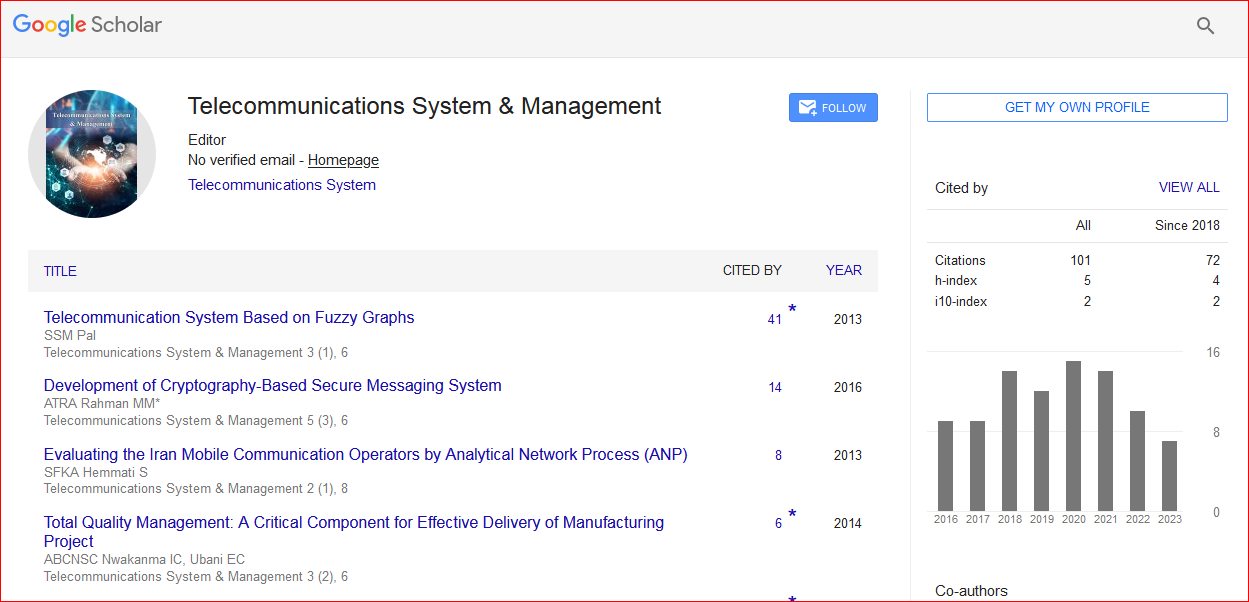
Telecommunications System & Management received 109 citations as per Google Scholar report