Short Communication - (2025) Volume 15, Issue 6
Received: 01-Dec-2025, Manuscript No. mccr-25-178209;
Editor assigned: 03-Dec-2025, Pre QC No. P-178209;
Reviewed: 17-Dec-2025, QC No. Q-178209;
Revised: 22-Dec-2025, Manuscript No. R-178209;
Published:
29-Dec-2025
, DOI: 10.37421/2161-0444.2025.15.816
Citation: Al-Khalid, Fatima. ”Targeting Protein-Protein Interactions For Drug Discovery.” Med Chem 15 (2025):816.
Copyright: © 2025 Al-Khalid F. This is an open-access article distributed under the terms of the Creative Commons Attribution License, which permits unrestricted use, distribution and reproduction in any medium, provided the original author and source are credited.
Chemical modulation of protein-protein interactions (PPIs) represents a critical and expanding frontier in drug design, offering a means to address previously intractable therapeutic targets. The ability of small molecules and peptides to disrupt or stabilize specific PPIs provides a powerful mechanism to impact disease pathways, moving beyond traditional drug modalities [1].
Developing small molecules that can effectively modulate protein-protein interactions (PPIs) presents a significant and ongoing challenge in the field of medicinal chemistry. The interfaces of PPIs are often characterized by their large surface areas and relatively flat, featureless landscapes, which traditionally lack the well-defined binding pockets that are typically favored by conventional small-molecule drugs [2].
The disruption of specific protein-protein interactions (PPIs) stands out as a particularly promising strategy for therapeutic intervention in a wide array of diseases. This approach involves a deep dive into the chemical strategies that are being employed to achieve the precise modulation of these interactions, including the sophisticated design of both small molecules and peptidomimetics [3].
Protein-protein interactions (PPIs) are absolutely fundamental to virtually all cellular functions, and their aberrant modulation or dysregulation is a key driver in the pathogenesis of numerous diseases. In this context, chemical biology has rapidly emerged as a powerful and indispensable tool for dissecting, understanding, and ultimately controlling these intricate interactions [4].
The immense therapeutic potential inherent in targeting protein-protein interactions (PPIs) is becoming increasingly apparent, opening up entirely new avenues for treating diseases where conventional drug targets are either limited or have proven refractory to existing therapies. This field encompasses a broad spectrum of chemical strategies aimed at modulating PPIs, ranging from small molecules to peptides and even macrocycles [5].
Modulating protein-protein interactions (PPIs) with small molecules signifies a fundamental paradigm shift in the landscape of drug discovery. This shift necessitates an understanding of the key challenges and exciting opportunities that lie within this burgeoning field, requiring innovative approaches to drug design and development [6].
The intricate nature of protein-protein interactions (PPIs) poses a significant and compelling frontier for the discipline of medicinal chemistry. This area of research involves a detailed examination of the chemical strategies that are being utilized to either disrupt or stabilize these critical interactions, with a particular focus on the development of novel small molecules and peptide mimetics [7].
Targeting protein-protein interactions (PPIs) is rapidly solidifying its position as an emerging and highly promising area within the broader discipline of drug design. This area of research is actively exploring the fundamental chemical principles and has witnessed recent breakthroughs in the development of small molecules specifically engineered to modulate these critical biological events [8].
The chemical modulation of protein-protein interactions (PPIs) offers a distinct and compelling advantage in the realm of drug design, fundamentally enabling the targeting of complex biological pathways that have historically been resistant to more traditional drug discovery approaches. This review specifically focuses on the chemical strategies and methodologies that are being employed to design small molecules capable of either inhibiting or stabilizing PPIs [9].
Interfering with protein-protein interactions (PPIs) represents a critically important and rapidly advancing area of research within medicinal chemistry, with the ultimate goal of developing entirely novel therapeutic agents. This research highlights recent and significant progress in the chemical design of both small molecules and peptides that possess the ability to modulate PPIs [10].
Chemical modulation of protein-protein interactions (PPIs) is a critical area in drug design, offering a way to target previously undruggable proteins. Small molecules and peptides can disrupt or stabilize specific PPIs, impacting disease pathways. Recent advancements focus on understanding the intricate binding interfaces and developing targeted chemical probes. This approach holds promise for treating a wide range of diseases, including cancer, infectious diseases, and neurological disorders, by offering novel therapeutic avenues beyond traditional enzyme inhibitors or receptor agonists/antagonists. Key challenges include achieving high specificity, cell permeability, and bioavailability [1].
Developing small molecules that can modulate protein-protein interactions (PPIs) is a significant challenge in medicinal chemistry. These interfaces are often large and flat, lacking the well-defined pockets favored by traditional drugs. However, computational approaches, fragment-based drug discovery, and novel screening techniques are enabling progress. Focusing on transient or allosteric interactions can offer more druggable targets. The goal is to design molecules that can precisely interfere with disease-relevant protein assemblies [2].
The disruption of specific protein-protein interactions (PPIs) represents a promising strategy for therapeutic intervention. This review delves into the chemical strategies employed to achieve this, including the design of small molecules and peptidomimetics. It highlights advances in understanding the biophysical basis of PPIs and the development of screening assays for identifying modulators. The focus is on translating these molecular insights into viable drug candidates for various diseases [3].
Protein-protein interactions (PPIs) are fundamental to cellular function, and their aberrant modulation drives many diseases. Chemical biology has emerged as a powerful tool for dissecting and controlling these interactions. This work explores the design principles and successful examples of small molecules that act as PPI inhibitors or stabilizers. It emphasizes the importance of structural biology and computational modeling in guiding the development of these novel therapeutics [4].
The therapeutic potential of targeting protein-protein interactions (PPIs) is immense, offering new avenues for treating diseases where traditional targets are limited. This article reviews the landscape of chemical strategies for modulating PPIs, encompassing small molecules, peptides, and macrocycles. It discusses the challenges associated with achieving specificity and efficacy, as well as the advancements in drug discovery platforms that are accelerating the identification of PPI modulators. The focus is on the translation of chemical insights into clinical applications [5].
Modulating protein-protein interactions (PPIs) with small molecules represents a paradigm shift in drug discovery. This article provides an overview of the key challenges and opportunities in this field. It highlights the importance of understanding the structural determinants of PPIs and the development of innovative chemical scaffolds. Furthermore, it discusses the emerging role of artificial intelligence and machine learning in accelerating the design of PPI-targeting drugs, aiming for greater selectivity and reduced off-target effects [6].
The intricate nature of protein-protein interactions (PPIs) presents a significant frontier for medicinal chemistry. This review examines the chemical strategies used to disrupt or stabilize PPIs, focusing on the development of small molecules and peptide mimetics. It underscores the crucial role of structural biology and biophysical techniques in characterizing PPI interfaces and guiding drug design. The article also touches upon the therapeutic implications for various diseases and the ongoing efforts to overcome drug-likeness challenges [7].
Targeting protein-protein interactions (PPIs) is an emerging and highly promising area in drug design. This article explores the chemical principles and recent breakthroughs in developing small molecules that can modulate these critical biological events. It highlights innovative chemical scaffolds and design strategies that address the inherent challenges of PPI interfaces, such as their large surface area and lack of defined binding pockets. The potential impact on treating diseases like cancer and neurodegenerative disorders is emphasized [8].
The chemical modulation of protein-protein interactions (PPIs) offers a distinct advantage in drug design, enabling the targeting of complex biological pathways that are not amenable to traditional drug discovery approaches. This review focuses on the chemical strategies and methodologies employed to design small molecules that can either inhibit or stabilize PPIs. It discusses the application of these strategies in various disease contexts and the continuous evolution of techniques to overcome the inherent challenges of PPI modulation [9].
Interfering with protein-protein interactions (PPIs) is a significant area of research in medicinal chemistry aimed at developing novel therapeutics. This article highlights recent progress in the chemical design of small molecules and peptides that can modulate PPIs. It emphasizes the importance of structure-based drug design and the development of high-throughput screening methods to identify potent and selective PPI modulators. The potential for treating a wide range of diseases is a driving force behind this field [10].
Targeting protein-protein interactions (PPIs) through chemical modulation is a critical area in drug design, offering novel therapeutic avenues for diseases previously considered undruggable. Small molecules and peptides are being developed to disrupt or stabilize these interactions. Challenges include the large, flat nature of PPI interfaces and achieving specificity. Advancements in computational approaches, fragment-based drug discovery, and screening techniques are enabling progress. Research focuses on understanding binding interfaces and designing targeted probes. Potential applications span cancer, infectious diseases, and neurological disorders. Innovative chemical scaffolds, AI, and machine learning are accelerating the design of more selective and effective PPI modulators. The field is translating molecular insights into clinical applications.
None
None
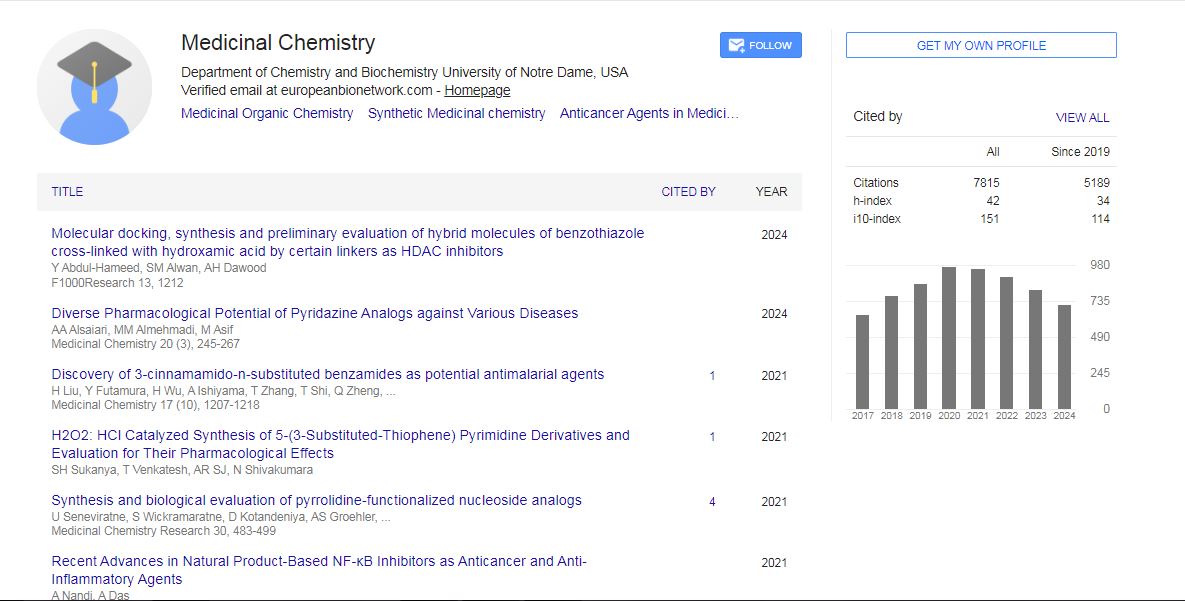
Medicinal Chemistry received 6627 citations as per Google Scholar report