Opinion - (2025) Volume 10, Issue 4
Received: 01-Aug-2025, Manuscript No. jomp-26-185100;
Editor assigned: 04-Aug-2025, Pre QC No. P-185100;
Reviewed: 18-Aug-2025, QC No. Q-185100;
Revised: 23-Aug-2025, Manuscript No. R-185100;
Published:
29-Aug-2025
, DOI: 10.37421/2576-3857.2025.10.317
Citation: Lindberg, Marcus. ”Targeting Ovarian Cancer Stem Cells for Better Outcomes.” J Oncol Med and Pract 10 (2025):317.
Copyright: © 2025 Lindberg M. This is an open-access article distributed under the terms of the Creative Commons Attribution License, which permits unrestricted use, distribution and reproduction in any medium, provided the original author and source are credited.
The critical role of cancer stem cells (CSCs) in the initiation, progression, and recurrence of ovarian carcinoma is a significant area of research, with specific markers and signaling pathways defining these persistent cell populations. These characteristics, including their association with therapeutic resistance, underscore the need for targeted strategies. Early research has identified key markers such as SOX2, OCT4, and ALDH1, which are instrumental in defining and maintaining CSC properties in ovarian cancer. Their implications in treatment failure are profound, necessitating a deeper understanding of their biological functions [1].
The dysregulation of aldehyde dehydrogenase 1 family member A1 (ALDH1A1), a well-established marker for cancer stem cells, has been specifically investigated in high-grade serous ovarian cancer (HGSOC). Elevated ALDH1A1 expression is demonstrably linked to chemoresistance and a poorer prognosis, highlighting its significance as a prognostic indicator and a potential therapeutic target. Studies are exploring the therapeutic potential of inhibiting ALDH1A1 activity to overcome established resistance mechanisms in ovarian cancer models, suggesting this approach could enhance treatment efficacy [2].
The Wnt/β-catenin signaling pathway has emerged as a crucial regulator in maintaining the stemness of ovarian cancer cells. Aberrant activation of this pathway is a driving force behind CSC self-renewal and their remarkable resistance to chemotherapy. Consequently, targeting specific components of the Wnt pathway is being proposed as a method to disrupt CSC function and sensitize ovarian tumors to conventional therapies, offering a novel avenue for treatment [3].
Furthermore, the metabolic vulnerabilities of ovarian cancer stem cells present unique opportunities for therapeutic intervention. CSCs exhibit distinct metabolic profiles, characterized by increased glycolysis and oxidative phosphorylation, which are essential for their survival and self-renewal capabilities. Research is focused on exploiting these metabolic pathways with targeted drugs to achieve selective elimination of CSCs, thereby impacting tumor growth and recurrence [4].
SOX2, a key pluripotency factor, plays a pivotal role in driving stemness and conferring therapeutic resistance in ovarian cancer. Overexpression of SOX2 has been shown to promote CSC characteristics and endow cells with resistance to chemotherapy. Consequently, inhibiting SOX2 expression or its downstream targets is being explored as a promising strategy to overcome treatment failure and improve patient outcomes in ovarian cancer [5].
Beyond intrinsic cellular mechanisms, the tumor microenvironment (TME) in ovarian cancer significantly supports cancer stem cell survival and niche formation. Modulating components of the TME, such as immune cells and the extracellular matrix, can indirectly impact CSC populations. This modulation holds the potential to enhance the efficacy of CSC-targeting therapies by creating a less supportive environment for these cells [6].
Another critical pluripotency factor, OCT4, is essential for the maintenance and expansion of ovarian cancer stem cells (CSCs). OCT4 is indispensable for CSC self-renewal and their resistance to platinum-based chemotherapy, a cornerstone treatment for ovarian cancer. Targeting OCT4 or its associated signaling network is therefore considered a vital strategy to improve treatment outcomes and overcome resistance [7].
The concept of targeting the CSC niche in ovarian cancer is gaining traction. The microenvironmental factors that support CSCs are critical for their survival and function. Strategies aimed at disrupting these niches, including the inhibition of specific signaling pathways or targeting stromal cells within the niche, are being investigated. Disrupting the niche can render CSCs more susceptible to conventional therapies and potentially prevent tumor recurrence [8].
Immunotherapy represents an emerging and promising frontier in targeting cancer stem cells (CSCs) within the context of ovarian cancer. CSCs possess mechanisms to evade immune surveillance, but various immunotherapeutic approaches, such as checkpoint inhibitors and adoptive cell therapy, are being adapted. These approaches aim to specifically eliminate CSCs, thereby improving the durability of treatment responses and long-term patient benefit [9].
Finally, targeted therapies, particularly small molecule inhibitors, show significant promise for eradicating ovarian cancer stem cells (CSCs). These inhibitors are designed to disrupt specific signaling pathways essential for CSC maintenance. By interfering with these pathways, these agents can induce CSC apoptosis and reduce tumor regrowth, highlighting the potential of precision medicine in addressing CSC-driven ovarian cancer [10].
Cancer stem cells (CSCs) are recognized as a critical driver of ovarian carcinoma initiation, progression, and recurrence, necessitating a comprehensive understanding of their unique biological characteristics and the development of effective therapeutic strategies. Key markers such as SOX2, OCT4, and ALDH1 are instrumental in defining these cells and are closely linked to their resistance to conventional treatments. Emerging strategies aim to specifically target these CSC populations to improve patient outcomes by eradicating these persistent cells, including the development of small molecule inhibitors, antibodies, and combination therapies [1].
A significant focus in ovarian cancer research is the role of ALDH1A1, a key marker for CSCs, particularly in high-grade serous ovarian cancer (HGSOC). Studies have consistently shown that elevated ALDH1A1 expression correlates with increased chemoresistance and a poorer overall prognosis. Consequently, the therapeutic potential of targeting ALDH1A1 activity is being actively investigated as a viable strategy to overcome resistance mechanisms and enhance the efficacy of existing treatments in ovarian cancer models [2].
The Wnt/β-catenin signaling pathway plays a fundamental role in maintaining the stemness properties of ovarian cancer cells, including their capacity for self-renewal and their inherent resistance to chemotherapy. Aberrant activation of this pathway has been identified as a major contributor to these CSC characteristics. Research efforts are therefore directed towards targeting specific components of the Wnt pathway to disrupt CSC function and sensitize ovarian tumors to conventional therapeutic modalities [3].
Metabolic reprogramming is another critical aspect of ovarian cancer stem cell biology that presents potential therapeutic vulnerabilities. CSCs exhibit distinct metabolic profiles, often characterized by enhanced glycolysis and oxidative phosphorylation, which are crucial for supporting their survival and self-renewal. Exploiting these unique metabolic pathways with targeted pharmacological agents offers a promising avenue for the selective elimination of CSCs, thereby impacting tumor growth and preventing relapse [4].
SOX2, a critical pluripotency factor, is implicated in driving stemness characteristics and conferring therapeutic resistance in ovarian cancer. Evidence suggests that SOX2 overexpression actively promotes CSC phenotypes and imparts resistance to chemotherapy. Inhibiting SOX2 expression or its downstream signaling cascades is being explored as a potent strategy to overcome treatment failure and improve therapeutic responses in ovarian cancer patients [5].
The tumor microenvironment (TME) profoundly influences the behavior of ovarian cancer stem cells, providing essential support for their survival and niche formation. Strategies that aim to modulate the TME, such as targeting specific immune cells or components of the extracellular matrix, can indirectly impact CSC populations. Such TME-directed approaches may enhance the overall efficacy of therapies designed to directly target CSCs [6].
OCT4, another key pluripotency factor, is vital for the maintenance and expansion of ovarian cancer stem cells (CSCs). Its role in CSC self-renewal and resistance to platinum-based chemotherapy, a standard treatment for ovarian cancer, is well-established. Consequently, targeting OCT4 or its associated signaling network is considered a crucial strategy for overcoming therapeutic resistance and improving patient outcomes in ovarian cancer [7].
The concept of targeting the CSC niche is a rapidly evolving area in ovarian cancer therapy. The microenvironmental factors within the niche are critical for CSC maintenance and survival. Strategies to disrupt these niches, including the inhibition of key signaling pathways or the targeting of stromal cells, are being developed. Disrupting the CSC niche can potentially sensitize CSCs to conventional treatments and inhibit tumor recurrence [8].
Immunotherapy is emerging as a powerful tool for targeting cancer stem cells (CSCs) in ovarian cancer. CSCs often employ mechanisms to evade immune detection, but advances in immunotherapy, including checkpoint inhibitors and adoptive cell therapy, are being refined. These refined approaches aim to specifically eliminate CSCs, leading to more durable and effective responses in patients [9].
Targeted therapies, particularly small molecule inhibitors, offer a precise approach to eradicating ovarian cancer stem cells (CSCs). These inhibitors are designed to interfere with essential signaling pathways that govern CSC maintenance and survival. By disrupting these pathways, targeted agents can induce CSC apoptosis and suppress tumor regrowth, underscoring the potential of precision medicine in managing CSC-driven ovarian cancer [10].
Ovarian cancer stem cells (CSCs) play a crucial role in disease initiation, progression, and recurrence, often exhibiting resistance to conventional therapies. Key markers like SOX2, OCT4, and ALDH1 are associated with CSC properties and therapeutic resistance. Strategies to combat ovarian cancer are increasingly focusing on targeting these CSCs directly or indirectly. This includes developing inhibitors for specific signaling pathways such as Wnt/β-catenin, exploiting metabolic vulnerabilities, and targeting the CSC niche. Immunotherapy and small molecule inhibitors are also being explored as promising avenues for CSC eradication. Understanding and targeting these CSC-specific mechanisms offers a potential pathway to improve treatment efficacy and patient outcomes.
None
None
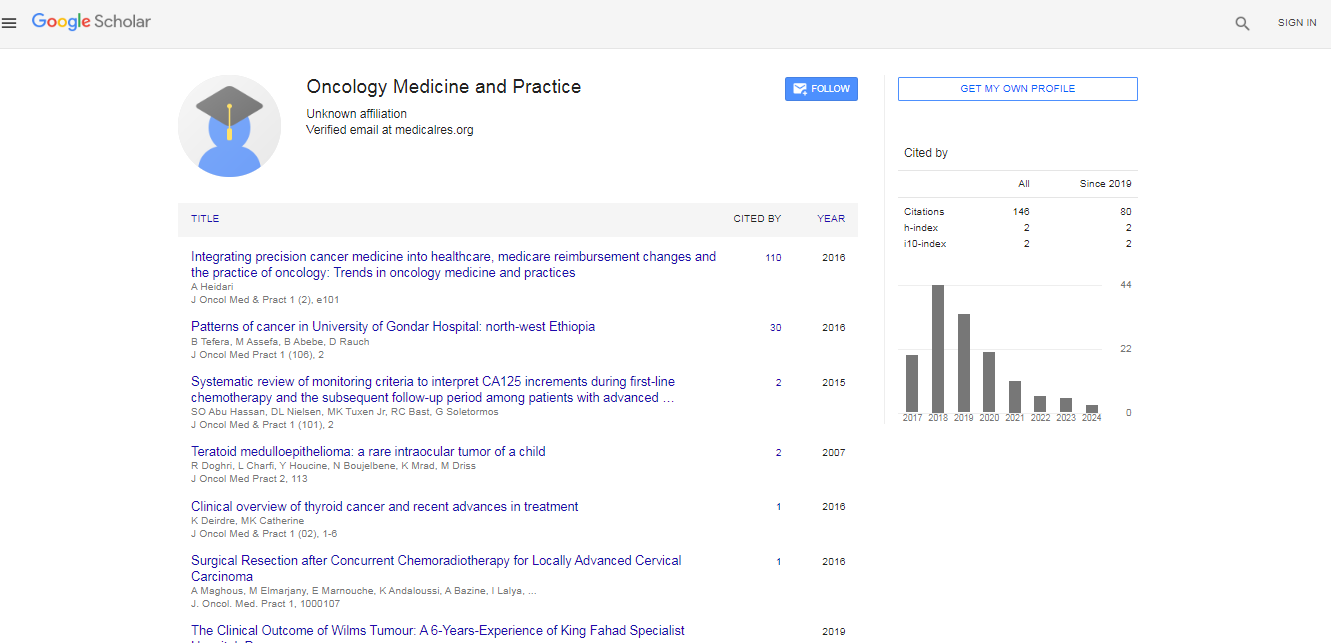
Journal of Oncology Medicine & Practice received 142 citations as per Google Scholar report