Perspective - (2025) Volume 10, Issue 5
Received: 01-Oct-2025, Manuscript No. jomp-26-185128;
Editor assigned: 03-Oct-2025, Pre QC No. P-185128;
Reviewed: 17-Oct-2025, QC No. Q-185128;
Revised: 22-Oct-2025, Manuscript No. R-185128;
Published:
29-Oct-2025
, DOI: 10.37421/2576-3857.2025.10.330
Citation: Dubois, Chloe. ”Targeted Therapies Advance Gastric Cancer Treatment.” J Oncol Med and Pract 10 (2025):330.
Copyright: © 2025 Dubois C. This is an open-access article distributed under the terms of the Creative Commons Attribution License, which permits unrestricted use, distribution and reproduction in any medium, provided the original author and source are credited.
The field of oncology is continually advancing, with a significant focus on the development of targeted therapies for complex diseases such as gastric cancer. High-throughput screening (HTS) has emerged as a pivotal technology in this endeavor, enabling the rapid identification of novel therapeutic agents. This approach allows researchers to sift through vast chemical libraries to find compounds with the potential to inhibit key molecular players in cancer progression. The application of HTS in gastric cancer research is particularly crucial due to the heterogeneity of the disease and the unmet need for more effective treatments [1].
Understanding the molecular underpinnings of gastric cancer is fundamental to the design of targeted therapies. This involves dissecting the intricate signaling pathways that drive tumor growth and survival. Advances in molecular profiling have shed light on actionable genetic alterations, providing a rationale for the development of specific inhibitors. These insights are transforming the way gastric cancer is approached, moving towards more personalized treatment strategies tailored to the individual patient's genetic makeup [2].
The journey of kinase inhibitor drug discovery for gastric cancer is multifaceted, encompassing early-stage research through to clinical application. A comprehensive understanding of the current landscape is vital, including the various classes of inhibitors, their mechanisms of action, and their performance in clinical trials. Furthermore, recognizing and addressing challenges such as drug resistance and the exploration of combination therapies are essential for maximizing therapeutic benefit [3].
Precision medicine is revolutionizing cancer treatment, and the discovery of novel kinase inhibitors exemplifies this paradigm. The development of inhibitors that target specific signaling pathways implicated in gastric cancer growth is a testament to this approach. Preclinical data demonstrating potent efficacy are critical for guiding these agents into clinical trials, offering hope for new therapeutic options [4].
Receptor tyrosine kinases (RTKs) play a significant role in the pathogenesis of gastric cancer, making them attractive therapeutic targets. Research focusing on the evaluation of RTK inhibitors in both in vitro and in vivo models provides valuable insights. These studies help in identifying potential drug targets and developing biomarkers that can aid in patient selection for targeted therapies, thereby enhancing treatment effectiveness [5].
While HTS offers immense potential, its application in complex cancers like gastric cancer presents unique challenges and opportunities. Various screening platforms and computational approaches are employed to identify promising drug candidates. The integration of omics data is increasingly important for enhancing target identification and accelerating the drug discovery process in this challenging disease [6].
One of the most significant hurdles in the efficacy of kinase inhibitors is the development of resistance. Gastric cancer patients often develop acquired resistance through genetic and epigenetic alterations. Understanding these resistance mechanisms is crucial for developing strategies to overcome them, including the design of next-generation inhibitors and the implementation of combination therapies [7].
The tumor microenvironment (TME) is increasingly recognized as a critical determinant of therapeutic response in gastric cancer. The complex interplay between tumor cells and their surrounding microenvironment can significantly influence the efficacy of kinase inhibitors. Strategies aimed at modulating the TME are being explored to improve treatment outcomes and overcome treatment failures [8].
Clinical validation is the ultimate test for any novel therapeutic agent. Phase I/II clinical trials are essential for evaluating the safety, tolerability, and preliminary efficacy of new kinase inhibitors. These studies provide crucial data for patients with advanced gastric cancer, particularly those with limited treatment options, offering potential new avenues for management [9].
The landscape of targeted therapies for gastric cancer is constantly evolving, with kinase inhibitors at the forefront. The importance of biomarker-driven therapy cannot be overstated, as it ensures that the right patients receive the most effective treatments. The continuous role of HTS in identifying new targets and therapeutic agents will undoubtedly shape the future of gastric cancer treatment [10].
High-throughput screening (HTS) plays a vital role in discovering novel kinase inhibitors for gastric cancer treatment. This method addresses the challenges and advancements in screening methodologies specifically designed for this complex disease, including target validation and assay development. The findings suggest that HTS can accelerate the discovery of effective targeted therapies, aiming to improve patient outcomes [1].
The molecular characteristics of gastric cancer are being investigated to identify actionable genetic alterations and their impact on targeted therapy. Various kinases involved in tumor progression and survival are discussed, providing a scientific basis for kinase inhibitor development. The research emphasizes the necessity of personalized treatment strategies guided by molecular profiling [2].
A review of kinase inhibitor drug discovery and development for gastric cancer synthesizes current knowledge. It examines different inhibitor classes, their mechanisms of action, and clinical trial results. The article also addresses challenges such as drug resistance and highlights the significance of combination therapies [3].
The development and validation of a novel kinase inhibitor targeting a specific signaling pathway crucial for gastric cancer growth are detailed. Preclinical data showcase its efficacy, supporting its progression into clinical trials and underscoring a precision medicine approach in oncology [4].
Specific receptor tyrosine kinases (RTKs) in gastric cancer and the efficacy of RTK inhibitors are investigated. Data from in vitro and in vivo models offer insights into potential therapeutic targets and biomarkers for patient selection, contributing to more targeted treatment strategies [5].
The application of HTS for drug discovery in complex cancers like gastric cancer presents both challenges and opportunities. The article explores various screening platforms and computational methods used to identify promising drug candidates, emphasizing the integration of omics data for improved target identification [6].
Mechanisms of resistance to kinase inhibitors in gastric cancer are examined. The study delves into genetic and epigenetic factors that contribute to acquired resistance and proposes strategies to overcome these issues, including the use of combination therapies and next-generation inhibitors [7].
The tumor microenvironment (TME) in gastric cancer is explored for its role in disease progression and response to therapies, including kinase inhibitors. The article discusses how TME components affect drug efficacy and outlines strategies for modulating the TME to achieve better treatment outcomes [8].
A phase I/II clinical trial assessing a novel kinase inhibitor in advanced gastric cancer patients is reported. The study presents data on safety, tolerability, and initial efficacy, suggesting its potential for patients with limited treatment choices [9].
A comprehensive review of current targeted therapies for gastric cancer, with a focus on kinase inhibitors, is provided. The importance of biomarker-driven therapy and the evolving role of HTS in identifying new targets and therapeutic agents are discussed [10].
This collection of research highlights advancements in targeted therapies for gastric cancer, particularly focusing on kinase inhibitors. High-throughput screening (HTS) is presented as a crucial tool for identifying novel drug candidates, accelerating the discovery process. The molecular landscape of gastric cancer is being elucidated to inform personalized treatment strategies based on genetic profiling. Research details the development and preclinical evaluation of specific kinase inhibitors, alongside investigations into the role of receptor tyrosine kinases. Challenges such as drug resistance mechanisms and the influence of the tumor microenvironment are addressed, with proposed strategies including combination therapies and next-generation inhibitors. Clinical trials are evaluating the safety and efficacy of new agents, offering hope for patients with advanced disease. The ongoing evolution of targeted therapies, driven by molecular insights and HTS, promises improved outcomes for gastric cancer patients.
None
None
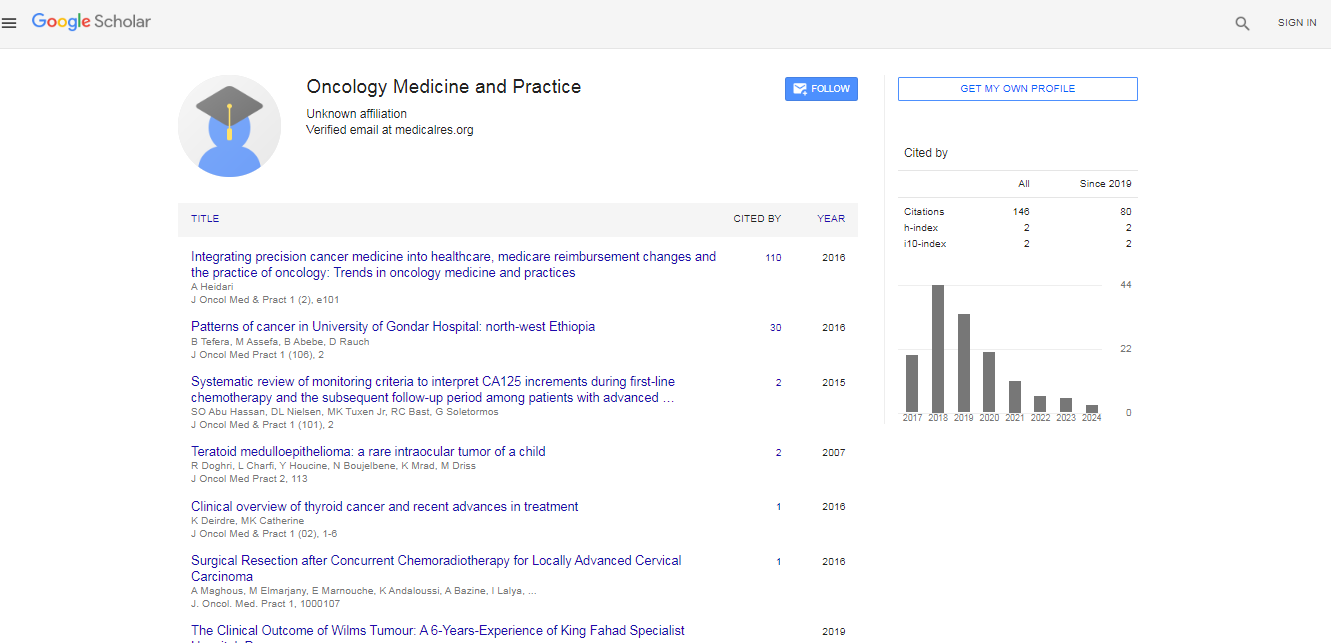
Journal of Oncology Medicine & Practice received 142 citations as per Google Scholar report