Brief Report - (2025) Volume 10, Issue 2
Received: 01-Apr-2025, Manuscript No. jomp-26-185076;
Editor assigned: 03-Apr-2025, Pre QC No. P-185076;
Reviewed: 17-Apr-2025, QC No. Q-185076;
Revised: 22-Apr-2025, Manuscript No. R-185076;
Published:
29-Apr-2025
, DOI: 10.37421/2576-3857.2025.10.295
Citation: Santos, Fernando. ”TAMs Drive Pancreatic Cancer: A Therapeutic Target.” J Oncol Med & Pract 10 (2025):295.
Copyright: © 2025 Santos F. This is an open-access article distributed under the terms of the Creative Commons Attribution License, which permits unrestricted use, distribution and reproduction in any medium, provided the original author and source are credited.
Tumor-associated macrophages (TAMs) are integral to the progression of pancreatic ductal adenocarcinoma (PDAC), profoundly influencing its pathogenesis. Their multifaceted roles encompass the suppression of anti-tumor immunity, the stimulation of tumor growth and invasion, and the promotion of angiogenesis, all of which contribute to the complex malignancy of PDAC [1].
The functional polarization of TAMs within the PDAC microenvironment is a critical determinant of disease outcome, largely governing the balance between pro-tumorigenic (M2-like) and anti-tumorigenic (M1-like) phenotypes. Consequently, strategies designed to reprogram TAMs towards an anti-tumorigenic state are actively being explored for their potential to bolster immune surveillance and enhance therapeutic efficacy [2].
A significant contribution of TAMs to the PDAC tumor microenvironment involves the secretion of immunosuppressive factors, notably Interleukin-10 (IL-10) and Transforming Growth Factor-beta (TGF-β). These cytokines effectively inhibit the activity of cytotoxic T cells and Natural Killer (NK) cells, thereby facilitating immune evasion by cancer cells and hindering their detection and destruction [3].
The prevalence of M2-like TAMs within PDAC is consistently linked to adverse prognostic indicators, including a poorer patient outlook and increased resistance to both conventional chemotherapy and immunotherapy. This underscores the potential of targeting TAMs as a vital strategy to surmount treatment resistance in PDAC [4].
Furthermore, TAMs actively participate in the promotion of epithelial-to-mesenchymal transition (EMT) in PDAC. This cellular process significantly augments tumor cell invasiveness and metastatic potential, as TAMs secrete soluble factors that directly drive EMT, thereby accelerating disease progression [5].
Angiogenesis, the formation of new blood vessels, is a process heavily modulated by TAMs in PDAC. Through the secretion of pro-angiogenic factors such as Vascular Endothelial Growth Factor (VEGF), TAMs contribute to the development of a dense yet dysfunctional tumor vasculature, which paradoxically supports tumor growth and facilitates metastasis [6].
The metabolic landscape of TAMs plays a crucial role in dictating their functions within the PDAC microenvironment. Emerging research suggests that targeting these specific metabolic pathways could represent a novel and effective approach to modulate TAM activity and ultimately improve therapeutic outcomes for patients [7].
Therapeutic interventions aimed at TAMs in PDAC are diverse and include strategies focused on depleting these cells, inhibiting their recruitment to the tumor site, and reprogramming their functional phenotype. Promising results have emerged from combination therapies that integrate TAM-targeting agents with established treatments like chemotherapy or immunotherapy [8].
The intricate spatial organization of TAMs within the PDAC microenvironment, along with their complex interactions with other stromal cells, is paramount to disease progression. A deeper understanding of these spatial relationships holds the key to identifying novel therapeutic targets and developing more effective treatment strategies [9].
In addition to their direct roles in immune modulation and tumor promotion, TAMs also contribute to the characteristic desmoplastic stroma of PDAC. This fibrotic stromal component can impede the penetration of therapeutic agents and the infiltration of immune cells, suggesting that targeting TAM-stroma interactions may be a promising avenue to enhance treatment delivery and efficacy [10].
Tumor-associated macrophages (TAMs) are recognized as critical cellular components within the tumor microenvironment of pancreatic ductal adenocarcinoma (PDAC), significantly influencing its progression and clinical trajectory. Their involvement spans multiple aspects of tumorigenesis, including the modulation of the immune response, support for tumor cell proliferation and dissemination, orchestration of new blood vessel formation, and contribution to resistance against therapeutic interventions [1].
The phenotype and functional state of TAMs are not uniform; rather, they exhibit considerable plasticity, with polarization towards M2-like (immunosuppressive and pro-tumor) or M1-like (anti-tumorigenic) phenotypes occurring within the PDAC milieu. Strategies that aim to reverse this polarization, steering TAMs towards an anti-tumorigenic state, are considered promising for reactivating anti-tumor immunity and amplifying the effectiveness of existing therapies [2].
One of the key mechanisms by which TAMs foster tumor progression is through the release of immunosuppressive cytokines, such as IL-10 and TGF-β. These soluble mediators actively dampen the cytotoxic capacity of effector immune cells, including T lymphocytes and NK cells, thereby creating an immune-tolerant environment that allows cancer cells to evade immune surveillance and destruction [3].
Clinically, a high abundance of M2-like TAMs in PDAC tumors is strongly associated with unfavorable prognoses and a diminished response to both chemotherapy and immunotherapy. This correlation highlights the potential therapeutic value of targeting TAMs to overcome acquired or intrinsic resistance mechanisms that limit treatment efficacy [4].
Beyond immune modulation, TAMs contribute to the aggressive nature of PDAC by promoting epithelial-to-mesenchymal transition (EMT). This process, critical for cancer cell dissemination, is actively supported by TAM-derived factors that induce a more migratory and invasive phenotype in tumor cells, facilitating their spread to distant sites [5].
The vascularization of PDAC tumors is also significantly influenced by TAMs. They secrete growth factors like VEGF that promote angiogenesis, leading to the formation of a tumor vasculature that, while supporting tumor growth, is often abnormal and leaky, further complicating treatment delivery and contributing to metastasis [6].
The metabolic activities of TAMs are intrinsically linked to their functions within the tumor microenvironment. Recent studies have illuminated the importance of TAM metabolic reprogramming, suggesting that targeting these metabolic pathways could offer novel therapeutic avenues for modulating TAM behavior and enhancing treatment outcomes [7].
Current research into TAM-centric therapies for PDAC encompasses a range of approaches, including strategies to reduce TAM numbers, inhibit their infiltration into tumors, and modify their pro-tumorigenic functions. The combination of these TAM-targeting agents with standard therapies is showing considerable promise in preclinical and early clinical studies [8].
The spatial distribution and cellular interactions of TAMs within the complex PDAC microenvironment are crucial determinants of disease progression. Understanding these intricate spatial relationships and their impact on interactions with other stromal and cancer cells is essential for uncovering new vulnerabilities and therapeutic targets [9].
Moreover, TAMs play a role in shaping the fibrotic stroma that is characteristic of PDAC. This dense stromal matrix can act as a physical barrier, hindering the penetration of systemically administered drugs and limiting the access of immune cells to the tumor. Therefore, targeting TAM-stroma crosstalk may represent a significant strategy to improve the efficacy of both chemotherapeutic and immunotherapeutic agents [10].
Tumor-associated macrophages (TAMs) are key contributors to pancreatic ductal adenocarcinoma (PDAC) progression. They promote immune suppression, tumor growth, invasion, angiogenesis, and therapeutic resistance. TAM heterogeneity and plasticity are crucial for developing effective anti-PDAC strategies. The polarization of TAMs towards M2-like phenotypes is linked to poor prognosis and treatment resistance. TAMs secrete immunosuppressive factors like IL-10 and TGF-β, inhibit anti-tumor immunity, and promote epithelial-to-mesenchymal transition (EMT) to enhance invasiveness and metastasis. They also drive angiogenesis through VEGF secretion and contribute to the desmoplastic stroma, impeding drug delivery. Targeting TAMs through depletion, recruitment inhibition, or reprogramming, often in combination therapies, shows promise. Understanding TAM metabolic reprogramming and their spatial interactions within the tumor microenvironment are critical for developing novel therapeutic interventions.
None
None
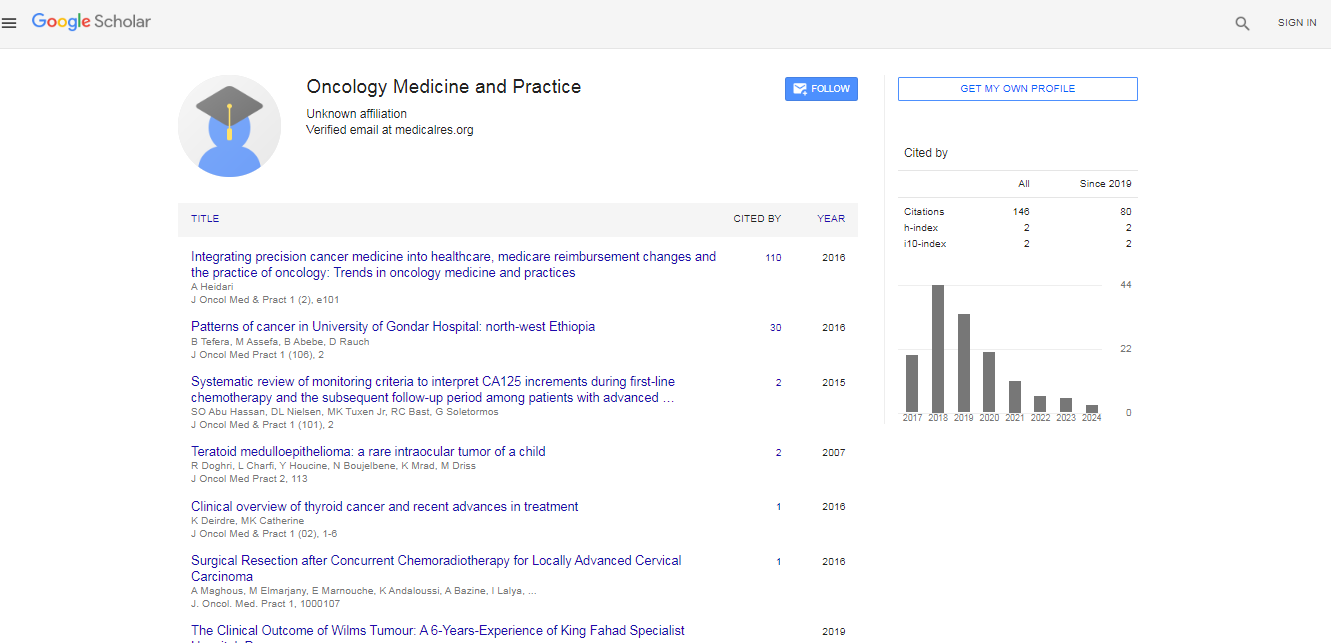
Journal of Oncology Medicine & Practice received 142 citations as per Google Scholar report