Brief Report - (2025) Volume 11, Issue 6
Received: 01-Dec-2025, Manuscript No. abp-25-178158;
Editor assigned: 03-Dec-2025, Pre QC No. P-178158;
Reviewed: 17-Dec-2025, QC No. Q-178158;
Revised: 22-Dec-2025, Manuscript No. R-178158;
Published:
29-Dec-2025
, DOI: 10.37421/2472-0496.2025.11.351
Citation: Peterson, Liam. ”Tailoring SSD Care: From Genes to Literacy.” Abnorm Behav Psychol 11 (2025):351.
Copyright: © 2025 Peterson L. This is an open-access article distributed under the terms of the Creative Commons Attribution License, which permits unrestricted use, distribution and reproduction in any medium, provided the original author and source are credited.
This article systematically reviews intervention approaches for children with speech sound disorder. It highlights that while various evidence-based practices exist, there's still a need for more research directly comparing the effectiveness of different methods and tailoring interventions to specific profiles of SSD. What this really means is, finding the best way to help each child often requires a careful look at what works and what doesn't across the board, and a lot of the time, the research doesn't give us a clear 'one size fits all' answer [1].
This review explores the genetic underpinnings of speech sound disorders, emphasizing that genetics play a significant role in their etiology. It points out that while several candidate genes have been identified, the genetic landscape is complex, often involving multiple genes and environmental interactions. Here's the thing, understanding the specific genetic contributions could lead to more targeted diagnostics and interventions down the line [2].
This systematic review and meta-analysis investigates the common co-occurrence of speech sound disorders and language disorders in preschool children. It reveals a high rate of comorbidity, suggesting that clinicians should routinely screen for both conditions when one is identified. What this really means is, if a child has trouble with speech sounds, it's highly likely they might also have broader language challenges, and we need to check for both to give them the best support [3].
This scoping review examines the diagnostic accuracy of various assessment tools used for speech sound disorders. It highlights a need for more robust evidence on the validity and reliability of many commonly used instruments. Let's break it down: clinicians rely on these tools daily, but we often lack comprehensive data to confidently say how accurate and consistent they are across different populations [4].
This systematic review and meta-analysis explores the relationship between speech sound disorders and phonological awareness skills in children. It confirms that children with SSD often exhibit poorer phonological awareness, which has implications for their literacy development. What this means is, addressing speech sound issues isn't just about clearer speech; it's also crucial for laying the groundwork for reading and writing success [5].
This systematic review investigates the neurological underpinnings of developmental speech sound disorders, looking at brain structure and function differences. It suggests that specific neural networks involved in speech motor planning and execution may be atypical in children with SSD. Here's the thing, understanding these brain differences helps us move beyond just observable speech errors to target the root causes, potentially leading to more effective, neurologically informed interventions [6].
This scoping review addresses speech sound disorders in children from culturally and linguistically diverse backgrounds. It highlights the complexities of distinguishing between typical second language acquisition patterns and true speech sound disorders, advocating for culturally sensitive and linguistically appropriate assessment and intervention practices. What this really means is, we can't just apply a one-size-fits-all approach; understanding a child's linguistic background is crucial to accurate diagnosis and effective support [7].
This systematic review explores the role of speech perception deficits in children with speech sound disorders. It indicates that many children with SSD also struggle with perceiving speech sounds accurately, suggesting that perception may be a contributing factor to their production difficulties. Let's break it down: sometimes, children don't just have trouble making sounds, they also have trouble hearing and distinguishing them, which is a critical piece of the puzzle for intervention [8].
This systematic review examines the long-term outcomes for children diagnosed with speech sound disorders, extending into adolescence and adulthood. It reveals that while many children improve, some continue to experience subtle speech and language difficulties, and are at higher risk for literacy and academic challenges. Here's the thing, resolving speech sound errors in early childhood doesn't always mean the end of the story; ongoing monitoring and support might be necessary for some individuals [9].
This systematic review investigates the role and effectiveness of parental involvement in interventions for children with speech sound disorders. It indicates that active parent participation can significantly enhance therapy outcomes, suggesting that clinicians should integrate parent training and home practice strategies. Let's break it down: therapy isn't just about what happens in the clinic; parents are key partners in reinforcing skills and creating a supportive learning environment at home [10].
Research systematically reviews intervention approaches for children with speech sound disorder (SSD), highlighting that while various evidence-based practices exist, more research is needed to compare their effectiveness and tailor them to specific SSD profiles [1]. This really means finding the best way to help each child often requires a careful look at what works and what doesn't, since a clear 'one size fits all' answer isn't always available in the research [1]. Complementing this, parental involvement significantly enhances therapy outcomes for children with SSD [10]. Active parent participation means clinicians should integrate parent training and home practice strategies, recognizing that therapy isn't just about what happens in the clinic; parents are key partners in reinforcing skills and creating a supportive learning environment at home [10].
The genetic underpinnings of speech sound disorders are complex, with genetics playing a significant role in their etiology, often involving multiple genes and environmental interactions [2]. Understanding these specific genetic contributions could lead to more targeted diagnostics and interventions down the line [2]. Beyond genetics, investigations into the neurological bases of developmental SSD reveal brain structure and function differences, suggesting atypical neural networks for speech motor planning and execution [6]. What this means is, understanding these brain differences helps us move beyond just observable speech errors to target the root causes, potentially leading to more effective, neurologically informed interventions [6]. Additionally, many children with SSD struggle with perceiving speech sounds accurately, indicating that perception deficits may contribute to production difficulties [8]. Let's break it down: sometimes, children don't just have trouble making sounds, they also have trouble hearing and distinguishing them, which is a critical piece of the puzzle for intervention [8].
There's a common co-occurrence of speech sound disorders and language disorders in preschool children, with a high rate of comorbidity that suggests clinicians should routinely screen for both conditions when one is identified [3]. What this really means is, if a child has trouble with speech sounds, it's highly likely they might also have broader language challenges, and we need to check for both to give them the best support [3]. Relatedly, children with SSD often exhibit poorer phonological awareness skills, which has significant implications for their literacy development [5]. Addressing speech sound issues isn't just about clearer speech; it's also crucial for laying the groundwork for reading and writing success [5].
Examining the diagnostic accuracy of various assessment tools for SSD highlights a need for more robust evidence on their validity and reliability [4]. Clinicians rely on these tools daily, but often lack comprehensive data to confidently say how accurate and consistent they are across different populations [4]. Adding to this complexity, speech sound disorders in children from culturally and linguistically diverse backgrounds require careful consideration [7]. It's challenging to distinguish between typical second language acquisition patterns and true SSD, advocating for culturally sensitive and linguistically appropriate assessment and intervention practices [7]. What this really means is, we can't just apply a one-size-fits-all approach; understanding a child's linguistic background is crucial to accurate diagnosis and effective support [7].
The long-term outcomes for children diagnosed with SSD, extending into adolescence and adulthood, reveal that while many children improve, some continue to experience subtle speech and language difficulties [9]. These individuals are at a higher risk for literacy and academic challenges [9]. Here's the thing, resolving speech sound errors in early childhood doesn't always mean the end of the story; ongoing monitoring and support might be necessary for some individuals to ensure continued success [9].
Intervention approaches for children with speech sound disorder (SSD) are varied, though more comparative research is needed to tailor methods effectively for individual profiles. This means finding the best way to help often requires a careful look at what works and what doesn't, as there isn't a clear 'one size fits all' answer. Genetics play a significant role in SSD, with a complex landscape involving multiple genes and environmental interactions. Understanding these genetic contributions could lead to more targeted diagnostics and interventions. A high rate of comorbidity exists between SSD and language disorders in preschool children, underscoring the need for routine screening of both conditions. If a child struggles with speech sounds, it's highly likely they might also have broader language challenges, necessitating comprehensive checks. Diagnostic accuracy of SSD assessment tools requires more robust evidence regarding their validity and reliability. Clinicians rely on these tools daily, but often lack comprehensive data to confirm their accuracy and consistency across diverse populations. Children with SSD frequently show poorer phonological awareness, which impacts their literacy development. Addressing speech sound issues is crucial not just for clearer speech, but also for foundational reading and writing success. The neurological underpinnings of developmental SSD involve atypical neural networks for speech motor planning and execution. Understanding these brain differences helps target root causes, leading to more effective, neurologically informed interventions. SSD in culturally and linguistically diverse children presents complexities, requiring culturally sensitive and linguistically appropriate assessment and intervention. We can't apply a one-size-fits-all approach; a child's linguistic background is vital for accurate diagnosis. Speech perception deficits are common in children with SSD, suggesting that difficulty perceiving sounds accurately contributes to production issues. Children sometimes struggle not just with making sounds, but also with hearing and distinguishing them, which is a critical piece for intervention. Long-term outcomes for children with SSD show that while many improve, some continue to experience subtle speech and language difficulties, increasing their risk for literacy and academic challenges. Resolving early speech errors doesn't always end the story; some individuals need ongoing monitoring. Parental involvement significantly enhances therapy outcomes for SSD. Active parent participation, integrated through training and home practice, means therapy extends beyond the clinic, with parents being key partners in creating a supportive learning environment.
None
None
1. Rocio R, Natalie PS, Margaret IY. "Speech Sound Disorder Intervention for Children: A Systematic Review".LSHSS 55 (2024):111-125.
Indexed at, Google Scholar, Crossref
2. Adele EJ, Simon EF, Katie LD. "The Genetics of Speech Sound Disorders: A Review".JSLHR 64 (2021):1530-1549.
Indexed at, Google Scholar, Crossref
3. Stephanie AP, Jessica HSL, Marc EF. "Comorbidity of speech sound disorders and language disorders in preschool children: A systematic review and meta-analysis".J Commun Disord 103 (2023):106323.
Indexed at, Google Scholar, Crossref
4. Caitlin MTB, Natalie PS, Margaret IY. "Diagnostic Accuracy of Speech Sound Disorder Assessment Tools: A Scoping Review".AJSLP 32 (2023):2603-2619.
Indexed at, Google Scholar, Crossref
5. Sarah V, Hanne S, Paul VH. "Phonological awareness in children with speech sound disorders: A systematic review and meta-analysis".Res Dev Disabil 120 (2022):104128.
Indexed at, Google Scholar, Crossref
6. Rebecca FS, Susan HL, Tiffany PG. "Neural bases of developmental speech sound disorders: A systematic review".Neuropsychologia 161 (2021):108031.
Indexed at, Google Scholar, Crossref
7. Patricia GS, Caitlin MTB, Margaret IY. "Speech Sound Disorders in Culturally and Linguistically Diverse Children: A Scoping Review".LSHSS 55 (2024):126-140.
Indexed at, Google Scholar, Crossref
8. Megan LO, Laura SK, Jonathan HP. "Speech perception deficits in children with speech sound disorders: A systematic review.".J Commun Disord 88 (2020):106060.
Indexed at, Google Scholar, Crossref
9. Susan HL, Rebecca FS, Elaine SS. "Long-term outcomes for children with speech sound disorders: A systematic review".JSLHR 64 (2021):3173-3190.
Indexed at, Google Scholar, Crossref
10. Sarah KK, Laura SK, Jonathan HP. "Parental Involvement in Speech Sound Disorder Interventions: A Systematic Review".J Commun Disord 97 (2022):106206.
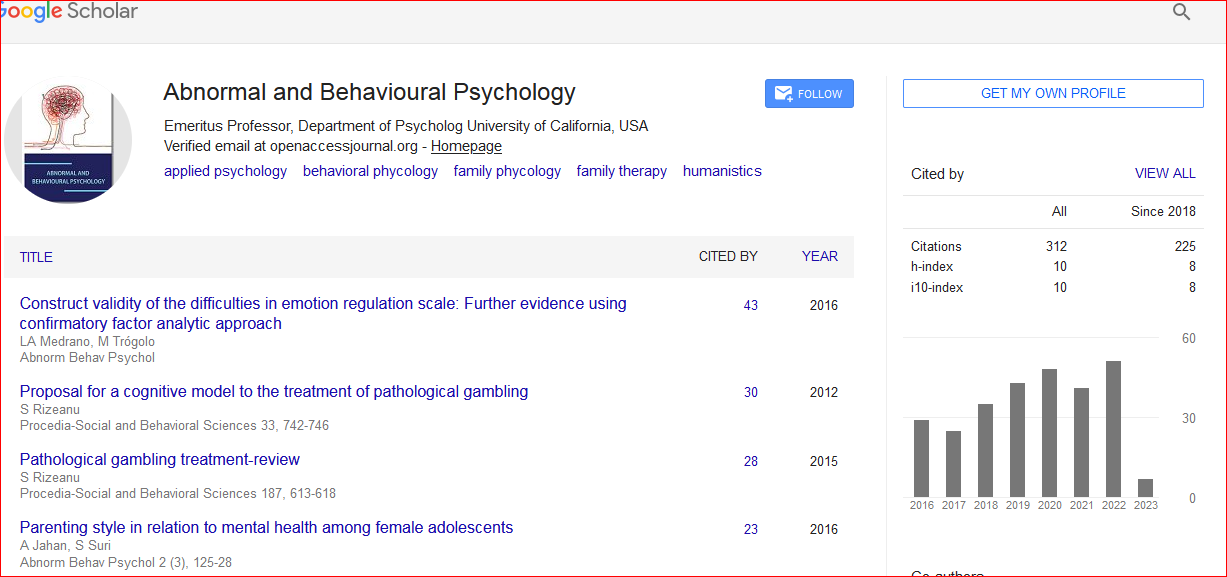
Abnormal and Behavioural Psychology received 361 citations as per Google Scholar report