Short Communication - (2025) Volume 13, Issue 6
Received: 01-Dec-2025, Manuscript No. jcdd-25-177703;
Editor assigned: 03-Dec-2025, Pre QC No. P-177703;
Reviewed: 17-Dec-2025, QC No. Q-177703;
Revised: 22-Dec-2025, Manuscript No. R-177703;
Published:
29-Dec-2025
, DOI: 10.37421/2329-9517.2025.13.707
Citation: Sofia Andersson. ”Systemic Racism and Cardiovascular
Health Disparities.” J Cardiovasc Dis Diagn 13 (2025):707.
Copyright: © 2025 A. Sofia This is an open-access article distributed under the terms of the Creative Commons Attribution License, which permits unrestricted use, distribution
and reproduction in any medium, provided the original author and source are credited.
Racial and ethnic disparities in cardiovascular disease (CVD) continue to represent a significant public health challenge in the United States. One study specifically highlights persistent racial and ethnic disparities in cardiovascular disease mortality trends, noting that despite overall improvements, these disparities persisted and, in some cases, widened for Black and Hispanic adults compared to White adults, particularly for certain cardiovascular conditions. This underscores the critical need for targeted interventions to address these ongoing inequities [1].
These disparities are not isolated incidents but are deeply intertwined with structural racism and the social determinants of health. Structural racism, acting through these social determinants, significantly contributes to cardiovascular disease disparities. Cardiovascular health professionals play a crucial role in recognizing and addressing these systemic factors, advocating for policy changes, and implementing community-based strategies to promote health equity [2].
Further emphasizing this connection, a scientific statement comprehensively reviews the profound impact of social determinants of health on cardiovascular outcomes. It outlines how factors like socioeconomic status, education, neighborhood environment, and systemic racism contribute significantly to these disparities. The statement strongly urges healthcare providers and policymakers to integrate these crucial considerations into prevention and treatment strategies to foster genuine health equity [4].
Digging deeper into specific conditions, analysis reveals persistent and concerning racial and ethnic disparities in hypertension management among U.S. adults. While overall control rates have improved over time, Black adults consistently exhibit lower control rates compared to White adults, emphasizing the need for targeted public health interventions and culturally sensitive care to effectively address these ongoing inequities [3].
Moreover, inequities are evident in the broader healthcare system. Research reveals significant racial and ethnic disparities in healthcare quality among Medicare beneficiaries, even after accounting for socioeconomic status. These findings suggest that factors beyond income, such as implicit bias and systemic inequities within the healthcare system itself, contribute to these differences, emphasizing the urgent need for comprehensive strategies to ensure truly equitable care for all [5].
Heart failure care also reflects these pervasive disparities. A statement from the American Heart Association (AHA) specifically addresses racial and ethnic disparities in heart failure care and outcomes. It details how various factors, ranging from social determinants of health to inequities in access to advanced therapies, contribute to worse prognoses for minority groups, strongly advocating for systemic changes to achieve equitable care [6].
A review of evidence consolidates information on racial and ethnic differences in atherosclerotic cardiovascular disease risk factor burden and control. It highlights how minority populations often face a higher prevalence of risk factors and poorer control rates, pointing to the complex interplay of biological, socioeconomic, and systemic factors that collectively contribute to these persistent health inequities [7].
Recognizing the urgency, an article serves as a clear call to action for addressing the profound disparities in cardiovascular disease prevention. It emphasizes that current strategies often fall short for minority and underserved populations. This calls for multi-faceted approaches that actively tackle social determinants, improve access to care, and tailor interventions to specific community needs to be effective [8].
The recent past has further underscored these issues. The COVID-19 pandemic starkly exposed and exacerbated pre-existing cardiovascular health disparities among racial and ethnic minority groups. This crisis presents a critical opportunity to implement systemic changes within healthcare and public health sectors to address the underlying social and economic inequities that drive these alarming outcomes [9].
Finally, the complexity of these disparities is further highlighted by the interplay of genetic and environmental factors. A review explores how genetic predispositions, alongside significant environmental and social determinants, collectively shape susceptibility and outcomes in ethnic disparities of cardiovascular disease. This highlights the ongoing need for comprehensive and personalized approaches in both research and clinical care to fully address these intricate challenges [10].
Racial and ethnic disparities in cardiovascular disease (CVD) represent a profound and ongoing public health crisis across the United States. Evidence consistently shows that despite overall advancements in cardiovascular health, significant gaps persist and, in some instances, are widening for specific minority groups. For example, a study examining mortality trends found that Black and Hispanic adults faced persistent or worsening disparities compared to White adults for various cardiovascular conditions, emphasizing the urgent need for targeted interventions [1]. These inequities are not limited to mortality; they are also prevalent in disease management, such as hypertension. Data reveals that Black adults continue to exhibit lower control rates for hypertension compared to White adults, highlighting the need for culturally sensitive care and specific public health initiatives [3]. Furthermore, minority populations often experience a higher prevalence of atherosclerotic cardiovascular disease risk factors and poorer control over them, indicating a complex interplay of various contributing factors [7].
The fundamental drivers of these pervasive disparities are often identified as structural racism and broader social determinants of health. Structural racism, operating through these social determinants, exerts a significant influence on cardiovascular disease disparities, demanding that cardiovascular health professionals actively recognize and address these systemic elements. This involves advocating for policy changes and implementing community-based strategies to foster health equity [2]. A comprehensive scientific statement further underscores this by detailing how factors such as socioeconomic status, educational attainment, neighborhood environment, and systemic racism are critical contributors to adverse cardiovascular outcomes. This statement strongly advocates for the integration of these considerations into all prevention and treatment strategies by healthcare providers and policymakers to achieve true health equity [4].
The impact of these systemic issues extends directly into healthcare quality and specific clinical outcomes. Research on Medicare beneficiaries, for instance, has revealed significant racial and ethnic disparities in the quality of care received, even after meticulously adjusting for socioeconomic status. This suggests that factors beyond financial standing, including implicit biases and systemic inequities embedded within the healthcare system, contribute substantially to these differences, necessitating robust and comprehensive strategies to ensure equitable care delivery for all [5]. Similarly, in the context of heart failure, a scientific statement from the American Heart Association thoroughly details how social determinants of health and unequal access to advanced therapies contribute to worse prognoses for minority groups, calling for profound systemic changes to rectify these imbalances and ensure equitable care [6].
Addressing these disparities effectively requires a robust focus on prevention and tailored interventions. A compelling call to action highlights that existing cardiovascular disease prevention strategies frequently fall short for minority and underserved populations. This necessitates the development and implementation of multi-faceted approaches designed to directly confront social determinants of health, improve equitable access to quality care, and specifically tailor interventions to meet the unique needs of diverse communities [8]. The goal here is not merely to treat disease but to proactively build healthier environments and systems.
Moreover, recent global events have starkly illuminated the fragility of health equity. The COVID-19 pandemic severely exposed and exacerbated pre-existing cardiovascular health disparities among racial and ethnic minority groups. This crisis, while tragic, also presents a pivotal opportunity for implementing wide-ranging systemic changes within both healthcare and public health infrastructures to address the underlying social and economic inequities that drive these adverse health outcomes [9]. The complexity is further compounded by biological and environmental factors; genetic predispositions, alongside significant environmental and social determinants, collectively influence susceptibility and outcomes in ethnic disparities of cardiovascular disease. This emphasizes the continuous need for comprehensive and personalized approaches in research and clinical care to fully understand and effectively mitigate these intricate challenges [10].
Racial and ethnic disparities in cardiovascular disease outcomes remain a critical public health challenge in the United States. Despite some overall improvements, mortality rates for conditions like cardiovascular disease continue to show persistent gaps, with Black and Hispanic adults often experiencing worse outcomes compared to White adults. These inequities extend to various aspects of cardiovascular health, including hypertension management, where Black adults demonstrate lower control rates, and the burden of atherosclerotic cardiovascular disease risk factors, which are often higher in minority populations. These profound disparities are not merely biological but are deeply rooted in structural racism and broader social determinants of health, such as socioeconomic status, education, neighborhood environment, and systemic inequities within the healthcare system itself. For instance, even among Medicare beneficiaries, significant differences in healthcare quality persist regardless of socioeconomic standing, suggesting factors like implicit bias contribute to unequal care. The COVID-19 pandemic further exposed and worsened these existing gaps, highlighting the urgent need for systemic change. Addressing these complex issues requires a multi-faceted approach. Cardiovascular health professionals are urged to recognize and tackle these systemic factors, advocating for policy changes and implementing community-based strategies to promote health equity. Efforts must focus on targeted public health interventions, culturally sensitive care, and improved access to advanced therapies for minority groups. Ultimately, a comprehensive strategy is needed that integrates social determinants into prevention and treatment, tailoring interventions to specific community needs and acknowledging the interplay of genetic and environmental factors. This collective understanding underscores a pressing call to action for equitable cardiovascular health.
Indexed at, Google Scholar, Crossref
Indexed at, Google Scholar, Crossref
Indexed at, Google Scholar, Crossref
Indexed at, Google Scholar, Crossref
Indexed at, Google Scholar, Crossref
Indexed at, Google Scholar, Crossref
Indexed at, Google Scholar, Crossref
Indexed at, Google Scholar, Crossref
Indexed at, Google Scholar, Crossref
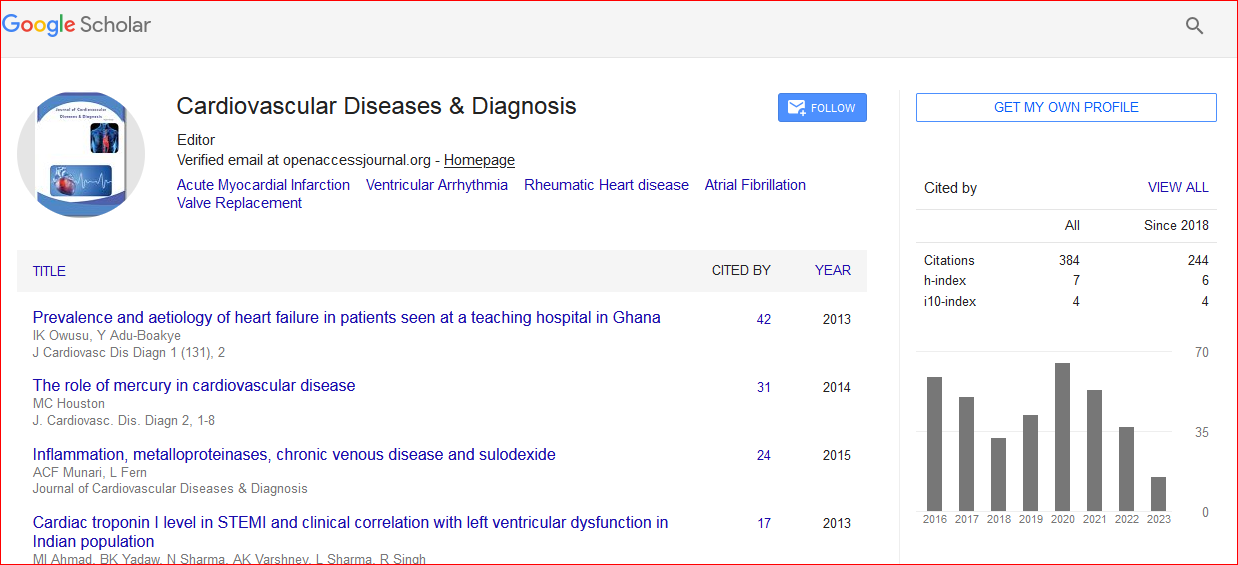
Cardiovascular Diseases & Diagnosis received 427 citations as per Google Scholar report