Perspective - (2025) Volume 11, Issue 4
Received: 01-Jun-2025, Manuscript No. jssc-26-188294;
Editor assigned: 04-Jun-2025, Pre QC No. P-188294;
Reviewed: 18-Aug-2025, QC No. Q-188294;
Revised: 22-Aug-2025, Manuscript No. R-188294;
Published:
29-Aug-2025
, DOI: 10.37421/2472-0437.2025.11.312
Citation: Morales, Diego. ”Sustainable Steel Construction: Optimized
Components for a Greener Future.” J Steel Struct Constr 11 (2025):312.
Copyright: © 2025 Morales D. This is an open-access article distributed under the terms of the Creative Commons Attribution License, which permits unrestricted use,
distribution and reproduction in any medium, provided the original author and source are credited.
The optimization of steel structural components is a critical area of research, driven by the imperative to enhance sustainability in the construction industry. Innovative approaches are being explored to reduce material consumption and minimize the environmental impact of steel structures. Lightweight designs and the advanced utilization of materials are at the forefront of these efforts, contributing to lower embodied energy and improved recyclability, aligning with principles of sustainable construction and reducing the overall environmental footprint of steel constructions[1].
The use of high-strength steel and composite materials presents a promising avenue for achieving slender yet robust structural members. This advancement allows for a significant reduction in the weight of structural elements, which in turn leads to lower transportation costs and a smaller foundation footprint. The performance benefits and structural integrity maintained with these advanced material choices are crucial for sustainable building projects[2].
A novel computational framework has been developed for the topology optimization of steel beams and columns. The primary objective of this framework is to minimize material usage while rigorously satisfying structural performance requirements under various load conditions. The optimization algorithms enable the creation of highly efficient, biomimetic steel structures that inherently reduce environmental impact[3].
The effectiveness of modular and prefabricated steel building systems in promoting sustainability is being systematically evaluated. Off-site fabrication significantly reduces construction waste, enhances quality control, and speeds up on-site assembly. This leads to fewer disruptions and a demonstrably lower carbon footprint, with further considerations for the disassembly and reuse of steel components at the end of their service life[4].
Advanced connection designs play a pivotal role in optimizing steel structures for sustainability. Innovative connections can effectively reduce material requirements, simplify assembly processes, and concurrently enhance the structural performance and longevity of steel buildings. These advancements contribute significantly to fostering a more circular economy within the construction sector[5].
The utilization of recycled steel in structural components is being thoroughly investigated, with a focus on assessing its mechanical properties and structural behavior. Research demonstrates that high-quality recycled steel can effectively replace virgin steel in numerous applications without compromising performance, thereby substantially reducing the environmental burden associated with primary steel production[6].
Generative design techniques are being applied to the creation of optimized steel structures. By exploring an extensive design space, generative design methodologies can identify novel and highly efficient forms that minimize material usage while fulfilling critical structural demands. This leads to the development of structures that are not only more sustainable but also possess enhanced aesthetic qualities[7].
The integration of Building Information Modeling (BIM) with Life Cycle Assessment (LCA) tools offers a powerful approach for optimizing steel structures. This combined methodology permits a comprehensive evaluation of environmental impacts across the entire lifecycle of a structure, thereby facilitating informed decision-making for more sustainable design and construction practices[8].
The potential of self-healing concrete is being explored for application in composite steel-concrete structures with the aim of enhancing durability and reducing maintenance requirements. By extending the service life of structures and minimizing the necessity for repairs, this technology offers a significant contribution to the overall sustainability of steel constructions[9].
The seismic performance of optimized steel moment-resisting frames designed with sustainability in mind is also under scrutiny. This research highlights how performance-based design, when coupled with material efficiency, can yield structures that are both resilient to seismic events and environmentally responsible, thereby minimizing damage and facilitating post-earthquake recovery[10].
Innovative approaches to optimizing steel structural components are central to advancing sustainable construction practices. The focus on lightweight designs and the sophisticated utilization of advanced materials directly addresses the need for reduced material consumption, lower embodied energy, and enhanced recyclability. These strategies are paramount in diminishing the environmental footprint of steel structures and are guided by rigorous life cycle assessment principles to inform design decisions towards greater sustainability[1].
The incorporation of high-strength steel and composite materials is instrumental in developing slender yet remarkably robust steel members. This allows for a substantial decrease in the weight of individual structural elements, leading to significant reductions in transportation expenses and a diminished foundation footprint. The study meticulously details the performance advantages and the structural integrity that are successfully maintained through these advanced material selections in the context of sustainable building projects[2].
A sophisticated computational framework has been engineered for the precise topology optimization of steel beams and columns. Its core function is to achieve the utmost material efficiency by minimizing the quantity of steel used while ensuring that all structural performance criteria are met under a diverse range of load conditions. The advanced optimization algorithms developed through this research facilitate the conceptualization and creation of steel structures that are not only highly efficient in their material usage but also exhibit biomimetic characteristics, inherently contributing to a reduced environmental impact[3].
The efficacy of modular and prefabricated steel building systems in advancing the goals of sustainability is a key area of investigation. The process of off-site fabrication yields substantial benefits, including a marked reduction in construction waste, improved standards of quality control, and accelerated on-site assembly procedures. These efficiencies translate into fewer site disruptions and a demonstrably lower carbon footprint, with an added advantage in the potential for the future disassembly and reuse of steel components, promoting a circular economy[4].
The development of innovative connection designs for steel structures is critically important for achieving optimal sustainability. These advanced connections are designed to reduce the overall material requirements for the structure, streamline the assembly process on-site, and simultaneously augment the structural performance and extend the service life of steel buildings. Such innovations are pivotal in driving forward a more circular economic model within the construction industry[5].
The research critically examines the performance of structural components fabricated using recycled steel. This evaluation includes a thorough assessment of their mechanical properties and their behavior under structural loads. The findings conclusively demonstrate that recycled steel, when of high quality, can serve as an effective substitute for virgin steel across a wide array of applications, crucially without any compromise in structural performance. This substitution significantly lessens the environmental impact directly associated with the production of new steel[6].
The application of generative design techniques is being actively explored for the creation of steel structures that are both optimized and sustainable. This advanced approach involves the exploration of an expansive design landscape to identify novel and exceptionally efficient structural forms. These forms are characterized by their minimal material requirements while still meeting all necessary structural demands, ultimately leading to buildings that are more environmentally responsible and visually appealing[7].
The synergistic integration of Building Information Modeling (BIM) with Life Cycle Assessment (LCA) tools provides a robust methodology for the optimization of steel structures. This dual approach enables a holistic and thorough evaluation of all environmental impacts that a structure may incur throughout its entire lifespan. Consequently, it empowers designers and engineers to make more informed choices that promote genuinely sustainable design and construction practices[8].
The integration of self-healing concrete into composite steel-concrete structures is being investigated as a means to significantly enhance durability and minimize the frequency of maintenance interventions. By extending the operational lifespan of these structures and reducing the need for remedial repairs, this innovative material technology represents a substantial contribution to the overall sustainability objectives of modern steel constructions[9].
The seismic performance of steel moment-resisting frames that have been specifically optimized for sustainability is a focal point of recent studies. The research underscores the significant advantages of employing performance-based design strategies in conjunction with material efficiency measures. This combination results in structures that are not only highly resilient in the face of seismic activity but also environmentally conscious, thereby mitigating potential damage and facilitating a more effective post-earthquake recovery process[10].
This collection of research highlights advancements in sustainable steel construction, focusing on optimizing structural components. Key areas include lightweight design, the use of high-strength and recycled steel, advanced connection designs, and modular construction systems. Computational tools like topology optimization and generative design are employed to minimize material usage and environmental impact. The integration of BIM and LCA tools facilitates comprehensive sustainability assessments throughout a structure's lifecycle. Furthermore, innovations like self-healing concrete enhance durability, while seismic performance of optimized frames ensures resilience. These efforts collectively aim to reduce embodied energy, lower carbon footprints, and promote circular economy principles in the steel construction sector.
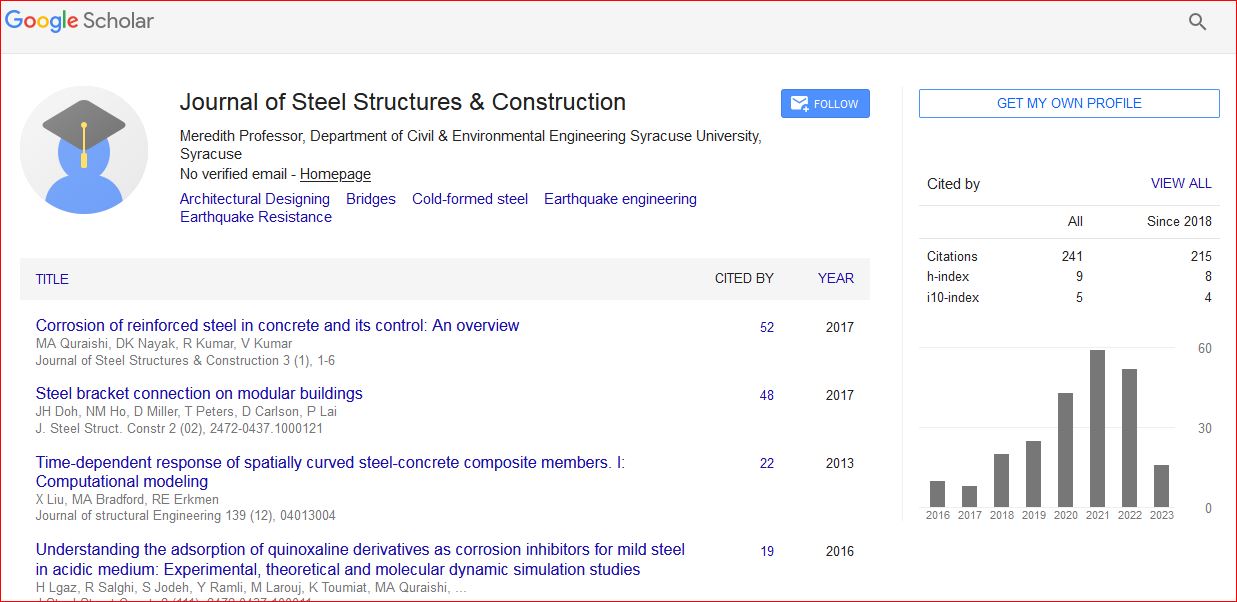
Journal of Steel Structures & Construction received 583 citations as per Google Scholar report