Opinion - (2025) Volume 13, Issue 5
Received: 01-Sep-2025, Manuscript No. economics-26-186070;
Editor assigned: 03-Sep-2025, Pre QC No. P-186070;
Reviewed: 17-Sep-2025, QC No. Q-186070;
Revised: 22-Sep-2025, Manuscript No. R-186070;
Published:
29-Sep-2025
, DOI: 10.37421/2375-4389.2025.13.545
Citation: Costa, Lucas Ferreira. ”Sustainable Development in
Sub-Saharan Africa: A Multifaceted Approach.” J Glob Econ 13 (2025):545.
Copyright: © 2025 Costa F. Lucas This is an open-access article distributed under the terms of the Creative Commons Attribution License, which permits unrestricted use,
distribution and reproduction in any medium, provided the original author and source are credited.
The imperative for sustainable development in Sub-Saharan Africa is intrinsically linked to the strategic management and allocation of its diverse resources. This region, rich in natural endowments and possessing a growing human capital base, faces complex challenges in translating these assets into widespread prosperity and resilience. Effective resource allocation is therefore not merely an economic consideration but a critical determinant of developmental outcomes, influencing everything from poverty reduction to long-term economic stability. This exploration will delve into the multifaceted aspects of resource allocation, examining its role in shaping the developmental trajectory of Sub-Saharan Africa [1].
Foreign direct investment (FDI) represents a significant external resource that can potentially accelerate economic growth across Sub-Saharan Africa. However, its transformative power is not automatic; it is profoundly shaped by the prevailing domestic institutional frameworks and the efficacy of existing resource allocation mechanisms. Understanding this interplay is crucial for maximizing the benefits of FDI while mitigating potential downsides, ensuring that external capital contributes to inclusive and sustainable development pathways [2].
Many nations within Sub-Saharan Africa are endowed with abundant natural resources, presenting both opportunities and significant challenges. The management of revenues derived from these resources is paramount to fostering inclusive development and avoiding the pitfalls of the 'resource curse.' Strategies for effective allocation towards essential sectors like education, healthcare, and infrastructure are critical for converting natural wealth into tangible societal progress and long-term prosperity [3].
Agriculture remains a cornerstone of many Sub-Saharan African economies, with a substantial portion of the population relying on it for livelihoods. Developing robust agricultural strategies that prioritize smallholder farmers, improve market access, and promote sustainable practices is essential for achieving widespread poverty reduction and enhancing food security. Such targeted interventions can unlock significant income potential and contribute to broader economic advancement [4].
Addressing the infrastructure deficit is a pivotal step towards unlocking the economic potential of Sub-Saharan Africa. Strategic investments in transportation, energy, and digital infrastructure are fundamental for facilitating trade, improving access to services, and fostering economic integration. Innovative financing and regional cooperation are key enablers for realizing ambitious infrastructure development goals [5].
Human capital development is recognized as a fundamental driver of economic transformation in Sub-Saharan Africa. A robust and skilled workforce, nurtured through increased investment in education, healthcare, and vocational training, is essential for fostering innovation, enhancing productivity, and improving global competitiveness. Prioritizing access and quality in these sectors is crucial for equipping the population for future economic demands [6].
Effective governance plays an indispensable role in ensuring that resources are allocated optimally for development across Sub-Saharan Africa. Strong institutions, characterized by transparency and accountability, are vital for channeling investments productively, improving public services, and curbing corruption. Participatory decision-making processes further enhance the likelihood of equitable development outcomes [7].
Trade liberalization presents a complex dynamic for resource allocation and economic diversification within Sub-Saharan Africa. While it can promote efficiency, its benefits are often unevenly distributed. The implementation of complementary domestic policies is crucial for supporting local industries, boosting competitiveness, and ensuring that trade agreements contribute to sustainable and inclusive growth [8].
Innovation and technology adoption are increasingly recognized as critical levers for enhancing resource allocation and driving productivity growth in Sub-Saharan Africa. Creating an environment that encourages research, development, and the widespread adoption of new technologies is essential for improving resource efficiency and fostering sustainable economic expansion [9].
The development of a robust financial sector is fundamental to facilitating effective resource allocation and driving sustainable development in Sub-Saharan Africa. Improved access to finance, efficient intermediation, and sound financial policies are crucial for mobilizing savings, directing investments, and supporting entrepreneurial activities. Reforms aimed at deepening financial markets and enhancing financial inclusion are paramount [10].
The critical role of resource allocation in Sub-Saharan Africa's pursuit of sustainable development is a pervasive theme across various studies. Effective management of natural endowments, human capital, and financial flows is identified as paramount for addressing persistent challenges like poverty and inequality. The necessity of inclusive governance and targeted investments is emphasized to ensure that development benefits are broadly distributed and contribute to long-term economic resilience, with a strong call for policies that move away from primary commodity dependence [1].
The intricate relationship between foreign direct investment (FDI) and the mobilization of domestic resources in Sub-Saharan Africa is a key area of investigation. While FDI can act as a catalyst for growth, its ultimate impact is significantly moderated by the quality of domestic institutions and the effectiveness of resource allocation mechanisms. The research strongly advocates for policies that facilitate the local integration of FDI and bolster domestic savings and investment, thereby ensuring a more equitable distribution of benefits and fostering sustainable development [2].
For resource-rich nations in Sub-Saharan Africa, the effective management of natural resource revenues is pivotal in promoting inclusive development and mitigating the 'resource curse.' Strategies for prudent allocation of these revenues towards critical areas such as education, healthcare, and infrastructure are proposed as essential. The study underscores the indispensable role of transparency, accountability, and economic diversification away from heavy resource dependence in safeguarding against risks and ensuring sustained economic prosperity [3].
The impact of agricultural development strategies on poverty reduction and food security in Sub-Saharan Africa is profound. Emphasis is placed on the importance of investing in smallholder farming, improving access to credit and markets, and promoting sustainable agricultural practices. The findings strongly suggest that well-directed interventions within the agricultural sector can significantly elevate incomes, improve nutritional outcomes, and contribute substantially to broader economic development [4].
Infrastructure development in Sub-Saharan Africa presents both significant challenges and considerable opportunities. Strategic investments in transportation, energy, and digital infrastructure are identified as crucial for unlocking economic potential, enhancing trade facilitation, and improving access to essential services. The paper also highlights the importance of innovative financing mechanisms and robust regional cooperation as key enablers for the successful implementation of infrastructure projects [5].
Human capital development stands as a cornerstone for achieving economic transformation in Sub-Saharan Africa. The research stresses the critical need for increased investment in education, healthcare, and skills training to cultivate a productive workforce capable of driving innovation and enhancing competitiveness. Policy recommendations are put forth to improve both the accessibility and quality of education and healthcare services, with a particular focus on reaching marginalized populations [6].
The significance of governance in achieving effective resource allocation for development in Sub-Saharan Africa cannot be overstated. Strong institutions, coupled with transparency and accountability, are deemed essential for directing resources towards productive investments and public services, thereby curbing corruption and enhancing overall development outcomes. The study also highlights the importance of decentralization and inclusive decision-making processes [7].
Trade liberalization's impact on resource allocation and economic diversification in Sub-Saharan Africa is multifaceted. While trade can foster efficiency and stimulate growth, the benefits are often not evenly distributed. The paper posits that complementary domestic policies are indispensable for bolstering local industries, augmenting competitiveness, and ensuring that trade liberalization contributes positively to sustainable and inclusive development [8].
Innovation and technology adoption play a crucial role in optimizing resource allocation and fostering productivity growth within Sub-Saharan Africa. The study advocates for the creation of an innovation-conducive environment, coupled with investments in research and development and the promotion of new technologies, as vital for improving resource efficiency and driving sustainable economic development. Examples of successful technology transfer and adaptation are also noted [9].
The development of the financial sector is a critical facilitator of effective resource allocation and sustainable development in Sub-Saharan Africa. Enhanced access to finance, efficient financial intermediation, and sound financial policies are key to mobilizing savings, channeling investments into productive sectors, and supporting entrepreneurship. The paper advocates for reforms aimed at deepening financial markets and improving financial inclusion across the region [10].
This collection of research highlights the multifaceted approaches to achieving sustainable development in Sub-Saharan Africa. Key themes include the critical role of effective resource allocation, encompassing natural endowments, human capital, and financial flows, in overcoming challenges like poverty and inequality. The studies emphasize the importance of inclusive governance, targeted investments, and diversification away from primary commodity dependence. Furthermore, the impact of foreign direct investment, natural resource revenue management, agricultural development, infrastructure, and trade liberalization are explored, with a consistent call for complementary domestic policies to ensure equitable benefit distribution and long-term economic resilience. Human capital development through education and healthcare, alongside fostering innovation and technology adoption, are identified as crucial drivers of economic transformation. Finally, the development of a robust financial sector is recognized as essential for mobilizing savings and channeling investments productively.
None
None
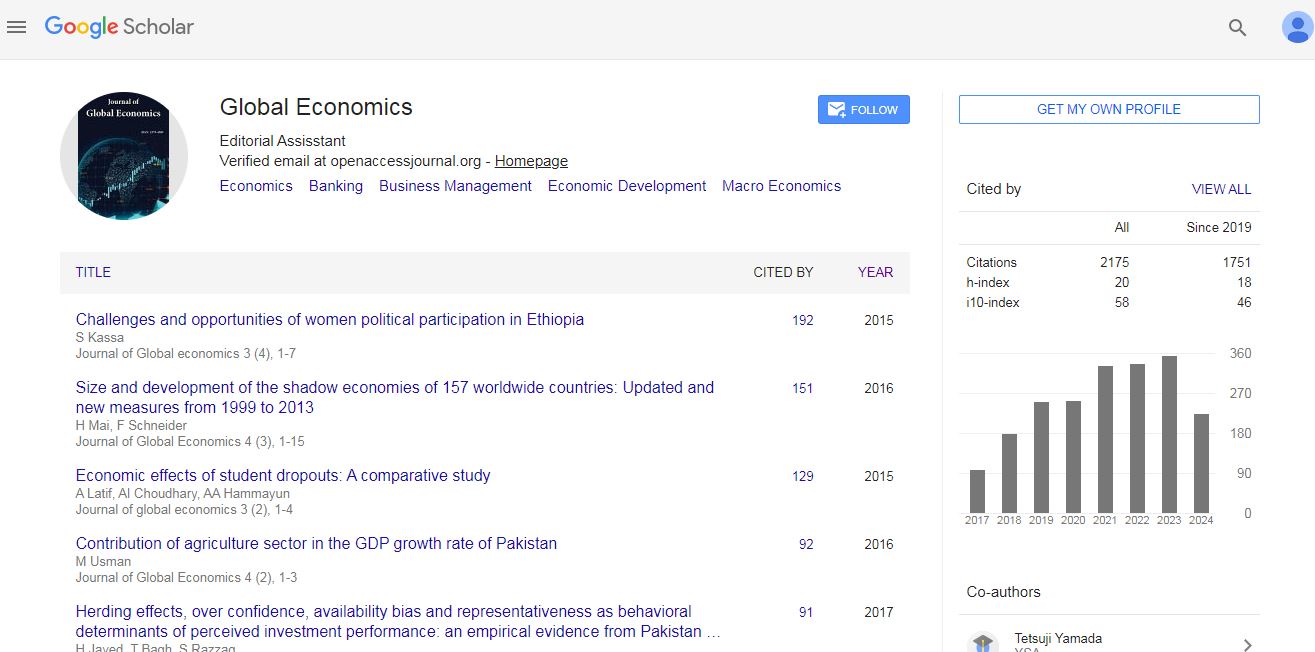
Journal of Global Economics received 2175 citations as per Google Scholar report