Short Communication - (2025) Volume 14, Issue 5
Received: 01-Oct-2025, Manuscript No. jbfa-25-176833;
Editor assigned: 03-Oct-2025, Pre QC No. P-176833;
Reviewed: 17-Oct-2025, QC No. Q-176833;
Revised: 22-Oct-2025, Manuscript No. R-176833;
Published:
29-Oct-2025
, DOI: 10.37421/2161-0673.2025.14.558
Citation: Ivanova, Maya. ”Sustainability: Driving Business Performance and Value.” J Bus Fin Aff 14 (2025):558.
Copyright: © 2025 Ivanova M. This is an open-access article distributed under the terms of the Creative Commons Attribution License, which permits unrestricted use, distribution and reproduction in any medium, provided the original author and source are credited.
Modern business landscapes increasingly emphasize the critical role of corporate sustainability in driving both economic success and environmental stewardship. A foundational insight reveals that Corporate Social Responsibility (CSR) initiatives profoundly enhance a firmâ??s financial performance. This positive correlation is notably strengthened when firms also engage in green innovation, suggesting a clear strategic advantage for organizations that prioritize environmentally conscious practices and actively seek innovative solutions for ecological challenges [1].
The importance of strong internal structures supporting these initiatives cannot be overstated. For instance, effective corporate governance mechanisms are shown to positively influence a firmâ??s commitment to CSR, ensuring that ethical and sustainable considerations are embedded within organizational culture, while simultaneously improving its overall financial outcomes. This underscores how strong oversight, transparent policies, and strategic direction can cultivate an environment conducive to sustained, responsible business practices [5].
Moreover, a global perspective highlights that superior Environmental, Social, and Governance (ESG) performance is directly associated with increased firm value. This indicates that investors worldwide are increasingly recognizing, valuing, and rewarding businesses that demonstrate strong and measurable sustainable practices, viewing them as indicators of long-term resilience and reduced risk [7].
Operational paradigms are also shifting dramatically towards sustainability-driven models. The concept of circular economy business models is gaining significant traction, identified as pivotal for achieving long-term business sustainability. These models concentrate intensely on optimizing resource efficiency, minimizing waste generation through redesign and reuse, and creating continuous value across entire product lifecycles, moving away from traditional linear economic approaches [2].
Complementing this, integrating sustainable supply chain management practices has been empirically proven to significantly boost organizational performance in manufacturing companies. This integration leads to comprehensive improvements across economic, environmental, and social dimensions, demonstrating the far-reaching benefits of responsible sourcing and operations [3].
In the realm of innovation, green innovation emerges as a powerful driver of enhanced firm performance. Its effectiveness is further amplified when firms have well-established Environmental Management Systems (EMS) in place. These systems provide the framework and processes necessary to more efficiently leverage green advancements, leading to superior environmental outcomes and tangible economic benefits [8].
This illustrates the critical, symbiotic relationship between proactive strategic environmental management and continuous innovative practices aimed at sustainability. Consumer dynamics are equally crucial in this evolving landscape, as research indicates a growing consumer preference for environmentally friendly products and brands. This trend emphasizes that businesses must engage in transparent communication, avoid greenwashing, and demonstrate authentic green practices to build profound consumer trust and foster sustainable consumption patterns, thereby securing a competitive edge [4].
Concurrently, actively engaging stakeholders is paramount for achieving comprehensive corporate sustainability across various economic contexts, both developed and developing. Such engagement fosters greater transparency, stimulates collaborative innovation, and builds essential legitimacy for a firmâ??s sustainability efforts, ensuring broad-based support and understanding [9].
Looking at broader strategic integration, a firm's commitment to the United Nationsâ?? Sustainable Development Goals (SDGs) has a significant positive impact on its corporate sustainability performance. Integrating these global goals into core business strategies is not merely a social responsibility, but also yields substantial long-term operational efficiencies and enhanced reputational advantages, aligning business objectives with global challenges [6].
Finally, digitalization is playing a transformative role in advancing these sustainable development goals for businesses. Various digital technologies are instrumental in improving resource efficiency, enhancing operational transparency, and enabling the development of entirely new sustainable business models, thereby generating both environmental and economic advantages in a rapidly evolving digital world [10].
This collective body of research paints a comprehensive picture of sustainability as a multifaceted strategic imperative, deeply intertwined with financial performance, operational excellence, innovation, robust governance, and meaningful stakeholder relations.
The contemporary business environment increasingly recognizes sustainability as a core driver of long-term success, transcending mere compliance to become a strategic imperative. Studies consistently reveal a strong positive relationship between corporate social responsibility (CSR) initiatives and a firm's financial performance. This link is particularly robust when CSR efforts are complemented by green innovation, allowing firms to achieve superior financial outcomes and gain a distinct competitive advantage through environmentally conscious practices [1]. The importance of sound corporate governance also emerges as a key factor; effective governance mechanisms not only foster deeper CSR engagement but also directly contribute to enhanced financial performance, suggesting that strong internal controls reinforce sustainable commitments [5]. Globally, firms demonstrating high Environmental, Social, and Governance (ESG) performance are observed to have increased firm value, indicating that investors are increasingly rewarding sustainable practices as a reflection of reduced risk and future resilience [7].
Beyond financial returns, the operational and strategic integration of sustainability yields substantial benefits. Circular economy business models, for instance, are highlighted as crucial for achieving true long-term business sustainability. These models focus on maximizing resource efficiency, significantly reducing waste, and creating continuous value throughout the entire product lifecycle, moving away from linear "take-make-dispose" approaches [2]. Similarly, the adoption of sustainable supply chain management practices is empirically shown to markedly enhance organizational performance across various manufacturing companies. By integrating environmental and social considerations into supply chain operations, businesses can realize improved economic, environmental, and social outcomes [3]. These findings underscore that sustainability is not just about ethical considerations but also about optimizing operational efficiency and creating systemic value.
Innovation, particularly green innovation, plays a pivotal role in this transformation. Research indicates that green innovation significantly boosts firm performance, with the presence of effective environmental management systems (EMS) acting as a crucial moderating factor. Firms with established EMS are better positioned to leverage green innovations, translating them into superior environmental and economic performance [8]. This highlights that structural support for environmental initiatives amplifies the positive impact of innovative green technologies and processes. Additionally, the evolving consumer landscape presents significant opportunities; consumers are increasingly valuing environmentally friendly products and brands. This trend necessitates that businesses communicate their green practices transparently and authentically to build trust and drive sustainable consumption [4]. Such green marketing strategies are no longer niche but essential for market relevance.
The broader strategic alignment with global sustainability goals and stakeholder interests is equally vital. A firm's proactive commitment to the United Nationsâ?? Sustainable Development Goals (SDGs) has been shown to positively impact its corporate sustainability performance. Integrating SDGs into core business strategies is presented as a mechanism for achieving long-term operational and reputational benefits, aligning corporate objectives with global challenges [6]. Moreover, active stakeholder engagement is identified as critical for achieving comprehensive corporate sustainability across diverse economic contexts. Dialogue and collaboration with stakeholders enhance transparency, foster innovation, and build legitimacy for a firm's sustainability initiatives, creating a shared vision and collective responsibility [9].
Finally, the advent of digitalization offers transformative potential for advancing sustainability agendas. Digital technologies are instrumental in enabling businesses to achieve sustainable development goals through various means. They improve resource efficiency, enhance transparency across operations, and facilitate the creation of entirely new sustainable business models, driving both environmental conservation and economic growth [10]. This integration of digital tools with sustainability objectives represents a powerful synergy, pushing businesses towards more efficient, transparent, and resilient operating models. Collectively, these studies paint a compelling picture of sustainability as a multi-faceted and interconnected strategy that drives financial performance, operational excellence, innovation, consumer loyalty, and global impact.
The provided research explores various facets of corporate sustainability and its impact on business performance. Studies highlight how Corporate Social Responsibility (CSR) initiatives, especially when integrated with green innovation, significantly enhance a firm's financial outcomes, suggesting a strategic advantage for environmentally conscious practices. Effective corporate governance also plays a crucial role in fostering CSR engagement and improving financial performance. Additionally, strong Environmental, Social, and Governance (ESG) performance is directly linked to increased firm value, indicating investor recognition of sustainable practices globally. Beyond direct financial links, the literature emphasizes the operational and strategic importance of sustainability. Circular economy business models are identified as critical for long-term business sustainability, focusing on resource efficiency and waste reduction. Similarly, adopting sustainable supply chain management practices improves organizational performance across economic, environmental, and social dimensions for manufacturing companies. Green innovation, particularly when supported by effective Environmental Management Systems (EMS), also drives superior environmental and economic performance. Consumer behavior is evolving, with an increasing preference for environmentally friendly products, underscoring the importance of transparent green marketing for businesses. Strategic alignment with Sustainable Development Goals (SDGs) contributes to corporate sustainability performance, offering long-term operational and reputational benefits. Digitalization is transforming businesses, enabling improved resource efficiency and new sustainable business models that support SDGs. Finally, active stakeholder engagement is crucial for comprehensive corporate sustainability, enhancing transparency, fostering innovation, and building legitimacy. Overall, the research consistently points to the multifaceted benefits of integrating sustainability into core business strategies, from financial gains to operational efficiency and enhanced reputation.
None
None
Indexed at, Google Scholar, Crossref
Indexed at, Google Scholar, Crossref
Indexed at, Google Scholar, Crossref
Indexed at, Google Scholar, Crossref
Indexed at, Google Scholar, Crossref
Indexed at, Google Scholar, Crossref
Indexed at, Google Scholar, Crossref
Indexed at, Google Scholar, Crossref
Indexed at, Google Scholar, Crossref
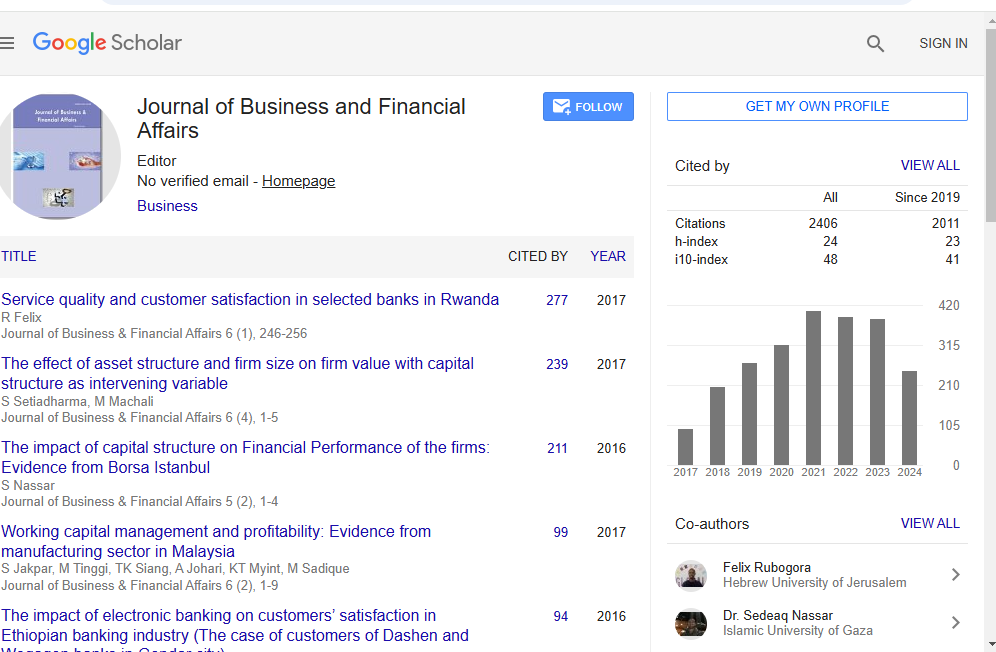
Journal of Business & Financial Affairs received 1726 citations as per Google Scholar report