Perspective - (2025) Volume 10, Issue 6
Received: 01-Nov-2025, Manuscript No. jfm-26-183010;
Editor assigned: 03-Nov-2025, Pre QC No. P-183010;
Reviewed: 17-Nov-2025, QC No. Q-183010;
Revised: 24-Nov-2025, Manuscript No. R-183010;
Published:
29-Nov-2025
, DOI: 10.37421/2472-1026.2025.10.447
Citation: Kim, Hana. ”Substance Use’s Grip on Violent Fatalities.” J Forensic Med 10 (2025):447.
Copyright: © 2025 Kim H. This is an open-access article distributed under the terms of the Creative Commons Attribution License, which permits unrestricted use, distribution and reproduction in any medium, provided the original author and source are credited.
The investigation into the correlation between substance use and violent fatalities is a critical area of forensic science and public health. Understanding the prevalence and impact of alcohol and drug intoxication in victims of violent deaths provides crucial insights into the circumstances surrounding these tragic events. Research by Davies et al. (2021) highlights a significant association between substance use and the factors contributing to violent fatalities, emphasizing the necessity for thorough toxicological analysis in all forensic investigations to ascertain accurate cause and manner of death [1].
Further contributing to this understanding, Williams et al. (2023) examined the intricate role of polydrug use in cases of interpersonal violence that unfortunately result in death. Their findings reveal that the concurrent presence of multiple substances can significantly complicate the interpretation of the events leading to demise, often necessitating the application of advanced and sophisticated toxicological methodologies to disentangle the effects of each substance [2].
Wilson et al. (2020) narrowed their focus to the specific impact of opioids and synthetic cannabinoids on the outcomes of violent deaths. This study brings to light the distinct challenges encountered in both the detection and the accurate interpretation of these potent substances within postmortem toxicology, underscoring the evolving landscape of drug abuse and its forensic implications [3].
Garcia et al. (2022) provided a comprehensive review of how the measured concentrations of alcohol and illicit drugs in postmortem blood samples can profoundly influence the determination of both the cause and the manner of death in cases of violent incidents. Their work strongly emphasizes the paramount importance of meticulously considering dose-response relationships when interpreting toxicological findings in this context [4].
Adding to the discourse on drug involvement, Chen et al. (2023) delved into the correlation between the use of stimulants and an individual's involvement in fatal assaults. Their research meticulously explores the behavioral effects commonly associated with stimulant use, which may directly contribute to the escalation of altercations and increase the likelihood of violent confrontations [5].
In a different but related vein, Perez et al. (2020) investigated the influence of chronic alcohol consumption on an individual's propensity to become a victim of violence that ultimately leads to death. This study illuminates the complex and often multifaceted interplay that exists between patterns of substance abuse and an individual's vulnerability to becoming a victim of violent crime [6].
The evolving landscape of drug use also brings forth the challenge of novel psychoactive substances (NPS). Brown et al. (2023) specifically examined the difficulties and recent advancements in the detection of NPS in postmortem samples obtained from victims of violent death, highlighting their emerging potential to contribute to lethal outcomes and posing new analytical hurdles [7].
Further exploring the impact of specific substances, Davis et al. (2022) conducted a retrospective study to analyze the contribution of cannabis use to fatal violent incidents. Their research thoughtfully considers both patterns of acute and chronic cannabis consumption, exploring potential links to impaired judgment and increased aggression that may precipitate violent events [8].
Jones et al. (2021) focused their attention on the significant impact of prescription opioid misuse on the occurrence of violent deaths. Their forensic toxicology examination highlights the persistent challenges in accurately distinguishing between therapeutic use and deliberate abuse of prescription opioids in the context of postmortem investigations [9].
Finally, Lee et al. (2023) provided an examination of the synergistic effects that can arise from the combined use of alcohol and other drugs (AOD) in fatal violent incidents. This research underscores the profound complexity of polydrug interactions when trying to accurately assess their contribution to mortality in forensic toxicological contexts [10].
The forensic examination of violent deaths frequently necessitates a thorough understanding of the role substance intoxication may play. The study by Davies et al. (2021) illustrates how alcohol and drug intoxication are significantly associated with the circumstances surrounding violent fatalities, underlining the critical need for comprehensive toxicological analysis in all such cases to accurately determine cause and manner of death [1].
Polydrug use presents a unique challenge in forensic investigations of fatal interpersonal violence. Williams et al. (2023) found that the presence of multiple substances complicates the interpretation of events, requiring advanced toxicological methodologies to discern the specific contributions of each drug to the fatal outcome [2].
Specific classes of drugs, such as opioids and synthetic cannabinoids, are of particular concern. Wilson et al. (2020) highlighted the difficulties in detecting and interpreting these substances in postmortem toxicology, suggesting a need for ongoing development of analytical techniques to address emerging drug trends [3].
Postmortem toxicology reports are central to death investigations, and the interpretation of alcohol and drug concentrations is crucial. Garcia et al. (2022) emphasized the importance of considering dose-response relationships when evaluating toxicological data in violent incidents to avoid misinterpretations of impairment or contribution to death [4].
Stimulant use has been implicated in violent behaviors, and Chen et al. (2023) explored the correlation between stimulant use and involvement in fatal assaults. Their work suggests that the behavioral effects of stimulants may play a role in precipitating violent confrontations [5].
Beyond active drug use, chronic substance abuse can also influence vulnerability. Perez et al. (2020) examined how chronic alcohol consumption can increase an individual's risk of becoming a victim of fatal violence, indicating a complex interplay between substance abuse patterns and vulnerability to crime [6].
The emergence of novel psychoactive substances (NPS) poses significant challenges for forensic toxicologists. Brown et al. (2023) detailed the advancements and ongoing difficulties in detecting NPS in postmortem samples from victims of violent death, recognizing their potential to contribute to fatalities [7].
Cannabis use is another area of forensic interest. Davis et al. (2022) conducted a retrospective study to understand the role of cannabis in fatal violent incidents, analyzing both acute and chronic use patterns and their potential links to impaired judgment and aggression [8].
Misuse of prescription medications, particularly opioids, is a significant public health concern that extends to violent fatalities. Jones et al. (2021) evaluated the impact of prescription opioid misuse in violent deaths, noting the forensic challenges in distinguishing therapeutic use from abuse in postmortem analyses [9].
Understanding the combined effects of substances is vital. Lee et al. (2023) investigated the synergistic effects of alcohol and other drugs (AOD) in fatal violent incidents, stressing the complexity of polydrug interactions in forensic toxicology and their implications for determining cause and manner of death [10].
This collection of research explores the significant impact of alcohol and drug use on violent fatalities. Studies highlight the prevalence of substance intoxication in victims, linking it to the circumstances of violent deaths and emphasizing the need for comprehensive toxicological analysis in forensic investigations. The research examines the complexities of polydrug use, the specific roles of opioids, synthetic cannabinoids, stimulants, and cannabis, and the challenges in detecting novel psychoactive substances. It also addresses the influence of chronic alcohol consumption and prescription opioid misuse on vulnerability and involvement in fatal assaults. The synergistic effects of combined substance use are also investigated, underscoring the intricate nature of drug interactions in forensic toxicology and their implications for determining cause and manner of death.
None
None
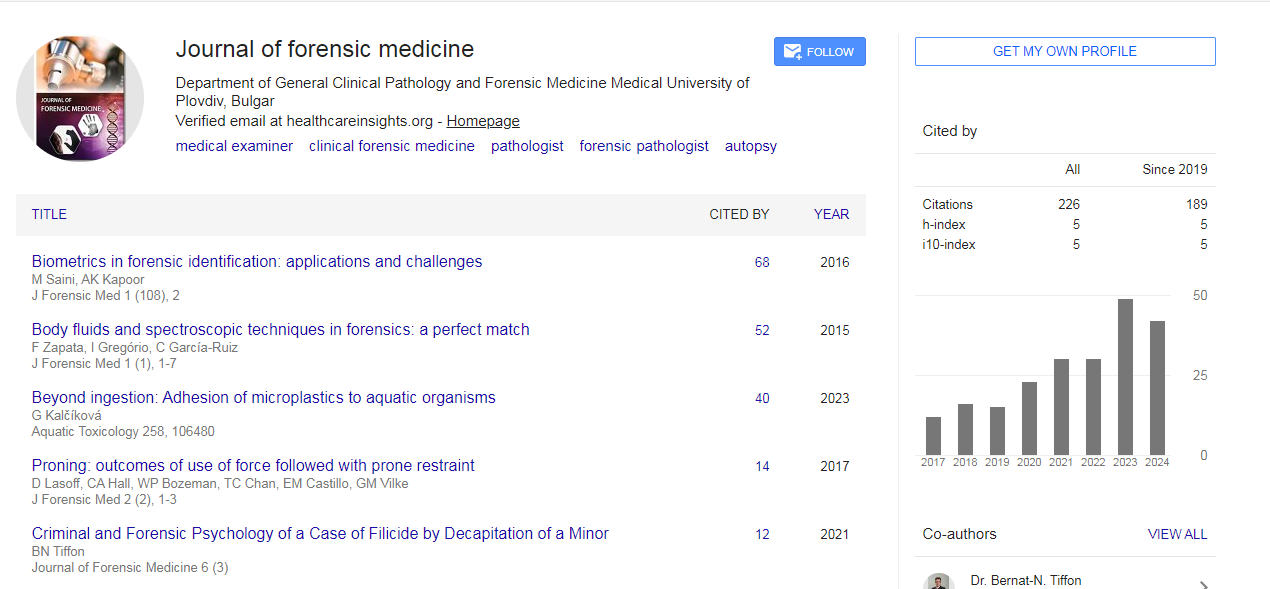
Journal of Forensic Medicine received 165 citations as per Google Scholar report