Opinion - (2025) Volume 10, Issue 6
Received: 01-Nov-2025, Manuscript No. jfm-26-183009;
Editor assigned: 03-Nov-2025, Pre QC No. P-183009;
Reviewed: 17-Nov-2025, QC No. Q-183009;
Revised: 24-Nov-2025, Manuscript No. R-183009;
Published:
29-Nov-2025
, DOI: 10.37421/2472-1026.2025.10.446
Citation: Adeyemi, Yusuf O.. ”Substance Intoxication’s Critical Role in Violent Fatalities.” J Forensic Med 10 (2025):446.
Copyright: © 2025 Adeyemi O. Yusuf This is an open-access article distributed under the terms of the Creative Commons Attribution License, which permits unrestricted use, distribution and reproduction in any medium, provided the original author and source are credited.
The forensic investigation of violent deaths is a complex field that increasingly necessitates a thorough understanding of the role alcohol and drugs play in these tragic incidents. Research has consistently highlighted a significant association between substance use and the heightened risk and specific characteristics of violent fatalities, underscoring the critical need for comprehensive toxicological screening in such cases. This approach is vital for unraveling the full context of violent deaths and informing investigative and legal processes. Findings from retrospective analyses point to a substantial link between the presence of alcohol and illicit drugs and the occurrence of violent deaths, emphasizing the importance of detailed toxicological assessments within forensic investigations [1].
Forensic toxicology offers a crucial lens through which to examine the neurobiological and behavioral effects of common intoxicants, particularly in how alcohol and drugs influence aggression and victim vulnerability during violent encounters. This perspective is essential for interpreting analytical findings from post-mortem samples and relating them to the cause and manner of death. The field provides detailed analytical methods for detecting a wide array of substances and offers insights into the interpretation of results in the context of violent fatalities [2].
Specific classes of drugs, such as stimulants and opioids, have been identified as having a notable contribution to violent fatalities. Studies analyzing case data aim to determine the frequency of their presence and their correlation with particular forms of violence. This research underscores the necessity of detailed drug profiling in medicolegal death investigations to achieve a comprehensive understanding of fatal incidents involving these substances [3].
Victimology research further illuminates the intricate relationship between substance abuse and violent fatalities by examining how prior substance abuse histories influence an individual's risk factors and their potential for survival when targeted by violence. This perspective calls for enhanced public health interventions and forensic reporting that acknowledges the long-term impact of addiction on an individual's vulnerability to violence [4].
A critical aspect of forensic investigation involves developing standardized methodologies for the toxicological assessment of victims in violent death cases, especially concerning alcohol and illicit drug residues. Addressing challenges such as post-mortem redistribution and the interpretation of complex drug combinations is paramount for ensuring consistent and reliable forensic practice and reporting [5].
Alcohol's pervasive role in assaults and homicides continues to be a significant area of study. Synthesizing recent findings on blood alcohol concentration levels and their association with violent behavior and victim outcomes highlights the ongoing relevance of alcohol testing in the forensic investigation of violent deaths. This research provides essential data for understanding alcohol's direct and indirect contributions [6].
The interplay between polysubstance use, encompassing combinations of alcohol and various drugs, and the risk of experiencing a violent death is a complex area of investigation. Statistical data on the co-occurrence of multiple substances in victims provides critical insights into the implications for forensic interpretation and the development of effective public health strategies aimed at mitigating these risks [7].
Drug-facilitated sexual assault (DFSA) cases that unfortunately result in death present a specific challenge within forensic investigations. Research in this area examines the substances involved, their contribution to victim incapacitation, and their role in subsequent fatalities, emphasizing the need for sensitive forensic testing and comprehensive case histories to address these sensitive cases [8].
The interpretation of post-mortem toxicology results, particularly concerning the influence of alcohol and drugs on the cause and manner of death in violent incidents, is fraught with challenges. Factors such as post-mortem metabolism, specimen collection protocols, and the inherent limitations of analytical methods must be carefully considered to ensure accurate conclusions in these critical investigations [9].
Cannabinoids represent another class of substances whose prevalence in victims of violent deaths warrants investigation. Examining their potential contribution to impaired judgment and increased risk-taking behavior is crucial for understanding the evolving landscape of drug use and its implications for forensic investigation, reinforcing the need for comprehensive drug screening in all violent death cases [10].
The prevalence and impact of alcohol and drug intoxication in victims of violent deaths are critically examined, with findings underscoring a significant association between substance use and the risk and nature of violent fatalities. This necessitates comprehensive toxicological screening in forensic investigations of such cases, highlighting challenges in data collection and interpretation within this context [1].
Forensic toxicology perspectives are applied to the neurobiological and behavioral effects of common intoxicants, detailing how drug and alcohol influence aggression and victim vulnerability in violent encounters. The article elaborates on analytical methods for detecting various substances in post-mortem samples and discusses the interpretation of results in relation to cause and manner of death [2].
Research focusing on the specific role of stimulants and opioids in violent fatalities analyzes case data to determine their frequency and correlation with particular types of violence. This study emphasizes the importance of detailed drug profiling in medicolegal death investigations for a complete understanding of fatal incidents [3].
Victimology studies explore how prior substance abuse histories in individuals who become victims of violence influence their risk factors and potential for survival. The research advocates for enhanced public health interventions and forensic reporting that considers the long-term impact of addiction on vulnerability [4].
A methodological approach to standardizing the toxicological assessment of victims in violent death cases, particularly for alcohol and illicit drugs, is presented. The article addresses challenges related to post-mortem redistribution and the interpretation of complex drug combinations, offering recommendations for consistent forensic practice [5].
A systematic review critically examines alcohol's role in assaults and homicides, synthesizing recent findings on blood alcohol concentration levels and their association with violent behavior and victim outcomes. The review highlights the ongoing relevance of alcohol testing in forensic investigations of violent deaths [6].
The complex interplay between polysubstance use and the risk of experiencing a violent death is investigated, providing statistical data on the co-occurrence of multiple substances in victims. The study discusses the implications for forensic interpretation and public health strategies aimed at addressing these risks [7].
Trends in drug-facilitated sexual assault (DFSA) cases resulting in death are analyzed, with research investigating the specific substances involved and their contribution to victim incapacitation and subsequent fatalities. The study stresses the importance of sensitive forensic testing and detailed case histories [8].
Challenges in interpreting post-mortem toxicology results, particularly concerning the influence of alcohol and drugs on the cause and manner of death in violent incidents, are explored. The paper discusses factors such as post-mortem metabolism, specimen collection, and the limitations of analytical methods [9].
The prevalence of cannabinoids in victims of violent deaths is investigated, examining their potential contribution to impaired judgment and increased risk-taking behavior. This study highlights the evolving landscape of drug use and its implications for forensic investigation, emphasizing the need for comprehensive drug screening [10].
This collection of research highlights the critical role of alcohol and drug intoxication in violent fatalities. Studies investigate the prevalence of various substances, including stimulants, opioids, cannabinoids, and alcohol, in victims of violent deaths. The research emphasizes the impact of these intoxicants on aggression, victim vulnerability, and risk-taking behaviors. Methodological challenges in toxicology, such as post-mortem redistribution and interpretation of results, are addressed, stressing the need for standardized practices. Victimology perspectives reveal how substance abuse histories increase vulnerability. The analysis of polysubstance use and drug-facilitated sexual assault cases further underscores the complex interplay between substance use and violent outcomes. Overall, these findings stress the indispensable nature of comprehensive toxicological screening and detailed forensic analysis in understanding and addressing violent deaths.
None
None
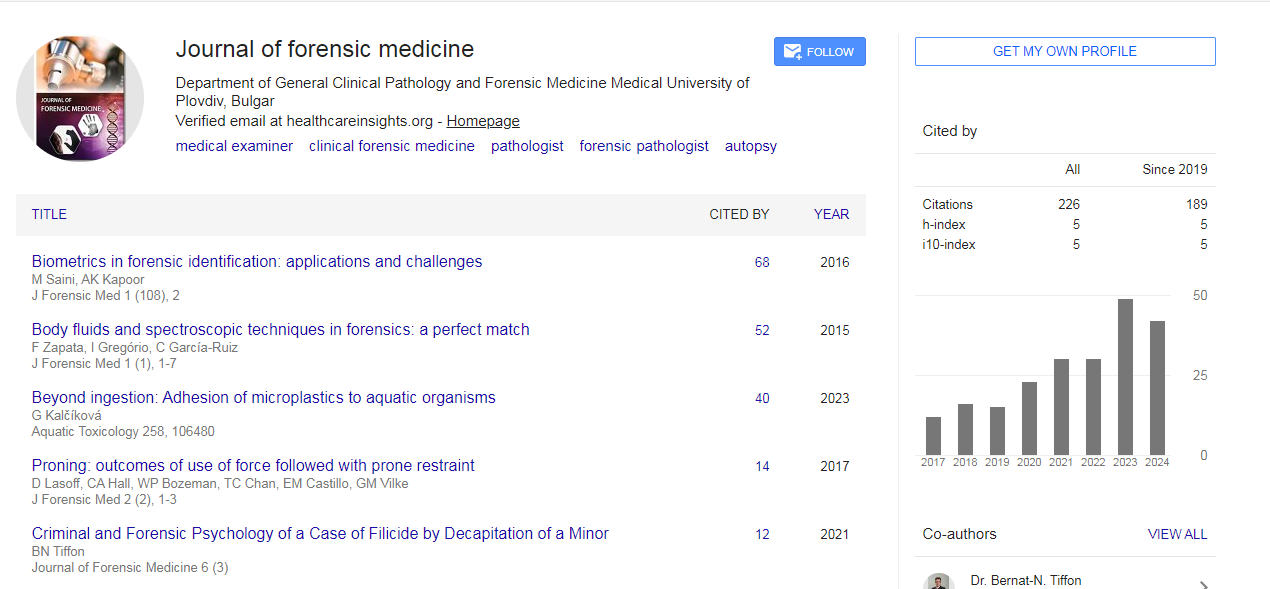
Journal of Forensic Medicine received 165 citations as per Google Scholar report