Perspective - (2025) Volume 14, Issue 4
Received: 01-Jul-2025, Manuscript No. mcce-26-190178;
Editor assigned: 03-Jul-2025, Pre QC No. P-190178;
Reviewed: 17-Jul-2025, QC No. Q-190178;
Revised: 22-Jul-2025, Manuscript No. R-190178;
Published:
29-Jul-2025
, DOI: 10.37421/2470-6965.2025.14.412
Citation: Boateng, Samuel. ”Strong Surveillance Drives Malaria Elimination: Data-Driven Strategies.” Malar Contr Elimination 14 (2025):412.
Copyright: © 2025 Boateng S. This is an open-access article distributed under the terms of the Creative Commons Attribution License, which permits unrestricted use, distribution and reproduction in any medium, provided the original author and source are credited.
Effective malaria elimination hinges on robust surveillance systems capable of detecting, reporting, and responding to malaria cases promptly. This involves strengthening case-based surveillance, improving diagnostic capacity at the community level, and leveraging data for targeted interventions. The shift from control to elimination demands enhanced sensitivity in detection and rapid action to prevent transmission [1].
The integration of routine health information systems with enhanced surveillance tools, such as mobile-based reporting and molecular diagnostics, is critical for detecting residual malaria transmission. This approach allows for real-time data analysis, enabling malaria programs to adapt their strategies and focus resources on high-risk areas and populations [2].
Active case detection, coupled with prompt diagnosis and treatment, plays a pivotal role in interrupting malaria transmission in low-prevalence settings. Community health workers are essential in this process, bridging the gap between healthcare facilities and remote populations, thereby improving access and timely management of malaria cases [3].
Molecular surveillance techniques, including genetic sequencing of malaria parasites, are increasingly important for understanding transmission dynamics, identifying parasite origins, and detecting drug resistance. These tools provide a deeper insight into the parasite population, aiding in the development of more precise elimination strategies [4].
Real-time data visualization and dashboards are crucial for malaria surveillance teams to monitor trends, identify hotspots, and assess the impact of interventions. This allows for adaptive management and rapid deployment of resources where they are most needed, improving the efficiency of elimination efforts [5].
Community engagement is fundamental to the success of malaria elimination programs. Informed and empowered communities can actively participate in surveillance, case reporting, and adherence to preventive measures, creating a supportive environment for elimination [6].
The development and implementation of sensitive diagnostic tools, including rapid diagnostic tests and microscopy, at peripheral levels of the health system are essential for early case detection and prompt treatment. This reduces the parasite reservoir and prevents further transmission [7].
Geographic information systems (GIS) and spatial analysis are invaluable for mapping malaria hotspots, identifying transmission clusters, and planning targeted interventions. This data-driven approach allows for a more precise allocation of resources and a better understanding of the spatial epidemiology of malaria [8].
Entomological surveillance, monitoring vector populations, their biting behavior, and insecticide resistance, is a critical component of malaria elimination. Understanding the local vector ecology informs the selection and deployment of effective vector control strategies [9].
The capacity building of healthcare workers in malaria surveillance, diagnosis, and case management is paramount for successful elimination. Ongoing training and supportive supervision ensure that frontline health workers are equipped with the necessary skills and knowledge to effectively implement surveillance protocols [10].
Strengthening malaria surveillance is a cornerstone of effective elimination efforts, requiring robust systems for timely detection, reporting, and response. This necessitates the enhancement of case-based surveillance mechanisms, bolstering diagnostic capabilities at the community level, and utilizing data to guide targeted interventions. The transition from malaria control to elimination mandates an increased sensitivity in case detection and swift actions to curb transmission [1].
Integrating routine health information systems with advanced surveillance tools, such as mobile reporting and molecular diagnostics, is vital for identifying persistent malaria transmission. Such an integrated approach facilitates real-time data analysis, empowering malaria programs to adjust strategies and concentrate resources on high-risk populations and areas [2].
Active case detection, combined with rapid diagnosis and treatment, plays a crucial role in halting malaria transmission, particularly in areas with low prevalence. Community health workers are indispensable in this context, serving as a vital link between healthcare facilities and isolated communities, thereby enhancing access to and the timeliness of malaria case management [3].
Molecular surveillance techniques, including the genetic sequencing of malaria parasites, are increasingly vital for comprehending transmission patterns, tracing parasite origins, and detecting resistance to antimalarial drugs. These advanced tools offer profound insights into the parasite population, contributing to the development of more refined elimination strategies [4].
The deployment of real-time data visualization tools and dashboards is essential for malaria surveillance teams to effectively monitor disease trends, pinpoint transmission hotspots, and evaluate the efficacy of implemented interventions. This capability enables adaptive management and the rapid allocation of resources to areas of greatest need, thereby improving the overall efficiency of malaria elimination initiatives [5].
Fostering community engagement is a fundamental requirement for the success of malaria elimination programs. When communities are well-informed and empowered, they can actively contribute to surveillance efforts, report cases, and adhere to preventive measures, cultivating an environment conducive to malaria elimination [6].
The establishment and widespread use of sensitive diagnostic tools, such as rapid diagnostic tests and microscopy, at the primary healthcare level are critical for the early identification and prompt treatment of malaria cases. This approach is instrumental in reducing the overall parasite reservoir and preventing onward transmission [7].
The application of geographic information systems (GIS) and spatial analysis techniques proves immensely valuable for mapping areas with high malaria incidence, identifying transmission clusters, and strategizing targeted interventions. This data-driven methodology allows for a more precise distribution of resources and a deeper understanding of malaria's spatial epidemiology [8].
Entomological surveillance, which involves monitoring vector populations, their biting habits, and susceptibility to insecticides, represents a critical element of malaria elimination strategies. A thorough understanding of the local vector ecology is essential for selecting and implementing effective vector control measures [9].
Building the capacity of healthcare workers in malaria surveillance, diagnosis, and patient management is of utmost importance for achieving successful elimination. Continuous training programs and supportive supervision ensure that frontline health personnel possess the requisite skills and knowledge to effectively execute surveillance protocols [10].
Effective malaria elimination relies on strong surveillance systems for timely detection and response, involving case-based surveillance, community-level diagnostics, and data-driven interventions. Integrating health information systems with tools like mobile reporting and molecular diagnostics is crucial for identifying residual transmission and adapting strategies. Active case detection with prompt diagnosis and treatment, especially by community health workers, is vital in low-prevalence settings. Molecular surveillance aids in understanding transmission dynamics and drug resistance. Real-time data visualization helps monitor trends and allocate resources efficiently. Community engagement is fundamental, empowering populations to participate in prevention and reporting. Sensitive diagnostics at peripheral levels enable early detection and treatment. GIS and spatial analysis are key for mapping hotspots and planning targeted interventions. Entomological surveillance informs vector control strategies. Capacity building of healthcare workers through training and supervision is paramount for successful implementation of elimination protocols.
None
None
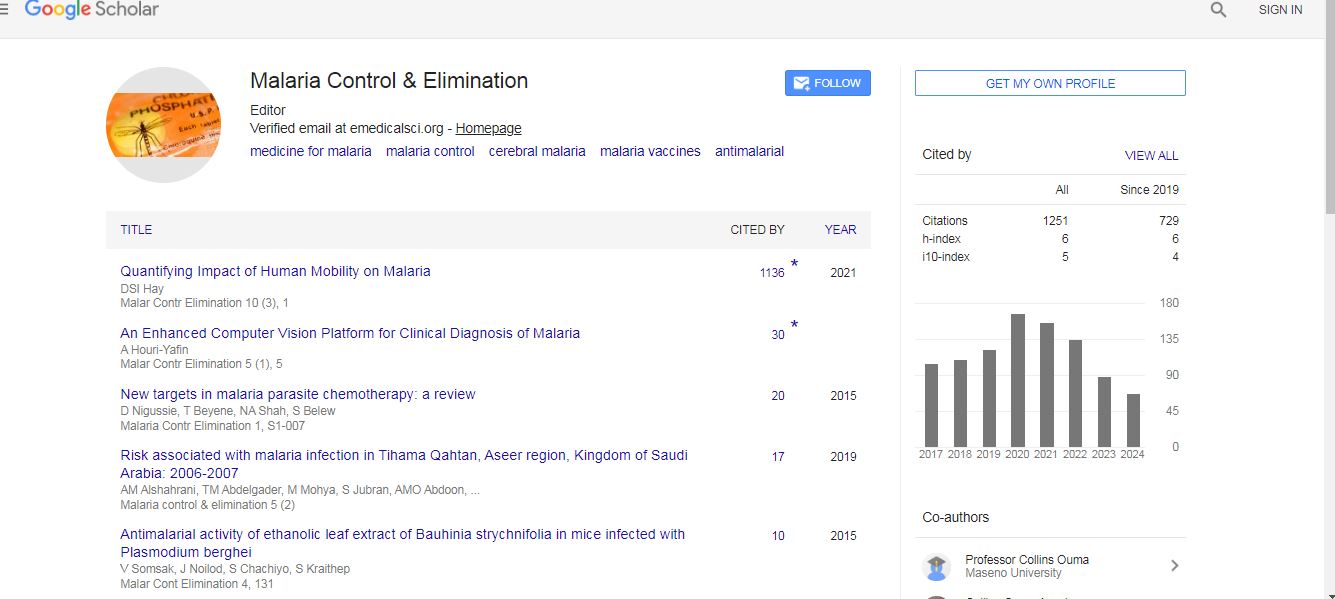
Malaria Control & Elimination received 1187 citations as per Google Scholar report