Brief Report - (2025) Volume 14, Issue 6
Received: 02-Nov-2025, Manuscript No. iem-26-179844;
Editor assigned: 04-Nov-2025, Pre QC No. P-179844;
Reviewed: 16-Nov-2025, QC No. Q-179844;
Revised: 23-Nov-2025, Manuscript No. R-179844;
Published:
30-Nov-2025
, DOI: 10.37421/2169- 0316.2025.14.327
Citation: Brown, Olivia. âStrategies for Enhancing Manufacturing Productivity.â J Ind Eng Manag 14 (2025):327.
Copyright: © 2025 Brown O. This is an open-access article distributed under the terms of the Creative Commons Attribution License, which permits unrestricted use, distribution and reproduction in any medium, provided the original author and source are credited.
The measurement and enhancement of productivity in manufacturing systems are complex endeavors, requiring a deep understanding of how various inputs interact to produce desired outputs. Early research has emphasized the development of comprehensive metrics that extend beyond basic output per hour, incorporating crucial elements such as quality, efficiency, and resource utilization. The integration of advanced technologies, including the Internet of Things (IoT), artificial intelligence (AI), and automation, plays a pivotal role in driving productivity gains. However, the effective measurement of these gains necessitates clear definitions, robust data collection systems, and well-defined analytical frameworks to pinpoint areas for improvement [1].
Digital transformation, particularly through the adoption of Industry 4.0 technologies, is a significant driver of manufacturing productivity. While these advancements offer substantial potential for increased output and efficiency, their successful implementation and the accurate measurement of their impact are paramount. Research underscores the need for integrated approaches to productivity measurement, spanning across different operational levels and considering both technological and organizational facets [2].
Lean manufacturing principles provide a foundational framework for productivity enhancement by focusing on the systematic elimination of waste within production processes. This approach is fundamental to increasing output and improving overall efficiency. Furthermore, a multi-dimensional perspective on productivity measurement, aligned with lean objectives, is proposed, emphasizing value stream optimization and a culture of continuous improvement [3].
The impact of automation and artificial intelligence (AI) on manufacturing productivity is a subject of considerable research. Intelligent automation systems are identified as key enablers of workflow optimization, error reduction, and throughput enhancement. Consequently, there is a growing imperative to develop metrics that accurately capture the performance improvements realized through these technologies, moving beyond traditional measurement paradigms [4].
The integration of the Internet of Things (IoT) into manufacturing processes offers significant potential for productivity enhancement. IoT facilitates real-time data acquisition from connected devices, providing granular insights into production operations. This enables more informed decision-making and improved operational efficiency. The paper outlines methods for quantifying productivity gains derived from IoT adoption, with a strong emphasis on the role of data analytics [5].
Comprehensive productivity measurement in manufacturing often calls for frameworks that consider total factor productivity (TFP). TFP offers a holistic view by accounting for multiple inputs and outputs, serving as a robust indicator of efficiency and innovation. Changes in technology, workforce skills, and organizational practices are all identified as significant influences on TFP, providing a more complete picture than single-factor productivity measures alone [6].
Supply chain resilience is increasingly recognized as a critical factor influencing manufacturing productivity. Disruptions within the supply chain can have substantial negative consequences on production output and operational efficiency. Research is exploring metrics to assess how resilient supply chains contribute to maintaining and improving productivity, particularly in dynamic and unpredictable market environments [7].
The role of human capital and workforce skills is instrumental in driving manufacturing productivity. Investments in employee training and development can yield significant improvements in output quality and operational efficiency. The exploration of how to precisely measure the contribution of skilled labor to overall productivity complements the understanding of technological advancements [8].
Simulation modeling emerges as a valuable tool for productivity analysis in manufacturing settings. It enables the testing of various operational scenarios, the identification of potential bottlenecks, and the optimization of resource allocation prior to on-site implementation. Simulation offers a proactive approach to productivity measurement and improvement [9].
Quality management systems play a direct and significant role in enhancing manufacturing productivity. A strong commitment to product quality inherently leads to reductions in waste, rework, and improved overall efficiency. Studies are exploring measurement methodologies that explicitly incorporate the quality dimension, thereby illustrating its direct correlation with overall performance [10].
Measuring productivity in manufacturing systems is a multifaceted challenge that necessitates a thorough examination of the interplay between various inputs, such as labor, capital, and materials, and the resulting outputs. Contemporary research underscores the importance of developing sophisticated metrics that move beyond simple output per labor hour, integrating critical dimensions like product quality, operational efficiency, judicious resource utilization, and system adaptability. The proliferation of advanced technologies, including the Internet of Things (IoT), artificial intelligence (AI), and automation, exerts a profound influence on productivity levels. However, the effective measurement of these impacts requires unambiguous definitions, robust data collection mechanisms, and comprehensive analytical frameworks to accurately identify operational bottlenecks and pinpoint opportunities for enhancement [1].
This research delves into the transformative effects of digital technologies on manufacturing productivity, with a specific focus on the integration of Industry 4.0 principles. It is observed that while these technologies hold immense promise for substantial productivity gains, their effective deployment and precise measurement are critical determinants of success. The study emphasizes the imperative for holistic and integrated approaches to measuring productivity across various strata of the manufacturing system, ensuring that both technical advancements and organizational dynamics are duly considered [2].
Lean manufacturing principles offer a robust framework for achieving enhanced productivity through the systematic identification and elimination of waste within production processes. This methodology is fundamental to maximizing output and improving overall operational efficiency. The authors advocate for a multi-dimensional approach to productivity measurement that is intrinsically aligned with lean objectives, focusing on the optimization of value streams and the cultivation of a culture dedicated to continuous improvement [3].
Investigations into the role of automation and artificial intelligence (AI) in augmenting manufacturing productivity reveal that intelligent automation systems are instrumental in optimizing workflows, minimizing errors, and accelerating throughput. Consequently, there is a heightened emphasis on the development of precise metrics capable of quantifying the performance enhancements driven by these sophisticated technologies, thereby transcending the limitations of traditional measurement methods [4].
The integration of the Internet of Things (IoT) within manufacturing environments is a key strategy for boosting productivity. IoT enables the collection of real-time data from interconnected devices, offering granular insights into production processes. This capability facilitates superior decision-making and enhances operational efficiency. The paper further outlines specific methodologies for quantifying the productivity improvements realized through the adoption of IoT, with a particular emphasis on the analytical capabilities of data [5].
Frameworks for measuring total factor productivity (TFP) in manufacturing are crucial for capturing a comprehensive view of efficiency and innovation. TFP considers the combined effects of multiple inputs and outputs, providing a more holistic assessment than traditional single-factor measures. The study highlights how technological advancements, improvements in labor skills, and evolving organizational practices collectively influence TFP, offering a more complete understanding of productivity drivers [6].
The impact of supply chain resilience on manufacturing productivity is a significant area of inquiry. Vulnerabilities within the supply chain can substantially impede production output and diminish operational efficiency. Research is focused on developing metrics to quantify how resilient supply chain strategies contribute to the maintenance and improvement of manufacturing productivity, especially in the face of global volatility [7].
Human capital and the cultivation of advanced workforce skills are recognized as pivotal factors in driving manufacturing productivity. Strategic investments in employee training and development programs can lead to substantial enhancements in the quality of output and overall operational efficiency. The paper explores methods for accurately measuring the specific contribution of a skilled workforce to overall productivity, complementing the impact of technological innovations [8].
Simulation modeling is presented as a powerful technique for conducting productivity analysis in manufacturing systems. It allows for the exploration of various operational scenarios, the identification of potential bottlenecks, and the optimization of resource allocation before committing to physical changes on the factory floor. Simulation provides a proactive mechanism for both measuring and improving productivity [9].
The relationship between robust quality management systems and manufacturing productivity is a critical focus. A strong emphasis on product quality inherently translates into reduced waste, fewer instances of rework, and improved overall efficiency. The article details approaches to productivity measurement that explicitly account for the quality dimension, thereby illustrating its direct and positive correlation with overall manufacturing performance [10].
This collection of research highlights key strategies and technologies for enhancing manufacturing productivity. It emphasizes the need for comprehensive metrics that go beyond simple output measures to include quality, efficiency, and resource utilization. Advanced technologies like IoT, AI, and automation are identified as significant drivers of productivity gains. Frameworks such as lean manufacturing and total factor productivity (TFP) are presented as essential for systematic improvement. The role of human capital, supply chain resilience, and quality management in boosting productivity is also explored. Tools like simulation modeling are crucial for proactive analysis and optimization.
None
None
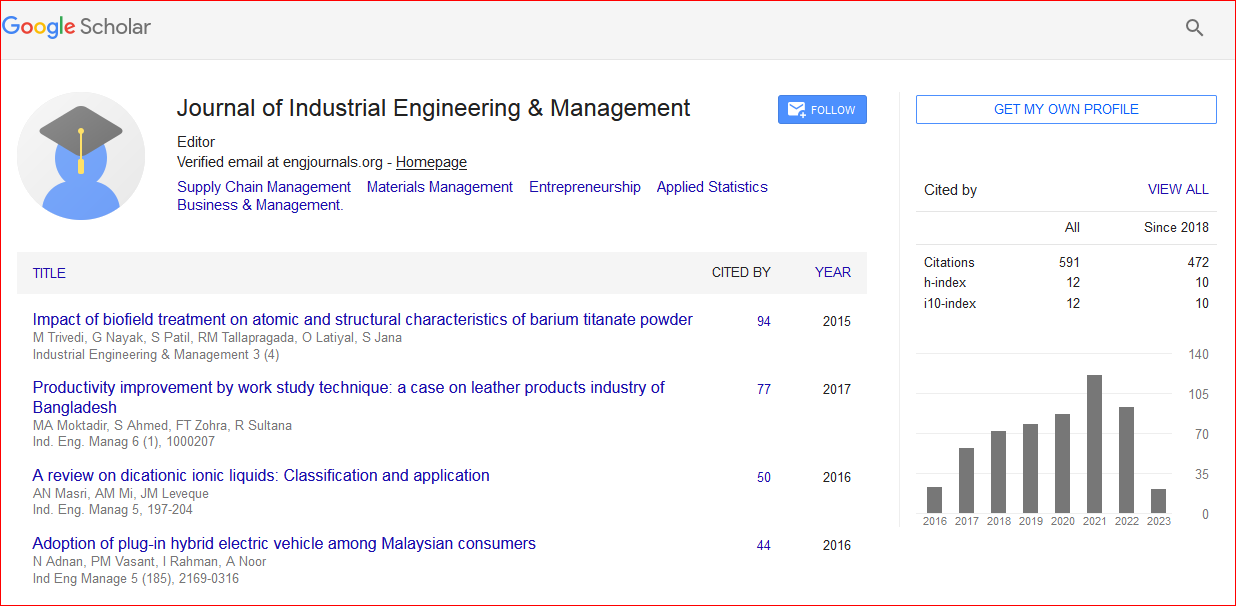
Industrial Engineering & Management received 739 citations as per Google Scholar report