Short Communication - (2025) Volume 14, Issue 5
Received: 01-Oct-2025, Manuscript No. jbfa-25-176832;
Editor assigned: 03-Oct-2025, Pre QC No. P-176832;
Reviewed: 17-Oct-2025, QC No. Q-176832;
Revised: 22-Oct-2025, Manuscript No. R-176832;
Published:
29-Oct-2025
, DOI: 10.37421/2161-0673.2025.14.557
Citation: Stein, Lucas. ”Strategic Sustainability: ESG, Digitalization, and Growth.” J Bus Fin Aff 14 (2025):557.
Copyright: © 2025 Stein L. This is an open-access article distributed under the terms of the Creative Commons Attribution License, which permits unrestricted use, distribution and reproduction in any medium, provided the original author and source are credited.
Corporate social responsibility (CSR) initiatives, combined with green innovation strategies, significantly contribute to the long-term sustainability of businesses. These practices are crucial drivers for enhancing a firm's sustainable performance, suggesting a strategic imperative for companies to integrate these elements into their core operations to achieve competitive advantages and resilience [1].
Systematic reviews also explore the relationship between circular economy business models and organizational innovation, which together drive business sustainability. Current research identifies key enablers and barriers, proposing frameworks that demonstrate how rethinking product design, consumption, and waste management through circular principles can lead to substantial sustainability improvements and novel value creation for businesses [2].
The intricate connection between Environmental, Social, and Governance (ESG) performance and a company's financial performance has been examined. Findings reveal that while ESG performance generally has a positive impact, the effectiveness of environmental management systems plays a crucial moderating role. This amplifies the financial benefits derived from strong ESG practices, advocating for integrated sustainability strategies [3].
Another review synthesizes the rapidly evolving intersection of digitalization and sustainable supply chain management. It outlines how technologies such as Artificial Intelligence (AI), blockchain, and the Internet of Things (IoT) can enhance transparency, efficiency, and environmental performance across supply chains. The review also identifies gaps in current research and proposes directions for future studies on leveraging digital tools for more resilient and sustainable operations [4].
Research investigates the links between Green Human Resource Management (GHRM) practices, green creativity among employees, and overall corporate environmental performance. It highlights that an organization's environmental ethics significantly moderates these relationships. A strong ethical foundation fosters an environment where GHRM initiatives and employee creativity more effectively translate into improved ecological outcomes for the business [5].
A comprehensive overview of research on Sustainable Business Models (SBMs) identifies key trends, challenges, and opportunities for innovation. This systematic review outlines various approaches companies adopt to integrate sustainability into their core operations, emphasizing the need for holistic strategies that consider environmental, social, and economic dimensions for long-term viability and impact [6].
Studies explore how digital transformation influences corporate sustainability, with evidence from Chinese firms. Findings suggest that integrating digital technologies can significantly enhance a company's environmental, social, and governance performance. This occurs by improving operational efficiency, enabling data-driven decision-making, and fostering innovation towards more sustainable practices, thereby linking technological advancement with corporate responsibility [7].
The relationship between Environmental, Social, and Governance (ESG) disclosure and firm value within an emerging market context has also been investigated. Results indicate that transparent ESG reporting positively influences a company's market valuation. This suggests that investors in these markets increasingly recognize and reward firms demonstrating strong commitment to sustainability and corporate responsibility through their disclosures [8].
Meta-analyses synthesize findings from numerous studies to clarify the impact of green innovation on firm performance. These analyses conclude that green innovation generally has a positive and significant effect on both environmental and financial performance. This underscores the strategic importance for businesses to invest in eco-friendly product and process innovations to achieve sustainable competitive advantages [9].
Finally, systematic reviews explore the critical role of stakeholder engagement in the process of sustainability reporting. They reveal that effective engagement with various stakeholder groups enhances the credibility, relevance, and completeness of sustainability reports. This fosters greater transparency and accountability, which are vital for building trust and driving genuine business sustainability initiatives [10].
The push for corporate sustainability has become a central theme in modern business discourse, driven by environmental concerns, social expectations, and economic pressures. Research consistently shows that integrating sustainable practices offers significant benefits, ranging from enhanced financial performance to improved competitive advantage. A key area of focus involves the synergy between Corporate Social Responsibility (CSR) initiatives and green innovation strategies. These elements are not merely beneficial but are crucial drivers for long-term business viability, urging companies to embed them deeply within their core operations to achieve resilience and market leadership [1, 9]. The positive impact of green innovation, in particular, extends to both environmental and financial outcomes, solidifying its strategic importance for businesses investing in eco-friendly products and processes [9].
Another vital aspect of sustainability is the adoption of circular economy business models. These models, coupled with organizational innovation, are instrumental in driving business sustainability. By re-evaluating and transforming product design, consumption patterns, and waste management processes, businesses can unlock substantial improvements in sustainability and create new value streams. Systematic reviews in this area identify key enablers and barriers, providing frameworks that guide companies toward more sustainable practices through circular principles [2, 6]. These approaches align with broader Sustainable Business Models (SBMs) that advocate for holistic strategies, integrating environmental, social, and economic dimensions for enduring viability [6].
Environmental, Social, and Governance (ESG) performance represents a critical framework for assessing a company's commitment to sustainability. Studies demonstrate a clear positive link between strong ESG performance and a company's financial standing. Crucially, the effectiveness of internal environmental management systems moderates this relationship, amplifying the financial benefits derived from robust ESG practices. This emphasizes the need for integrated sustainability strategies that are not just aspirational but are systematically implemented and managed [3]. Furthermore, transparent ESG disclosure plays a significant role in influencing firm value, particularly within emerging markets. In these contexts, investors increasingly value and reward companies that openly commit to sustainability and corporate responsibility through their reporting, recognizing the long-term benefits of such transparency [8].
Digital transformation is emerging as a powerful enabler for corporate sustainability. The integration of digital technologies, such as Artificial Intelligence (AI), blockchain, and the Internet of Things (IoT), can profoundly enhance various aspects of sustainable operations. These technologies improve operational efficiency, facilitate data-driven decision-making, and foster innovation, leading to better environmental, social, and governance performance [4, 7]. This technological advancement links directly with corporate responsibility, making supply chains more transparent, efficient, and environmentally friendly. Additionally, Green Human Resource Management (GHRM) practices are integral to cultivating a sustainable culture within organizations. GHRM, when underpinned by strong organizational environmental ethics, encourages green creativity among employees. This synergy translates effectively into improved ecological outcomes for the business, highlighting the human element in achieving corporate environmental goals [5]. Effective stakeholder engagement is also paramount for sustainability reporting, boosting its credibility and relevance, thereby building trust and accountability [10].
Modern businesses face increasing pressure to adopt sustainable practices, moving beyond mere compliance to strategic integration. This body of research illustrates various pathways and crucial factors influencing corporate sustainability. Corporate Social Responsibility (CSR) initiatives and green innovation emerge as central drivers, enhancing a firm's performance and providing competitive advantages. Incorporating eco-friendly practices and ethical frameworks allows companies to achieve greater resilience. The importance of Environmental, Social, and Governance (ESG) performance is repeatedly highlighted. Strong ESG practices, particularly when supported by effective environmental management systems, positively affect financial performance and firm value, especially in emerging markets. This suggests that investors increasingly recognize and reward transparent ESG reporting and genuine commitment to sustainability. Digitalization plays a transformative role, enhancing efficiency and environmental performance across supply chains. Technologies like Artificial Intelligence (AI), blockchain, and the Internet of Things (IoT) foster transparency and data-driven decisions, linking technological advancement with corporate responsibility. Furthermore, Sustainable Business Models (SBMs), including circular economy principles, offer novel value creation through rethinking product design and waste management. Effective stakeholder engagement is also vital, improving the credibility and completeness of sustainability reporting, which in turn builds trust and drives genuine initiatives. Green Human Resource Management (GHRM), alongside organizational environmental ethics, cultivates green creativity among employees, translating into better ecological outcomes. These studies collectively advocate for a holistic, integrated approach to sustainability, encompassing environmental, social, and economic dimensions for long-term viability.
None
None
Indexed at, Google Scholar, Crossref
Indexed at, Google Scholar, Crossref
Indexed at, Google Scholar, Crossref
Indexed at, Google Scholar, Crossref
Indexed at, Google Scholar, Crossref
Indexed at, Google Scholar, Crossref
Indexed at, Google Scholar, Crossref
Indexed at, Google Scholar, Crossref
Indexed at, Google Scholar, Crossref
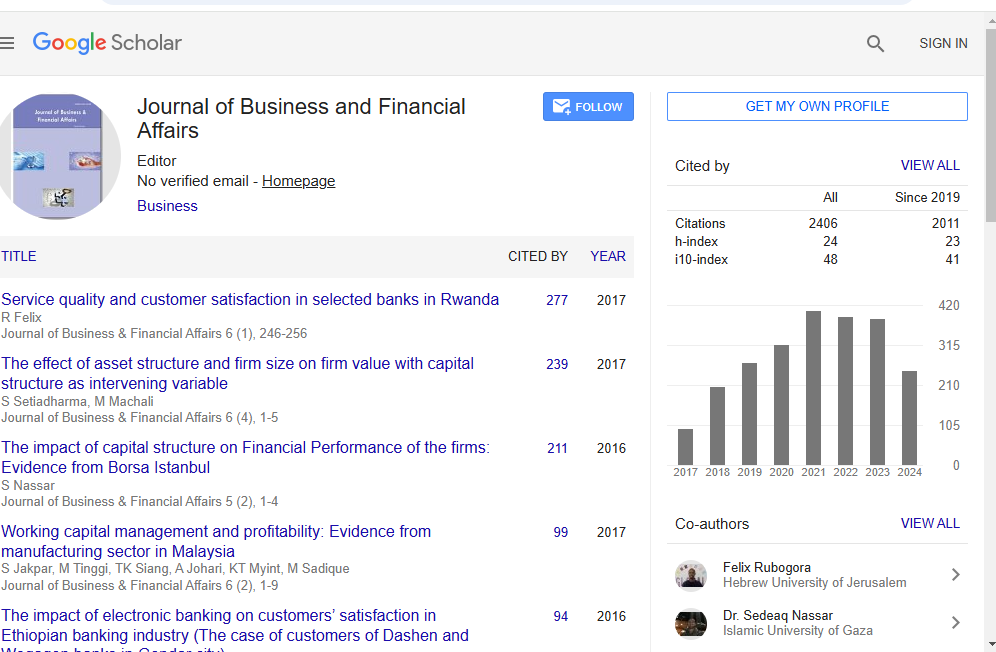
Journal of Business & Financial Affairs received 1726 citations as per Google Scholar report