Short Communication - (2025) Volume 14, Issue 6
Received: 01-Nov-2025, Manuscript No. pbt-25-178169;
Editor assigned: 03-Nov-2025, Pre QC No. P-178169;
Reviewed: 17-Nov-2025, QC No. Q-178169;
Revised: 24-Nov-2025, Manuscript No. R-178169;
Published:
29-Nov-2025
, DOI: 10.37421/2167-7689.2025.14.518
Citation: González, Laura. ”Strategic Pharmaceutical Regulatory Affairs for Global Success.” Pharmaceut Reg Affairs 14 (2025):518.
Copyright: © 2025 González L. This is an open-access article distributed under the terms of the Creative Commons Attribution License, which permits unrestricted use, distribution and reproduction in any medium, provided the original author and source are credited.
A robust regulatory affairs strategy is paramount for pharmaceutical product development and market access, requiring proactive engagement with regulatory bodies and a deep understanding of evolving global compliance landscapes. Key considerations include early scientific advice, robust data generation, and a clear submission pathway tailored to target markets [1].
The strategy must address the increasing complexity of regulatory submissions, including the integration of real-world evidence and advanced manufacturing technologies. Continuous monitoring of regulatory intelligence and adaptation to new guidelines are essential for timely approvals and lifecycle management [2].
Effective regulatory affairs strategy involves building strong relationships with health authorities, fostering transparency, and ensuring compliance with Good Clinical Practice (GCP), Good Manufacturing Practice (GMP), and Good Pharmacovigilance Practice (GVP). Early engagement can mitigate risks and accelerate development timelines [3].
Strategic planning for regulatory submissions must account for regional variations in regulatory requirements, particularly for emerging markets. A global regulatory strategy needs to be adaptable, considering local data needs, language requirements, and specific dossier formats [4].
The digital transformation of regulatory affairs necessitates investments in regulatory information management (RIM) systems and data analytics. These tools enhance efficiency, ensure data integrity, and facilitate compliance with electronic submission standards like eCTD [5].
Pharmacovigilance and post-market surveillance are critical components of a comprehensive regulatory affairs strategy. A robust system for signal detection, risk assessment, and communication ensures patient safety and maintains product compliance throughout its lifecycle [6].
The strategy for new drug applications (NDAs) and marketing authorization applications (MAAs) must be meticulously planned, addressing preclinical and clinical data requirements, quality aspects, and labeling. Collaboration between R&D, manufacturing, and regulatory affairs teams is vital [7].
Regulatory affairs professionals play a pivotal role in ensuring that clinical trials are designed and conducted in compliance with international ethical and scientific quality standards (ICH-GCP). This adherence is foundational to generating reliable data for regulatory submissions [8].
The regulatory strategy for biosimilars requires a nuanced approach, focusing on demonstrating similarity and interchangeability. This involves extensive comparative analytical, non-clinical, and clinical studies to meet the stringent requirements of regulatory agencies [9].
Regulatory affairs professionals must possess strong communication skills to effectively interact with regulatory agencies, internal stakeholders, and external partners. Clear, concise, and accurate communication is fundamental to the success of regulatory strategies and submissions [10].
Navigating the evolving landscape of pharmaceutical regulatory affairs demands a strategic and proactive approach. This involves meticulous engagement with regulatory bodies and a profound comprehension of the dynamic global compliance environment. Essential elements include seeking early scientific advice, generating comprehensive data, and defining a clear submission pathway that is specifically tailored to each target market's unique requirements [1].
The complexities inherent in modern regulatory submissions necessitate a forward-thinking strategy. This includes the seamless integration of real-world evidence and the adoption of advanced manufacturing technologies. Ongoing surveillance of regulatory intelligence, coupled with timely adaptation to emerging guidelines, are indispensable for achieving prompt approvals and effectively managing the product lifecycle [2].
A cornerstone of successful regulatory affairs is the cultivation of robust relationships with health authorities. Fostering an environment of transparency and ensuring strict adherence to Good Clinical Practice (GCP), Good Manufacturing Practice (GMP), and Good Pharmacovigilance Practice (GVP) are paramount. Proactive engagement at the earliest stages can significantly mitigate potential risks and expedite development timelines [3].
Strategic planning for regulatory submissions must explicitly account for the diverse regional variations in regulatory requirements, particularly when targeting emerging markets. A globally oriented regulatory strategy needs to be inherently adaptable, carefully considering local data demands, specific language needs, and distinct dossier formatting conventions [4].
The ongoing digital transformation within pharmaceutical regulatory affairs mandates strategic investments in sophisticated regulatory information management (RIM) systems and advanced data analytics capabilities. These technological tools are instrumental in enhancing operational efficiency, ensuring the utmost data integrity, and facilitating seamless compliance with electronic submission standards, such as the eCTD format [5].
Pharmacovigilance and post-market surveillance represent critical, indispensable components of any comprehensive regulatory affairs strategy. The establishment of a robust system for the timely detection of safety signals, thorough risk assessment, and effective communication strategies is vital for safeguarding patient safety and maintaining continuous product compliance throughout its entire lifecycle [6].
The strategic planning process for new drug applications (NDAs) and marketing authorization applications (MAAs) requires meticulous attention to detail. This involves addressing all preclinical and clinical data requirements, quality attributes, and precise labeling information. Close collaboration among R&D, manufacturing, and regulatory affairs teams is absolutely essential for success [7].
Regulatory affairs professionals shoulder the significant responsibility of ensuring that clinical trials are meticulously designed and executed in full accordance with international ethical and scientific quality standards, specifically ICH-GCP. This unwavering adherence is the fundamental basis for generating reliable and credible data that is essential for successful regulatory submissions [8].
Developing a regulatory strategy for biosimilar products demands a highly nuanced and specialized approach. The primary focus must be on unequivocally demonstrating similarity and interchangeability with the reference biologic. This entails undertaking extensive comparative analytical studies, rigorous non-clinical assessments, and comprehensive clinical trials to satisfy the stringent requirements stipulated by regulatory agencies worldwide [9].
Effective communication is an indispensable skill for regulatory affairs professionals, enabling them to engage productively with regulatory agencies, internal project teams, and external collaborators. The delivery of clear, concise, and entirely accurate communication is fundamental to the successful implementation of regulatory strategies and the timely approval of submissions [10]
A comprehensive pharmaceutical regulatory affairs strategy is essential for product development and market access, requiring proactive engagement with regulatory bodies and understanding global compliance. Key elements include early scientific advice, robust data generation, and tailored submission pathways. The strategy must address increasing submission complexity, integrate real-world evidence and advanced manufacturing, and adapt to new guidelines. Strong relationships with health authorities, transparency, and adherence to GCP, GMP, and GVP are crucial. Strategic planning needs to account for regional variations and be adaptable. Digital transformation through RIM systems and data analytics enhances efficiency and compliance. Pharmacovigilance and post-market surveillance are vital for patient safety and product compliance. Meticulous planning for NDAs and MAAs, involving cross-functional collaboration, is necessary. Regulatory professionals ensure clinical trial compliance with ICH-GCP. Biosimilar strategies focus on demonstrating similarity through extensive studies. Effective communication is fundamental to success in regulatory affairs.
None
None
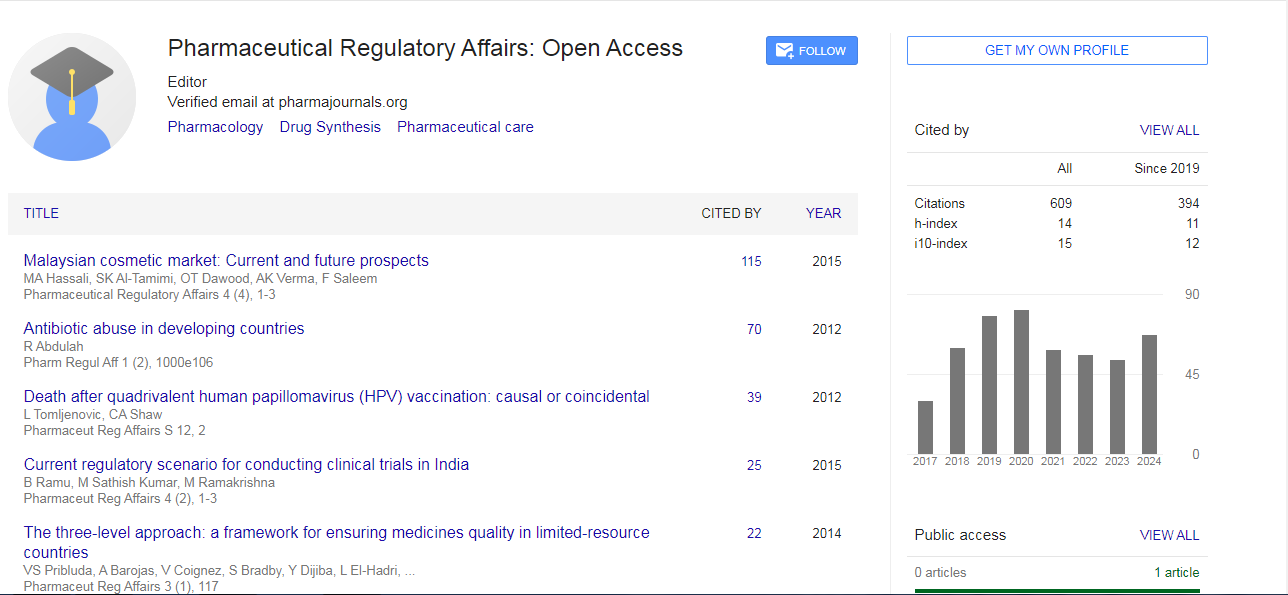
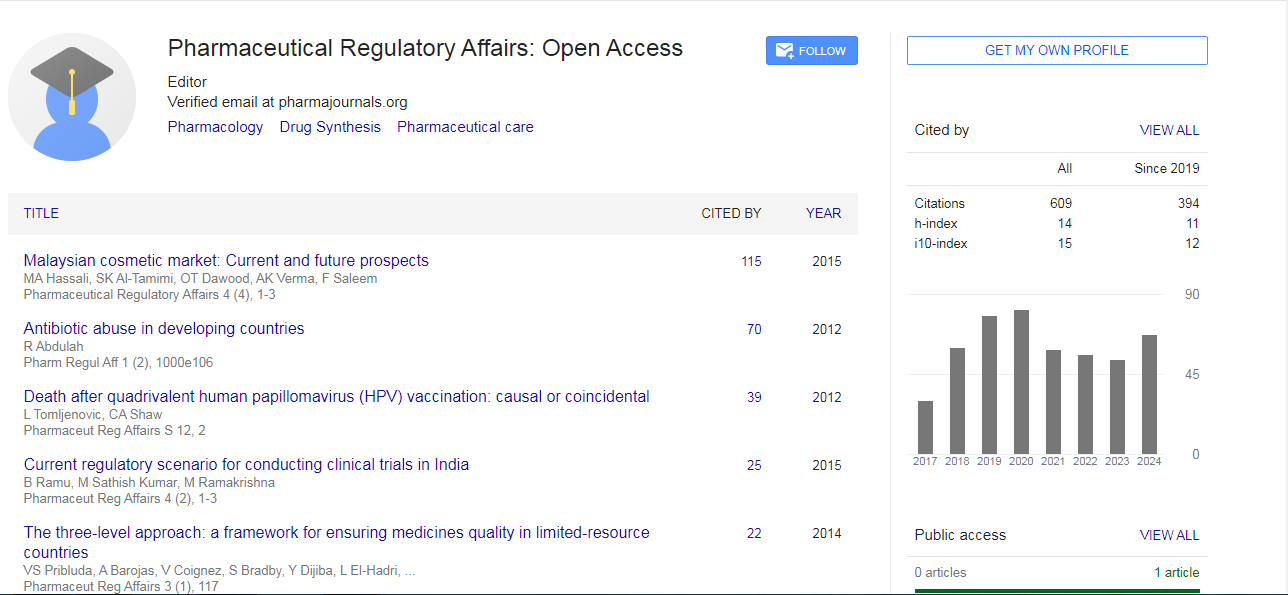
Pharmaceutical Regulatory Affairs: Open Access received 533 citations as per Google Scholar report