Short Communication - (2025) Volume 14, Issue 3
Received: 01-Jun-2025, Manuscript No. jbfa-25-174151;
Editor assigned: 03-Jun-2025, Pre QC No. P-174151;
Reviewed: 17-Jun-2025, QC No. Q-174151;
Revised: 23-Jun-2025, Manuscript No. R-174151;
Published:
30-Jun-2025
, DOI: 10.37421/2167-0234.2025.14.538
Citation: Patel, Ananya. ”Strategic Digital Transformation: Orchestration and Agility.” J Bus Fin Aff 14 (2025):538.
Copyright: © 2025 Patel A. This is an open-access article distributed under the terms of the Creative Commons Attribution License, which permits unrestricted use, distribution and reproduction in any medium, provided the original author and source are credited.
The contemporary business environment demands a nuanced understanding of strategic management, particularly concerning adaptability, capability development, and innovation. Firms today grapple with the imperatives of digital transformation, recognizing its potential far beyond mere technological upgrades. This article explores how firms orchestrate various capabilities to effectively implement digital transformation initiatives. It emphasizes a knowledge-based perspective, highlighting the critical role of knowledge integration and strategic learning in developing and leveraging these capabilities. What this really means is successful digital shifts aren't just about technology; they're about how an organization structures its knowledge and adapts [1].
The strategic potential of digital transformation extends significantly beyond process automation, offering profound opportunities for firms to reshape competitive landscapes, foster new business models, and create sustained value. Here's the thing: thinking past just automating tasks opens up real strategic advantages [3].
Furthermore, strategic management itself is undergoing a digital transformation, drawing on the concept of dynamic capabilities. This evolution outlines how firms can leverage digital tools and processes to renew their strategic planning, implementation, and adaptation. What this really means is that how companies manage strategy needs to evolve with digital tools, much like other business functions [4].
Central to strategic success is the effective orchestration of resources and the development of robust capabilities. This paper bridges resource orchestration, competitive advantage, and entrepreneurship by proposing that how firms combine and deploy their resources can shape their entrepreneurial efforts. It posits that understanding this interplay is crucial for sustaining competitive edge, especially in dynamic environments. What this really means is that entrepreneurial success isn't just about having good resources; it's about how cleverly you use and organize them [2].
Strong alliances don't just happen; they're built through deliberate actions and learning within the organization. This perspective offers a microfoundational view on how firms develop capabilities to manage their alliance portfolios, emphasizing the dynamic processes and individual-level actions that shape these strategic assets [8].
To thrive in dynamic environments, firms increasingly rely on strategic agility and organizational ambidexterity. This meta-analytic review synthesizes research on strategic agility and organizational ambidexterity, clarifying their relationship and impact on firm performance. It offers insights into how firms can simultaneously explore new opportunities and exploit existing capabilities to navigate dynamic environments. Let's break it down: being strategically agile means you're good at both finding new paths and excelling at what you already do well [5].
The ability to simultaneously pursue exploration and exploitation, known as organizational ambidexterity, significantly impacts innovation performance, especially when strategic alliances are involved. Smart partnerships can give companies an edge in innovation if they're already good at balancing new ventures with existing strengths [6].
Beyond internal capabilities and alliances, external factors like corporate governance and stakeholder engagement play a crucial role in firm value and strategy. This study examines how corporate social performance affects firm value, introducing corporate governance as a moderated mediator. It demonstrates that effective governance structures can amplify the positive financial returns from strong social performance, suggesting that doing good needs good oversight to translate into financial gains. Here's the thing: good governance doesn't just manage risk; it helps companies get more value out of their social efforts [7].
Companies are increasingly looking beyond their walls for strategic ideas, not just product innovation. This approach, termed open strategy, involves external stakeholders in strategic processes, highlighting both benefits and challenges [9].
Furthermore, board interlocks, where individuals sit on multiple corporate boards, influence firm performance through a social capital lens. What this really means is that who sits on your board, and who else they're connected to, can significantly affect how well your company performs, for better or worse [10].
This collective body of work provides a comprehensive outlook on strategic challenges and opportunities in today's interconnected business landscape.
The evolving landscape of strategic management is characterized by a persistent emphasis on dynamic capabilities and digital transformation. Firms are increasingly realizing that merely automating processes is insufficient; instead, a profound strategic shift is required. Orchestrating capabilities for digital transformation is critical, viewed from a knowledge-based perspective where knowledge integration and strategic learning are paramount for successful implementation [1]. The true value lies in how an organization structures its knowledge and adapts to new digital realities. This extends to the very core of strategic management, which itself undergoes digital transformation, leveraging digital tools for renewed strategic planning and adaptation [4]. What this really means is that how companies manage strategy needs to evolve with digital tools, much like other business functions. The strategic potential of digital transformation goes beyond automation, fostering new business models and sustained value creation [3].
Resource orchestration stands as a fundamental driver for competitive advantage and entrepreneurship. How firms combine and deploy their resources directly shapes entrepreneurial efforts, highlighting the necessity of clever resource utilization for a sustained competitive edge in dynamic environments [2]. This involves a microfoundational understanding of how firms develop capabilities to manage their alliance portfolios. Strong alliances don't just happen; they're built through deliberate actions and learning within the organization, shaping these strategic assets dynamically [8]. The development of these capabilities is an ongoing process rooted in individual-level actions.
Organizational agility and ambidexterity are pivotal for navigating complex market conditions and driving innovation. A meta-analytic review clarifies the relationship between strategic agility and organizational ambidexterity, demonstrating their impact on firm performance by enabling simultaneous exploration of new opportunities and exploitation of existing capabilities [5]. Being strategically agile means you're good at both finding new paths and excelling at what you already do well. This ability to balance exploration and exploitation significantly influences innovation performance, especially when complemented by strategic alliances [6]. Smart partnerships can give companies an edge in innovation if they're already good at balancing new ventures with existing strengths.
Beyond internal operational dynamics, external interactions and governance structures profoundly impact firm success. The concept of open strategy, evolving from open innovation, emphasizes involving external stakeholders in strategic processes to crowdsource insights, highlighting a shift where companies increasingly look beyond their walls for strategic ideas [9]. Corporate social performance, for example, impacts firm value, with effective corporate governance structures moderating and amplifying these positive financial returns. Good governance doesn't just manage risk; it helps companies get more value out of their social efforts [7]. Furthermore, the influence of board interlocks, or connections between multiple corporate boards, on firm performance is examined through a social capital lens, indicating that these connections can provide valuable information and resources while also posing potential risks [10]. What this really means is that who sits on your board, and who else they're connected to, can significantly affect how well your company performs, for better or worse. These diverse elements collectively paint a picture of strategic complexity, where integrated approaches to capabilities, resources, partnerships, and governance are essential for enduring success.
This body of research explores various facets of strategic management, emphasizing how organizations navigate complex and evolving business landscapes. A key theme is digital transformation, seen not just as process automation but as a strategic imperative demanding the orchestration of diverse capabilities and knowledge integration for sustained value creation. What this really means is successful digital shifts aren't just about technology; they're about how an organization structures its knowledge and adapts. The digital transformation of strategic management itself, leveraging dynamic capabilities, is also a focal point, suggesting that how companies manage strategy needs to evolve with digital tools, much like other business functions. Resource orchestration is central to achieving competitive advantage and fostering entrepreneurial efforts. Firms effectively combine and deploy their resources to shape their strategic endeavors. Entrepreneurial success isn't just about having good resources; it's about how cleverly you use and organize them. Organizational agility and ambidexterity are crucial for firm performance, allowing companies to simultaneously explore new opportunities and exploit existing strengths. Strategic partnerships, here's the thing, can significantly enhance innovation outcomes for ambidextrous firms. Strong alliances don't just happen; they're built through deliberate actions and learning within the organization. The discussions also cover open strategy, where external stakeholders contribute to strategic processes, and the influence of corporate governance on firm value. Good governance doesn't just manage risk; it helps companies get more value out of their social efforts. Additionally, board interlocks are examined as a source of social capital influencing firm performance. What this really means is that who sits on your board, and who else they're connected to, can significantly affect how well your company performs, for better or worse.
None
None
Indexed at, Google Scholar, Crossref
Indexed at, Google Scholar, Crossref
Indexed at, Google Scholar, Crossref
Indexed at, Google Scholar, Crossref
Indexed at, Google Scholar, Crossref
Indexed at, Google Scholar, Crossref
Indexed at, Google Scholar, Crossref
Indexed at, Google Scholar, Crossref
Indexed at, Google Scholar, Crossref
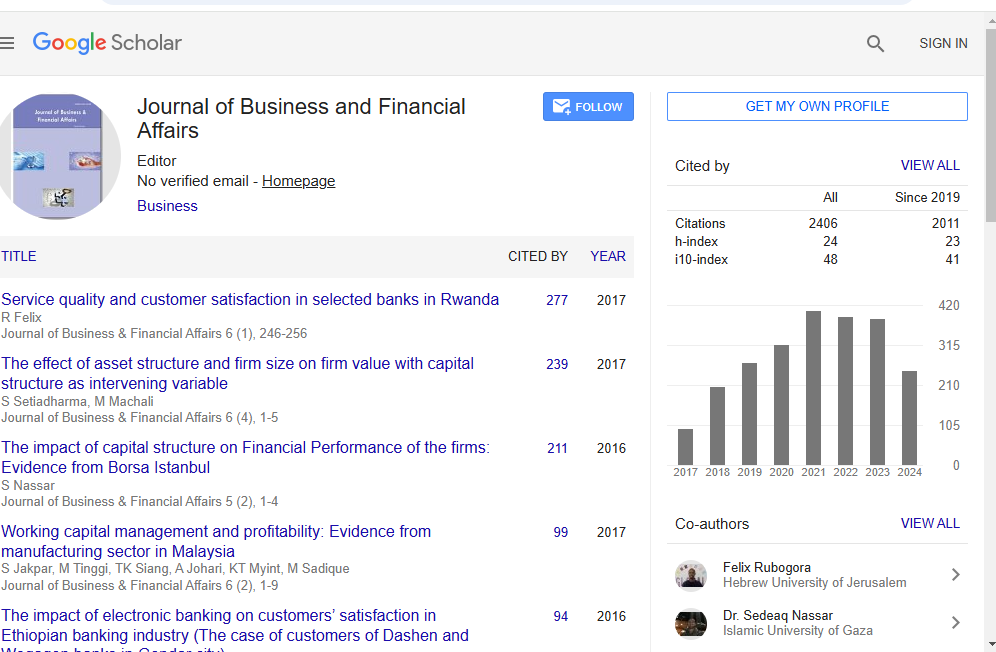
Journal of Business & Financial Affairs received 1726 citations as per Google Scholar report