Commentary - (2025) Volume 14, Issue 3
Received: 01-Jun-2025, Manuscript No. jbfa-25-174143;
Editor assigned: 03-Jun-2025, Pre QC No. P-174143;
Reviewed: 17-Jun-2025, QC No. Q-174143;
Revised: 23-Jun-2025, Manuscript No. R-174143;
Published:
30-Jun-2025
, DOI: 10.37421/2167-0234.2025.14.532
Citation: Kim, Yuna. ”Strategic CSR Drives Business Success and Sustainability.” J Bus Fin Aff 14 (2025):532.
Copyright: © 2025 Kim Y. This is an open-access article distributed under the terms of the Creative Commons Attribution License, which permits unrestricted use, distribution and reproduction in any medium, provided the original author and source are credited.
A recent meta-analysis meticulously explores the intricate relationship between corporate social responsibility (CSR) and a company's financial success. The findings strongly suggest that CSR generally contributes positively to financial performance, although the specific impact can vary significantly based on contextual factors and how CSR initiatives are carefully implemented. It's clear that this isn't a one-size-fits-all solution; truly effective CSR necessitates careful strategic alignment with a business's overarching strategy to deliver genuine and measurable returns[1].
Another important research study delves into how companies strategically communicated their CSR efforts during the challenging global COVID-19 pandemic, specifically examining differences across various cultures. The findings underscore the critical role of transparent and empathetic communication during a crisis, demonstrating its power to shape public perception and build stakeholder trust differently in diverse cultural contexts. This serves as a vital reminder that good intentions must be coupled with thoughtful, culturally aware messaging to achieve desired outcomes[2].
This systematic review effectively connects corporate social responsibility with broader, long-term sustainability goals. The research maps out the existing body of knowledge, pinpointing key themes and identifying notable gaps in our current understanding. It powerfully emphasizes that CSR is not merely about performing good deeds; it represents a fundamental pathway to achieving environmental and social sustainability over the long run, thereby suggesting crucial future directions for both academic research and practical applications[3].
A comprehensive review offers a critical examination of how corporate social responsibility operates within emerging markets, a setting often distinct from developed economies. The authors highlight the unique challenges and opportunities encountered by firms in these rapidly developing regions, identifying significant research areas that require more focused attention. It becomes evident that local institutional contexts and deeply ingrained cultural norms profoundly shape how CSR is understood, interpreted, and practiced outside of traditional Western paradigms[4].
This literature review investigates the crucial intersection of corporate social responsibility and stakeholder engagement, particularly focusing on the demanding mining sector. Here's the thing: effective engagement with a wide array of stakeholders, from local communities to influential environmental groups, is not just a commendable practice; it is absolutely essential for a mining company to secure and maintain its social license to operate. The review clearly pinpoints critical factors necessary for successful interaction, strongly suggesting that transparent dialogue, mutual respect, and the creation of shared value are fundamental ingredients for sustained success[5].
This meta-analysis comprehensively explores the intricate connections between a firm's environmental CSR efforts, its actual environmental performance, and its capacity for fostering green innovation. What this really means is that proactively engaging in environmental social responsibility consistently leads to superior environmental outcomes and actively stimulates more innovative, eco-friendly solutions within the company. It serves as a clear signal that green CSR goes beyond mere compliance; it truly acts as a powerful driver for achieving both long-term sustainability and gaining a competitive advantage in the modern business landscape[6].
A detailed study examines how employees' perceptions of their company's corporate social responsibility activities directly influence their overall performance. The research highlights the critical mediating roles of trust and organizational identification in this dynamic. Basically, when employees genuinely believe their company acts responsibly and demonstrates authentic care, they tend to trust the organization more deeply and feel a stronger, more personal connection to it, which, in turn, significantly boosts their individual and collective performance[7].
This meta-analysis synthesizes a broad range of findings on how corporate social responsibility initiatives influence consumer behavior. The evidence robustly suggests that a company's CSR efforts positively impact various consumer responses, spanning from initial purchase intentions to cultivating strong brand loyalty. It confirms that consumers are increasingly factoring a company's social and environmental record into their buying decisions, indicating that authentic and transparent CSR is a profoundly significant element in building robust and lasting consumer relationships[8].
A systematic review thoroughly explores the complex integration of corporate social responsibility principles throughout global supply chains. It brings to light the growing complexity of effectively managing social and environmental issues across diverse and interconnected global networks. What it demonstrates is that genuinely effective CSR in supply chains absolutely requires strong collaboration, unwavering transparency, and a steadfast commitment to ethical practices at every stage, from raw material sourcing right through to final product delivery. This understanding highlights critical areas for immediate improvement and future dedicated research[9].
This systematic review deeply delves into the relationship between corporate social responsibility and innovation within organizations. The findings strongly suggest a reciprocal and mutually beneficial relationship: actively engaging in CSR can significantly stimulate various forms of innovation, encompassing everything from tangible product and process improvements to the development of entirely new business models focused on sustainability. Conversely, innovative approaches are frequently indispensable for effectively addressing complex social and environmental challenges, clearly showing that CSR can serve as a powerful catalyst for fostering organizational creativity and driving continuous progress[10].
Corporate Social Responsibility (CSR) significantly influences a company's financial success and overall sustainability efforts. Research consistently suggests that CSR generally contributes positively to financial performance, though this impact varies based on specific contextual factors and the effectiveness of its implementation. Effective CSR demands careful alignment with business strategy to truly pay off. Furthermore, a firm's environmental CSR efforts are directly linked to improved environmental performance and its capacity for green innovation, acting as a clear driver for both sustainability and competitive advantage. The integration of these aspects forms a crucial understanding of CSR's wide-ranging implications in the business world [1] [6].
Communication strategies around CSR are vital, especially during times of crisis. During the COVID-19 pandemic, companies' communication of their CSR efforts highlighted the importance of transparent and empathetic messaging. This approach critically shapes public perception and builds stakeholder trust, with varying effectiveness across different cultural contexts. In sectors like mining, effective engagement with stakeholders, encompassing local communities and environmental groups, is not merely good practice; it is essential for securing a company's social license to operate. Transparent dialogue and shared value creation are key factors for successful interaction [2] [5].
Internally, employees' perceptions of their company's CSR activities profoundly influence their performance. The research shows that trust and organizational identification play critical mediating roles. When employees believe their company genuinely cares and acts responsibly, they tend to trust the organization more and feel a stronger connection to it, which in turn boosts their performance. Externally, CSR initiatives positively impact consumer behavior. Evidence suggests these initiatives affect various consumer responses, from purchase intentions to brand loyalty. Consumers are increasingly considering a company's social and environmental record in their buying decisions, indicating that authentic CSR is a significant factor in building strong consumer relationships [7] [8].
Beyond immediate impacts, CSR serves as a fundamental pathway to achieving broader sustainability goals. Systematic reviews map out existing knowledge, pointing to key themes and gaps in understanding, emphasizing that CSR is crucial for long-term environmental and social sustainability, and suggesting future directions for both research and practice. The operation of CSR in emerging markets, a context often distinct from developed economies, reveals unique challenges and opportunities. Local institutional contexts and cultural norms significantly shape how CSR is understood and practiced outside of Western paradigms, necessitating nuanced approaches [3] [4].
Integrating corporate social responsibility principles throughout supply chains presents growing complexity, requiring collaboration, transparency, and a commitment to ethical practices from raw material sourcing to product delivery. This highlights critical areas for improvement and future research. Finally, CSR has a reciprocal relationship with innovation. Engaging in CSR can stimulate various forms of innovation, from product and process improvements to new business models focused on sustainability. Conversely, innovative approaches are often required to effectively address social and environmental challenges, demonstrating that CSR can be a powerful catalyst for organizational creativity and progress [9] [10].
Corporate Social Responsibility (CSR) profoundly impacts various aspects of business, from financial outcomes to stakeholder relationships. Research consistently shows CSR positively influences a company's financial success, though its effectiveness depends on strategic implementation and contextual factors. Environmental CSR, in particular, drives better environmental performance and fosters green innovation, enhancing both sustainability and competitive advantage. During crises, transparent CSR communication is crucial for public perception and trust across diverse cultures. Effective stakeholder engagement is also essential for maintaining a social license to operate, especially in sensitive industries. Internally, employee perceptions of CSR boost performance through increased trust and identification. Externally, CSR initiatives positively shape consumer behavior, increasing purchase intentions and brand loyalty as consumers integrate ethical considerations into their buying decisions. Furthermore, CSR is a fundamental pathway to achieving broader sustainability goals, with its application in emerging markets presenting unique challenges shaped by local norms. Integrating CSR throughout complex supply chains requires collaboration and transparency, and it serves as a powerful catalyst for organizational innovation, fostering new business models focused on sustainability.
None
None
Indexed at, Google Scholar, Crossref
Indexed at, Google Scholar, Crossref
Indexed at, Google Scholar, Crossref
Indexed at, Google Scholar, Crossref
Indexed at, Google Scholar, Crossref
Indexed at, Google Scholar, Crossref
Indexed at, Google Scholar, Crossref
Indexed at, Google Scholar, Crossref
Indexed at, Google Scholar, Crossref
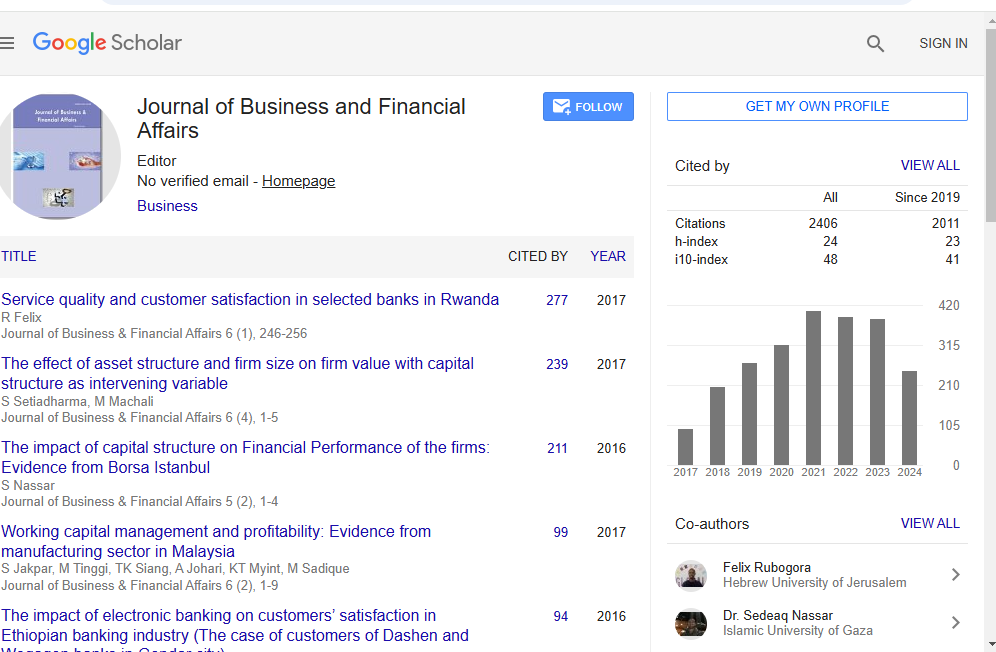
Journal of Business & Financial Affairs received 1726 citations as per Google Scholar report