Perspective - (2025) Volume 11, Issue 6
Received: 01-Dec-2025, Manuscript No. jssc-26-188331;
Editor assigned: 03-Dec-2025, Pre QC No. P-188331;
Reviewed: 17-Dec-2025, QC No. Q-188331;
Revised: 22-Dec-2025, Manuscript No. R-188331;
Published:
29-Dec-2025
, DOI: 10.37421/2472-0437.2025.11.315
Citation: Mbeki, Thabo. ”Steel: Sustainable Infrastructure’s
Strong, Recyclable Backbone.” J Steel Struct Constr 11 (2025):331.
Copyright: © 2025 Mbeki T. This is an open-access article distributed under the terms of the Creative Commons Attribution License, which permits unrestricted use, distribution
and reproduction in any medium, provided the original author and source are credited.
Steel's inherent qualities, including its remarkable strength, ductility, and amenability to recycling, firmly establish it as a foundational material for sustainable infrastructure development. This emphasis underscores its pivotal role in mitigating embodied carbon emissions through sophisticated design methodologies, the widespread adoption of prefabrication techniques, and the end-of-life valorization of materials [1].
The continuous evolution of steel production processes and the development of novel structural systems are indispensable for addressing the escalating requirements of a burgeoning global population. Simultaneously, these advancements are crucial for minimizing adverse environmental consequences, particularly within the framework of creating resilient and adaptable urban environments [1].
Significant progress has been made in the realm of high-strength steels, coupled with innovative connection designs, which collectively facilitate the construction of lighter and demonstrably more efficient steel structures. This technological leap directly correlates with a reduction in overall material consumption and a decrease in the embodied energy associated with construction endeavors [2].
This research rigorously emphasizes the profound importance of conducting comprehensive lifecycle assessments. Such assessments are imperative for fully quantifying and appreciating the extensive environmental advantages offered by steel, spanning the entire spectrum from initial raw material extraction through to eventual deconstruction and subsequent recycling processes [2].
The strategic application of optimized steel structural systems, guided by the principles of performance-based design, offers a substantial pathway to reducing material waste and overall consumption. This holistic approach critically considers the entire lifecycle of a structure, thereby fostering enhanced durability and adaptability for potential future repurposing initiatives [3].
Furthermore, the specific focus on modular construction methodologies and the extensive use of prefabrication with steel components serve to amplify sustainability benefits. These practices contribute by minimizing disruptions at construction sites and significantly improving overall construction efficiency and effectiveness [3].
Steel's exceptional strength-to-weight ratio empowers the realization of designs that incorporate longer spans and more slender profiles. This architectural and engineering advantage directly translates to a minimized foundation footprint, consequently reducing the associated environmental impact stemming from extensive groundwork and material usage [4].
Concurrently, the ongoing development and implementation of environmentally benign steel production methods, such as those leveraging hydrogen as a reducing agent, are of paramount importance for elevating the sustainability quotient of steel structures. This paper critically examines how innovative structural forms that capitalize on these inherent properties contribute to the creation of resilient and environmentally conscious infrastructure projects [4].
Steel's inherent recyclability stands as a pronounced advantage in the pursuit of sustainable infrastructure development. Structures meticulously designed for subsequent disassembly and the facile reuse of their constituent steel components can lead to a dramatic curtailment of waste generation and a significant reduction in the demand for virgin raw materials [5].
This body of research meticulously investigates a diverse array of methodologies and strategies aimed at ensuring the long-term durability and adaptability of steel structures. Such efforts are fundamentally geared towards facilitating their eventual and effective reuse in the development of new construction projects, thereby closing the material loop [5].
Steel's inherent strength, ductility, and recyclability are foundational attributes that position it as a premier material for constructing sustainable infrastructure. This focus highlights its capability to reduce embodied carbon through optimized design, prefabrication, and end-of-life reuse strategies. Innovations in steel production and structural systems are vital for meeting the demands of a growing global population while minimizing environmental impact, especially in the context of developing resilient and adaptable urban environments [1].
Advancements in high-strength steel alloys and the creation of innovative connection designs are progressively enabling the development of lighter and more resource-efficient steel structures. This progress directly translates into reduced material consumption and a lower embodied energy footprint for construction projects. The research strongly emphasizes the necessity of conducting thorough lifecycle assessments to fully comprehend and quantify the environmental benefits associated with steel, from the initial extraction of raw materials to its eventual deconstruction and recycling [2].
The strategic deployment of optimized steel structural systems, informed by robust performance-based design principles, can lead to significant reductions in material usage and construction waste. This contemporary approach inherently considers the entire lifecycle of a structure, thereby promoting enhanced durability and adaptability for future repurposing. The focus on modular construction and prefabrication techniques using steel further bolsters sustainability by minimizing on-site disruptions and improving overall construction efficiency [3].
Steel's capacity for achieving high strength-to-weight ratios facilitates the design of structures with longer spans and more slender profiles, which in turn minimizes the foundation footprint and its associated environmental ramifications. The ongoing development of greener steel production methodologies, including those utilizing hydrogen, is crucial for enhancing the overall sustainability of steel structures. This paper delves into how innovative structural forms leveraging these unique properties contribute to the creation of resilient and environmentally conscious infrastructure [4].
The intrinsic recyclability of steel represents a substantial advantage for sustainable infrastructure projects. Structures thoughtfully designed for disassembly and the subsequent reuse of their steel components can dramatically reduce waste generation and the reliance on virgin materials. This research critically examines various methods aimed at ensuring the long-term durability and adaptability of steel structures, thereby facilitating their eventual reuse in new construction ventures [5].
Steel's ability to be manufactured with exceptional precision and its predictable performance characteristics make it an ideal material for prefabrication. This leads to accelerated construction timelines, reduced on-site waste generation, and improved quality control, all of which contribute to enhanced sustainability in infrastructure development. The paper further explores the integration of Building Information Modeling (BIM) and advanced manufacturing techniques specifically for steel structures [6].
The embodied carbon associated with structural steel has been a significant area of focus for improvement within the industry. Research efforts directed towards increasing the utilization of recycled steel content and developing low-carbon steelmaking processes are fundamental to achieving truly sustainable infrastructure solutions. This particular study quantifies the environmental benefits derived from incorporating higher percentages of recycled content in steel structures [7].
The durability and inherent resistance of steel structures to various environmental factors, such as corrosion and seismic activity, are critical determinants of their long-term sustainability. The implementation of effective protective coatings and the application of advanced design techniques serve to extend the service life of steel infrastructure, thereby reducing the necessity for frequent replacements and the associated consumption of resources. This paper provides an in-depth examination of innovative corrosion protection systems specifically designed for steel structures [8].
Steel exhibits excellent ductility and energy dissipation capabilities, characteristics that make it a highly favored material for constructing earthquake-resistant structures. This inherent seismic performance directly contributes to the overall resilience and longevity of infrastructure, which are paramount considerations in sustainable development strategies. The study meticulously analyzes the seismic performance of multi-story steel buildings under various simulated conditions [9].
The integration of advanced digital technologies, including Building Information Modeling (BIM) and artificial intelligence (AI), holds immense potential for further optimizing steel structural designs with a focus on sustainability. These powerful tools enable more accurate material quantification, facilitate waste reduction initiatives, and enhance construction planning processes, ultimately leading to more efficient and environmentally responsible infrastructure development. This research investigates the application of AI-driven design optimization specifically tailored for steel structures [10].
Steel is a highly sustainable material for infrastructure due to its strength, ductility, and recyclability, contributing to reduced embodied carbon through efficient design and reuse [1, 5, 7]. Innovations in high-strength steel and connection designs lead to lighter, more material-efficient structures with lower embodied energy [2].
Performance-based design and prefabrication further minimize waste and improve efficiency [3, 6]. Steel's high strength-to-weight ratio allows for reduced foundation impact, and greener production methods are crucial [4].
Its durability and seismic resistance enhance infrastructure longevity and resilience [8, 9]. Digital technologies like BIM and AI optimize steel design for sustainability [10].
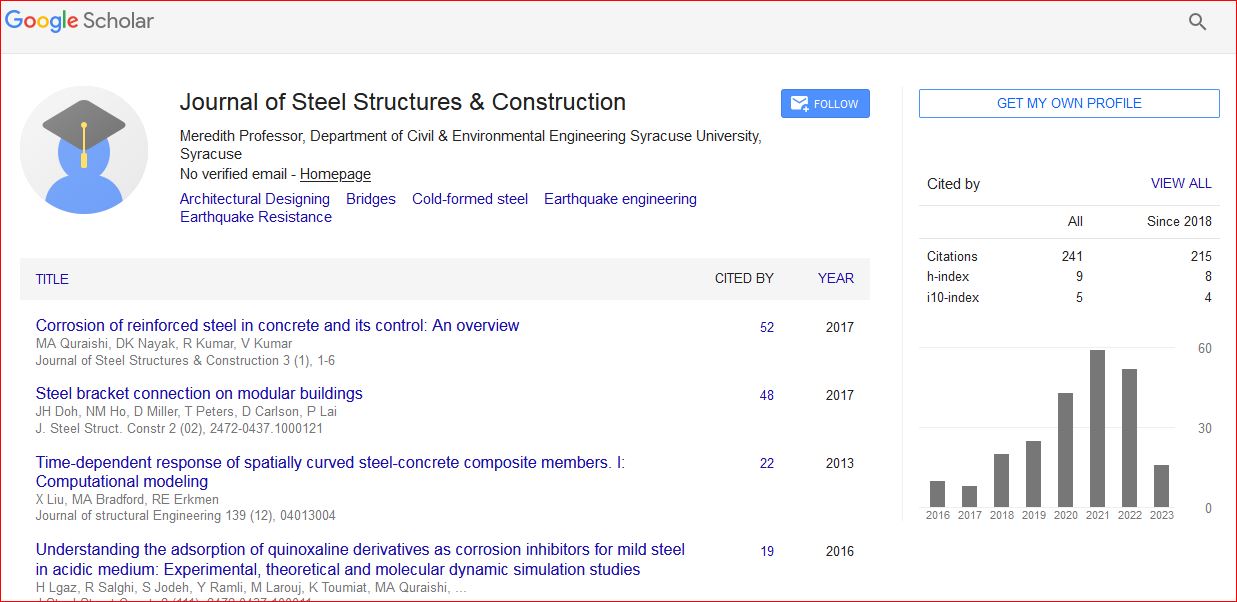
Journal of Steel Structures & Construction received 583 citations as per Google Scholar report