Short Communication - (2025) Volume 11, Issue 3
Received: 01-Jun-2025, Manuscript No. jssc-26-188282;
Editor assigned: 03-Jun-2025, Pre QC No. P-188282;
Reviewed: 17-Jun-2025, QC No. Q-188282;
Revised: 23-Jun-2025, Manuscript No. R-188282;
Published:
30-Jun-2025
, DOI: 10.37421/2472-0437.2025.11.304
Citation: Popescu, Andrei. ”Steel Structures: Design, Performance,
and Sustainability.” J Steel Struct Constr 11 (2025):304.
Copyright: © 2025 Popescu A. This is an open-access article distributed under the terms of the Creative Commons Attribution License, which permits unrestricted use,
distribution and reproduction in any medium, provided the original author and source are credited.
The structural integrity and safety of industrial buildings are paramount, necessitating robust engineering solutions. Steel, with its high strength-to-weight ratio, has long been a preferred material for constructing these large-span facilities, offering durability and versatility in design. Various structural systems are employed, each with distinct advantages and considerations for load-bearing capacity and seismic resistance [1].
The behavior of cold-formed steel structures, often used in lighter industrial applications, has been extensively studied to understand their performance under diverse load conditions, including deformation characteristics and failure mechanisms [2].
For buildings in seismically active regions, the seismic performance of steel portal frames is a critical aspect of design. Research has focused on evaluating the influence of connection types on ductility and energy dissipation to ensure safer seismic resilience [3].
Industrial environments can expose steel structures to corrosive elements, making durability and corrosion resistance significant concerns. Protective coating systems and advanced material treatments are crucial for extending the service life of steel components and minimizing maintenance [4].
Fire safety is another indispensable consideration for industrial buildings, and the fire performance of steel structural systems has been thoroughly investigated. Understanding the impact of elevated temperatures on steel's mechanical properties informs effective fire protection strategies [5].
The application of high-strength steel offers opportunities for lighter and more efficient industrial structures. Analyzing the benefits and challenges of these advanced materials, including fabrication and connection complexities, is vital for optimal utilization [6].
Designing effective steel roof structures for industrial buildings, especially those with large spans and heavy loads, requires innovative solutions that balance cost-effectiveness with structural performance and aesthetics [7].
Beyond structural considerations, the energy efficiency of steel structures in industrial settings is gaining importance. Design modifications and material choices that address thermal bridging and insulation can significantly improve thermal performance and reduce energy consumption [8].
The stability of steel columns within industrial building frames is fundamental to overall structural integrity. Numerical investigations into buckling behavior, considering boundary conditions and geometric imperfections, are essential for determining load-carrying capacity [9].
Furthermore, the trend towards sustainable construction has led to explorations of sustainable steel materials and practices in industrial buildings. Research into material recycling and life cycle assessment helps promote greener construction methods [10].
A comprehensive analysis of steel structural systems for industrial buildings delves into critical factors such as load-bearing capacity, seismic resistance, and constructability. The study aims to identify optimal material selection and design strategies to bolster the structural integrity and economic feasibility of large-span industrial facilities [1].
Investigating the behavior of cold-formed steel structures under various load conditions provides valuable insights into their suitability for industrial settings. This research addresses deformation characteristics and potential failure mechanisms, offering essential design guidelines for enhanced performance and safety [2].
The seismic performance of steel portal frames, commonly employed in industrial buildings, is a subject of significant research. Finite element analysis is utilized to assess the influence of different connection types on ductility and energy dissipation, thereby guiding the development of safer seismic designs [3].
The durability and corrosion resistance of steel structures in aggressive industrial environments are thoroughly examined. The study explores various protective coating systems and material treatments designed to prolong the service life of steel components, ultimately reducing maintenance costs and ensuring steadfast structural integrity [4].
Assessing the fire performance of steel structural systems in industrial buildings is a critical safety imperative. This research investigates effective fire protection strategies and the consequential impact of elevated temperatures on steel's mechanical properties, providing crucial data for robust fire safety design [5].
The application of high-strength steel in the construction of industrial buildings is explored to achieve lighter and more efficient structural solutions. This paper analyzes the inherent benefits and challenges associated with utilizing these advanced materials, including considerations for fabrication and connection details [6].
Optimal design of steel roof structures for industrial buildings, particularly those with large spans and heavy loading conditions, is the focus of dedicated research. Innovative structural solutions are presented that effectively balance cost-effectiveness with superior structural performance and aesthetic appeal [7].
The energy efficiency of steel structures within industrial buildings is investigated, with particular attention paid to thermal bridging and insulation strategies. The study explores design modifications and material choices aimed at improving the building's overall thermal performance and minimizing energy consumption [8].
A numerical investigation into the buckling behavior of steel columns used in industrial building frames provides crucial insights. The research examines the influence of various boundary conditions and geometric imperfections on the ultimate load-carrying capacity of these critical structural elements [9].
Finally, the integration of sustainable steel materials and construction practices for industrial buildings is discussed. This research highlights the environmental impact of steel production and proposes actionable strategies for material recycling and life cycle assessment to foster a more sustainable approach to construction [10].
This collection of research explores various aspects of steel structures in industrial buildings. It covers comparative analyses of different steel structural systems, the behavior of cold-formed steel, and seismic performance evaluations of steel portal frames. The studies also address durability and corrosion resistance in industrial environments, fire performance, and the application of high-strength steel for improved efficiency. Further research delves into optimal design of large-span roof structures, energy efficiency considerations through design and material choices, buckling analysis of steel columns, and the integration of sustainable steel materials and practices. The findings collectively aim to enhance structural integrity, safety, economic viability, and environmental responsibility in industrial construction.
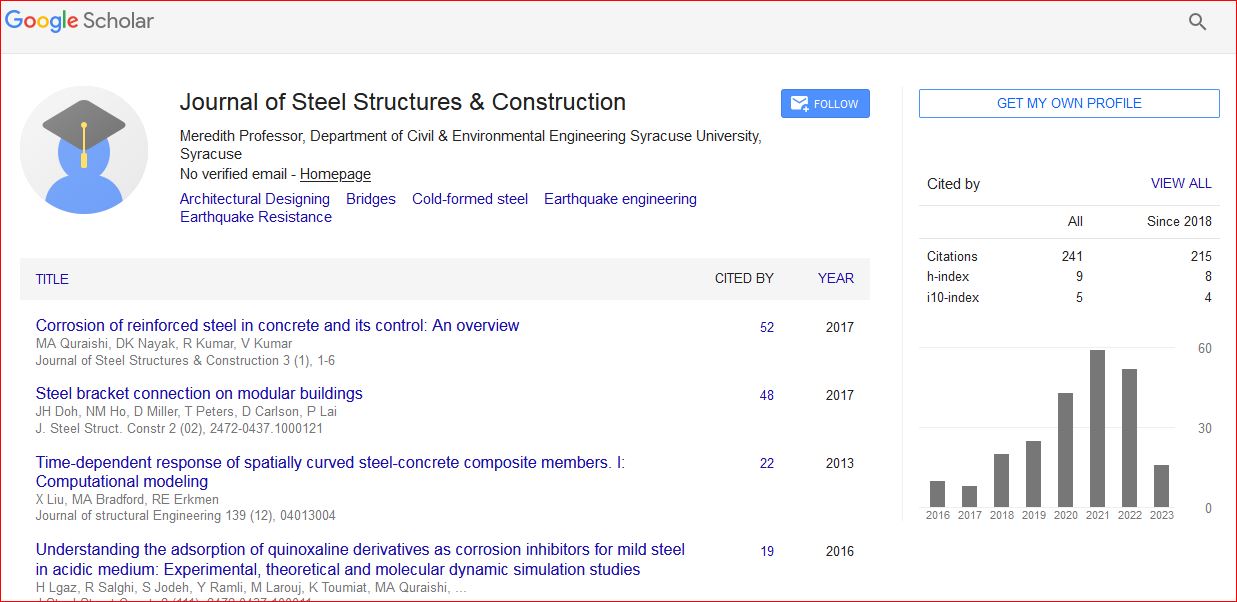
Journal of Steel Structures & Construction received 583 citations as per Google Scholar report