Brief Report - (2025) Volume 11, Issue 5
Received: 01-Oct-2025, Manuscript No. jssc-26-188303;
Editor assigned: 03-Oct-2025, Pre QC No. P-188303;
Reviewed: 17-Oct-2025, QC No. Q-188303;
Revised: 22-Oct-2025, Manuscript No. R-188303;
Published:
29-Oct-2025
, DOI: 10.37421/2472-0437.2025.11.316
Citation: Reddy, Ramesh. ”Steel Structural Resilience: Strength,
Durability, and Safety.” J Steel Struct Constr 11 (2025):316.
Copyright: © 2025 Reddy R. This is an open-access article distributed under the terms of the Creative Commons Attribution License, which permits unrestricted use, distribution
and reproduction in any medium, provided the original author and source are credited.
The structural integrity of steel systems is paramount in their capacity to withstand extreme weather phenomena. Steel's inherent properties, including its high strength-to-weight ratio and ductility, render it highly effective in resisting substantial wind loads, seismic forces, and direct impacts from debris [1].
The seismic performance of steel moment-resisting frames has been extensively studied, revealing critical insights into their behavior under severe earthquake simulations. The energy dissipation capabilities of steel connections and the overall robustness of these structural systems are key factors in their resilience [2].
Debris impact, a prevalent hazard during extreme weather events such as tornadoes and hurricanes, poses a significant threat to steel structures. Research has focused on evaluating the impact resistance of various steel cladding systems and structural components through rigorous experimental and numerical analyses [3].
The long-term durability of steel structures is a crucial consideration, especially when exposed to corrosive environments that are often intensified by extreme weather conditions like coastal storms and high humidity. Strategies for corrosion protection and the use of advanced steel alloys are vital for maintaining structural integrity [4].
Steel-composite structures exhibit promising performance under dynamic loading conditions that simulate extreme wind gusts and seismic tremors. The synergistic interaction between steel and concrete elements in composite beams and slabs contributes to enhanced strength and stiffness [5].
Wind-induced vibrations in tall steel buildings can be significantly amplified during extreme wind events, posing challenges to both occupant comfort and structural safety. Advanced analysis techniques and mitigation strategies are essential for addressing this phenomenon [6].
In the aftermath of extreme events, fires can become a critical concern for steel structures. Understanding the behavior of steel members at elevated temperatures and the effectiveness of fire protection measures is vital for improving fire safety and post-event resilience [7].
The cyclic performance of steel connections is of utmost importance for seismic design, enabling structures to endure repeated stress cycles from earthquakes. Ductility, strength, and energy dissipation characteristics of various connection types are critical for reliable seismic performance [8].
The application of high-strength steel in bridges subjected to extreme weather conditions, including high winds and seismic activity, offers significant advantages. These include reduced material usage and enhanced load-carrying capacity, which are crucial for critical infrastructure [9].
The resilience of steel structures against cascading failures initiated by extreme weather events is a complex area of study. Designing for redundancy and incorporating robust detailing are crucial to prevent progressive collapse following localized failures caused by events like strong winds or earthquakes [10].
Steel structural systems offer significant advantages in their ability to resist extreme weather events, owing to their high strength-to-weight ratio and ductility, which are crucial for enduring wind loads, seismic forces, and debris impacts [1].
Research on the seismic performance of steel moment-resisting frames highlights their capacity to withstand severe earthquake simulations. The effectiveness of steel connections in dissipating energy and maintaining overall structural integrity is a focal point of investigation [2].
To address the threat of debris impact during extreme weather, such as tornadoes and hurricanes, studies have experimentally and numerically evaluated the impact resistance of steel cladding systems and structural components, identifying key design parameters for enhanced resilience [3].
Ensuring the long-term durability of steel structures in corrosive environments, often exacerbated by extreme weather, involves the review of protective coating systems and advanced steel alloys. This research guides material selection and maintenance for structures in challenging climates [4].
Steel-composite structures demonstrate improved performance under dynamic loading conditions representative of extreme wind gusts and seismic tremors. The combined strength and stiffness of steel and concrete elements are analyzed for optimized resilience [5].
Mitigating wind-induced vibrations in tall steel buildings, a common issue during extreme winds, requires advanced computational fluid dynamics analysis and wind tunnel testing. Aerodynamic design and damping systems are emphasized for occupant comfort and structural safety [6].
The fire resistance of steel structures is a critical factor, especially post-extreme events. Investigations into steel member behavior at elevated temperatures and the efficacy of fire protection methods aim to enhance building safety in such scenarios [7].
Cyclic loading performance of steel connections is fundamental to seismic design, enabling structures to withstand repeated stress from earthquakes. Studies analyze ductility, strength, and energy dissipation for improved seismic resilience [8].
Bridges constructed with high-strength steel show enhanced performance under extreme environmental conditions. This research considers fatigue and ductility, highlighting benefits like reduced material usage and increased load capacity for vital infrastructure [9].
Preventing cascading failures in steel structures under extreme loads is crucial. Studies focus on redundancy and robust detailing to avoid progressive collapse after localized failures caused by events such as strong winds or earthquakes [10].
Steel structural systems demonstrate significant resilience against extreme weather events due to their inherent strength and ductility, effectively resisting wind, seismic forces, and debris impacts. Research into steel moment-resisting frames and connections highlights their capacity for energy dissipation and overall structural integrity during seismic activity. Studies also address the impact resistance of steel cladding and the long-term durability of steel structures in corrosive environments, emphasizing the need for protective measures. The performance of steel-composite structures under dynamic loading, along with strategies to mitigate wind-induced vibrations in tall buildings, are critical areas of investigation. Furthermore, the fire resistance of steel structures and the cyclic performance of connections are vital for safety and seismic resilience. The use of high-strength steel in infrastructure and the design of steel structures to prevent cascading failures under extreme loads are also key research focuses, all contributing to enhanced structural safety and robustness.
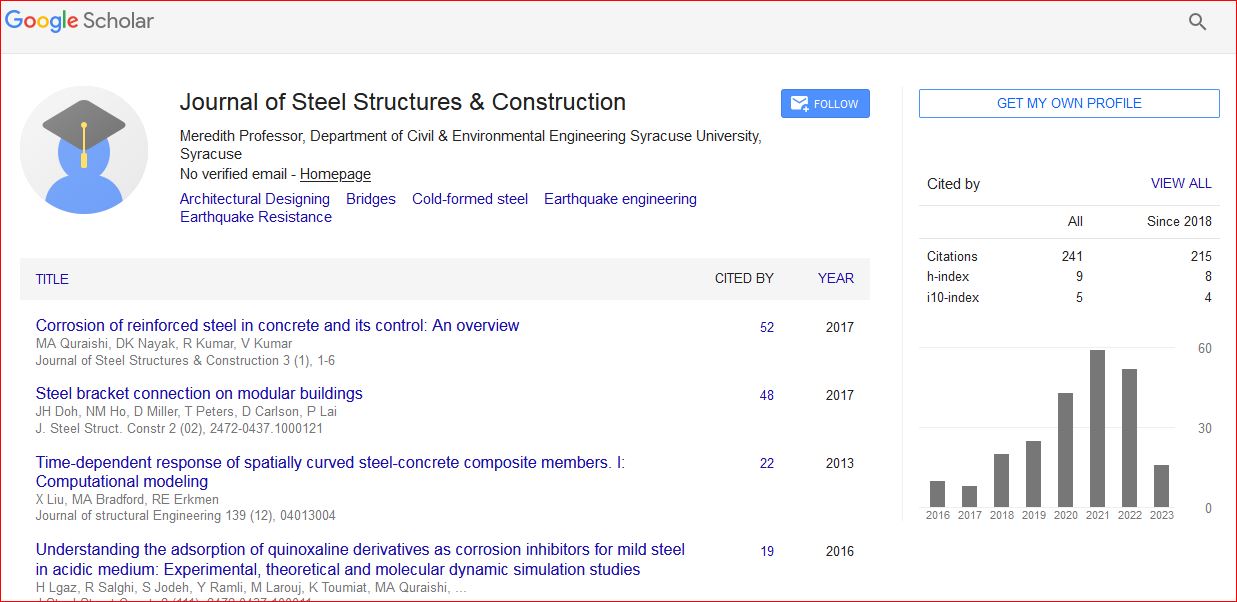
Journal of Steel Structures & Construction received 583 citations as per Google Scholar report