Perspective - (2025) Volume 11, Issue 5
Received: 01-Oct-2025, Manuscript No. jssc-26-188315;
Editor assigned: 03-Oct-2025, Pre QC No. P-188315;
Reviewed: 17-Oct-2025, QC No. Q-188315;
Revised: 22-Oct-2025, Manuscript No. R-188315;
Published:
29-Oct-2025
, DOI: 10.37421/2472-0437.2025.11.323
Citation: Okafor, Chinedu. ”Steel Structural Member Analysis
and Design Advancements.” J Steel Struct Constr 11 (2025):323.
Copyright: © 2025 Okafor C. This is an open-access article distributed under the terms of the Creative Commons Attribution License, which permits unrestricted use,
distribution and reproduction in any medium, provided the original author and source are credited.
The structural integrity of steel members is a paramount concern in modern construction, necessitating rigorous analysis and design methodologies to ensure safety and efficiency. Adekunle et al. (2023) explored the critical aspects of strength analysis for steel structural members, emphasizing methods for predicting load-bearing capacity and ensuring overall structural integrity by considering various failure modes, material properties, and design codes to prevent catastrophic failures and optimize material usage in civil engineering projects [1].
In seismically active regions, the resilience of steel structures against earthquake-induced forces is of utmost importance. Wang et al. (2022) focused on the seismic performance of steel structures, evaluating the effectiveness of different connection designs in resisting earthquake-induced forces and examining the ductility and energy dissipation capabilities of various steel members, offering insights into best practices for designing resilient steel buildings [2].
Slender steel elements, commonly found in bridges and tall buildings, are susceptible to buckling under combined loads. Smith et al. (2023) investigated the buckling behavior of thin-walled steel members under combined axial and bending loads, presenting advanced numerical simulations and experimental validation to predict critical buckling loads and analyze post-buckling deformation, which is crucial for their safe design [3].
The long-term durability and safety of steel constructions are significantly influenced by fatigue, especially in structures subjected to repeated loading cycles. Brown et al. (2022) examined the fatigue life prediction of steel structural components, incorporating probabilistic approaches and advanced material models to enhance the accuracy of fatigue assessments and improve long-term performance [4].
Understanding the behavior of steel structures under extreme conditions, such as fire, is vital for ensuring occupant safety and structural survival. Davis et al. (2023) presented an investigation into the fire resistance of steel structural members, focusing on the impact of elevated temperatures on material strength and stiffness and evaluating various fire protection strategies to maintain load-carrying capacity during fire events [5].
Composite structures, which leverage the synergistic properties of different materials, offer efficient structural solutions. Chen et al. (2022) explored the behavior of steel members in composite structures, specifically focusing on the interaction between steel and concrete, analyzing load transfer mechanisms and failure modes in steel-concrete composite beams and columns to optimize the design of these efficient systems [6].
The application of different design codes can lead to variations in structural analysis outcomes, highlighting the importance of comparative evaluations. Garcia et al. (2023) presented a comparative study of different design codes for the strength analysis of steel structural members, evaluating their conservatism and applicability to offer insights into how code provisions influence design outcomes and promote a better understanding of code-based structural design [7].
For complex steel structures, advanced analytical techniques are essential for accurate strength assessment. Kim et al. (2022) focused on the application of advanced finite element analysis (FEA) techniques for the strength assessment of complex steel structures, discussing the modeling of material nonlinearities, geometric imperfections, and boundary conditions to achieve accurate predictions of structural behavior under various loading scenarios [8].
Offshore structures operate in challenging environments and are subjected to unique loading conditions. Anderson et al. (2023) investigated the behavior of steel members in offshore structures, considering the harsh marine environment and cyclic loading, examining the influence of corrosion, wave loads, and extreme weather events on the strength and fatigue life of steel components crucial for their safety and longevity [9].
The use of high-strength steel presents an opportunity for weight reduction and increased load-carrying capacity in construction. Nguyen et al. (2022) explored the potential of high-strength steel in modern construction, analyzing its mechanical behavior and fabrication challenges to provide guidance for its effective implementation in various structural applications [10].
The fundamental aspect of ensuring the safety and longevity of steel structures lies in accurately analyzing their strength under various operational and environmental conditions. Adekunle et al. (2023) provided a comprehensive overview of strength analysis methodologies for steel structural members, emphasizing the critical need to account for diverse failure modes, material characteristics, and adherence to established design codes to prevent structural collapse and optimize resource utilization within civil engineering projects [1].
In earthquake-prone areas, the ability of steel structures to withstand seismic forces is a critical design consideration. Wang et al. (2022) conducted an evaluation of the seismic performance of steel moment resisting frames, specifically assessing the effectiveness of novel connection designs in dissipating earthquake energy and enhancing the ductility of steel members, thereby informing the design of more resilient buildings in seismically active zones [2].
The behavior of slender steel components, such as those found in bridges and high-rise buildings, is significantly influenced by buckling phenomena when subjected to combined axial and bending loads. Smith et al. (2023) employed advanced numerical simulations and experimental validation to accurately predict critical buckling loads and analyze post-buckling deformations for thin-walled steel members, providing essential data for the safe design of these elements [3].
A significant factor in the long-term performance of steel structures, particularly those subjected to dynamic or repeated loading, is fatigue. Brown et al. (2022) presented a comprehensive approach to probabilistic fatigue life assessment for steel structural members, integrating advanced material models and probabilistic methods to improve the predictive accuracy of fatigue behavior and ensure enhanced durability and safety in steel constructions [4].
Steel structures must be designed to maintain their integrity and load-carrying capacity even when exposed to extreme events like fires. Davis et al. (2023) investigated the fire resistance of steel structural members, focusing on the impact of elevated temperatures on their mechanical properties and evaluating the efficacy of various fire protection strategies to ensure structural performance during fire incidents [5].
The integration of steel with other materials, such as concrete, in composite structures offers significant advantages in terms of structural efficiency and performance. Chen et al. (2022) analyzed the behavior of steel-concrete composite members under combined loads, detailing the load transfer mechanisms and potential failure modes in beams and columns, which is crucial for optimizing the design of these advanced structural systems [6].
A crucial aspect of structural engineering practice involves the consistent application and comparison of various design codes to ensure optimal and safe structural outcomes. Garcia et al. (2023) conducted a comparative analysis of different design codes used for the strength assessment of steel structural members, evaluating their respective conservatism and applicability to provide insights into how code provisions affect design decisions and to foster a deeper understanding of code-based design principles [7].
For intricate steel structures with complex geometries and loading conditions, advanced computational methods are indispensable for accurate strength evaluation. Kim et al. (2022) discussed the application of sophisticated finite element analysis techniques for assessing the strength of complex steel structures, detailing the appropriate modeling of material non-linearities, geometric imperfections, and boundary conditions to achieve reliable predictions of structural responses [8].
Steel members in offshore environments face unique challenges, including corrosive conditions and cyclic loading from waves and weather. Anderson et al. (2023) studied the strength and fatigue characteristics of steel members in offshore structures, examining the detrimental effects of corrosion, wave loads, and extreme weather on their performance, which is critical for the safety and operational life of offshore platforms [9].
The utilization of high-strength steel offers substantial benefits, including reduced member weights and enhanced load-carrying capabilities, making it an attractive material for modern construction. Nguyen et al. (2022) explored the practical applications and mechanical behavior of high-strength steel in structural engineering, addressing fabrication considerations and providing guidance for its effective integration into diverse structural designs [10].
This collection of research highlights key advancements in the analysis and design of steel structural members across various applications. Studies cover the critical aspects of strength analysis for general construction, seismic performance and novel connection designs, buckling behavior of thin-walled members, fatigue life prediction for long-term durability, and fire resistance to ensure structural integrity during extreme events. The research also delves into the behavior of steel in composite structures, comparative analyses of design codes for consistent application, advanced finite element analysis for complex structures, the unique challenges of steel in offshore environments, and the application of high-strength steel for improved efficiency. Collectively, these works emphasize the importance of considering diverse loading conditions, material properties, and advanced analytical techniques to ensure the safety, reliability, and optimal performance of steel structures.
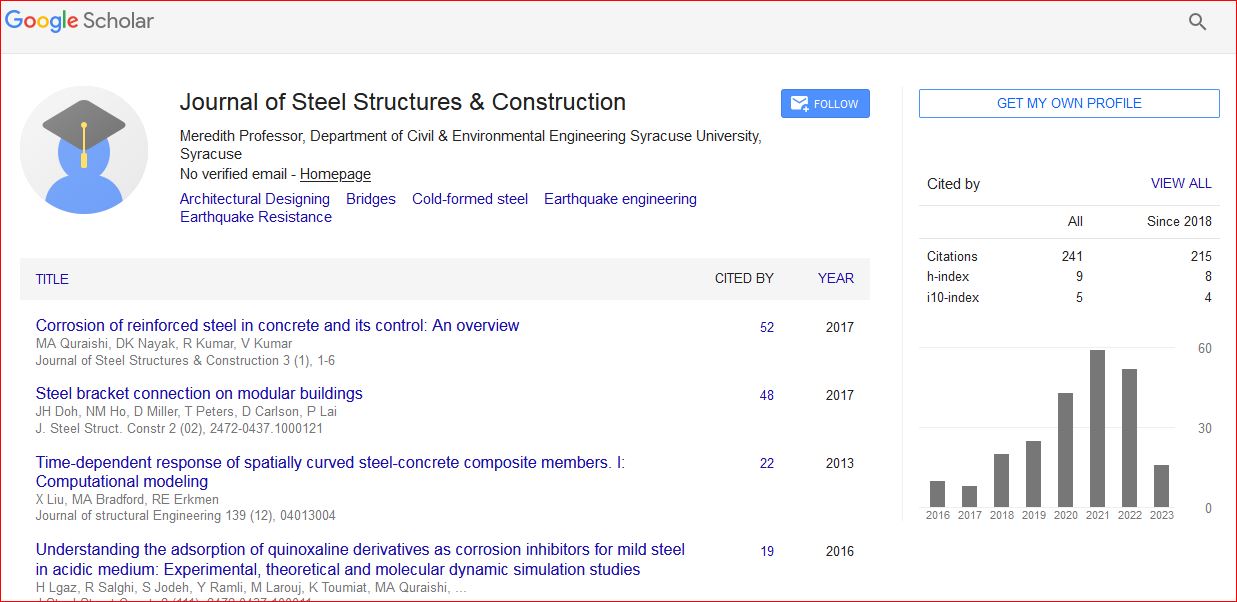
Journal of Steel Structures & Construction received 583 citations as per Google Scholar report