Short Communication - (2025) Volume 11, Issue 5
Received: 01-Oct-2025, Manuscript No. jssc-26-188318;
Editor assigned: 03-Oct-2025, Pre QC No. P-188318;
Reviewed: 17-Oct-2025, QC No. Q-188318;
Revised: 22-Oct-2025, Manuscript No. R-188318;
Published:
29-Oct-2025
, DOI: 10.37421/2472-0437.2025.11.325
Citation: Yılmaz, Mehmet. ”Steel Space Frames: Performance,
Design, and Applications.” J Steel Struct Constr 11 (2025):325.
Copyright: © 2025 Yılmaz M. This is an open-access article distributed under the terms of the Creative Commons Attribution License, which permits unrestricted use,
distribution and reproduction in any medium, provided the original author and source are credited.
Steel space frame systems represent a critical area of structural engineering, particularly for large-span applications where efficiency and stability are paramount. These structures, characterized by their three-dimensional interconnectedness of members, offer unique advantages in terms of load distribution and material optimization. The seismic performance of such systems, for instance, has been a subject of intensive research, with studies highlighting the crucial role of joint design and material properties in withstanding dynamic forces like earthquakes. Enhancements in connection details can significantly improve ductility and energy dissipation capabilities, ensuring greater resilience during seismic events [1].
Furthermore, the fundamental behavior of tubular steel space frames under various loading conditions continues to be explored. Understanding how these elements respond to axial, shear, and bending loads is essential for accurate structural analysis and design. Numerical simulations and experimental validation are key to uncovering the complex interactions within these structures, particularly concerning local buckling, which can significantly impact overall capacity and necessitate detailed examination of connection zones and member slenderness [2].
Optimizing the configurations of steel space frames for long-span applications is another significant challenge in structural engineering. The pursuit of both structural efficiency and minimized material usage drives the development of advanced analysis techniques, such as genetic algorithms and finite element analysis, to explore a vast array of geometric possibilities. The aim is to identify specific geometric ratios and member arrangements that reduce self-weight and enhance stiffness, thereby enabling cost-effective designs for expansive roofs and bridges [3].
The selection of appropriate steel alloys also plays a pivotal role in the performance of space frame systems, especially under fatigue loading. Investigating the influence of different steel types on crack initiation and propagation under cyclic stresses provides valuable insights into material selection for applications subjected to vibration or repeated loads. High-strength alloys, while offering superior fatigue resistance, demand careful consideration of stress concentrations at joints due to their inherent brittleness [4].
Beyond traditional structural applications, lightweight steel space frames are finding increasing utility in façade engineering. Their integration into building envelopes demands careful analysis of structural requirements for supporting cladding, ensuring wind resistance, and accommodating thermal expansion. The ability of space frames to realize complex architectural forms while maintaining stability and a reduced visual impact makes them an attractive option for modern building design [5].
The dynamic response of steel space frames to external forces, such as wind loads, is a critical consideration for tall and slender structures. Phenomena like vortex-induced vibrations and flutter require sophisticated analysis, often involving the coupling of computational fluid dynamics (CFD) with structural analysis. Mitigation strategies, including aerodynamic shaping and damping mechanisms, are vital to prevent excessive oscillations and ensure structural integrity [6].
Fire safety is a non-negotiable aspect of structural design, and the fire resistance of steel space frame systems is a dedicated area of research. Evaluating thermal behavior under elevated temperatures and the efficacy of various fire protection measures, such as intumescent coatings and insulation, is crucial for maintaining structural integrity for a specified duration during a fire event [7].
Exploring the potential of composite materials in space frame construction offers exciting avenues for enhanced structural performance. Integrating steel with materials like concrete or timber can lead to synergistic effects, resulting in higher stiffness-to-weight ratios and improved fire resistance compared to purely steel structures. This interdisciplinary approach opens up new possibilities for innovative and more efficient designs [8].
The successful realization of large-scale steel space frames hinges on advanced fabrication and erection techniques. Challenges related to precision manufacturing, modular assembly, and on-site construction for complex geometries are being addressed through the integration of technologies like robotic welding, advanced surveying, and Building Information Modeling (BIM). These advancements significantly improve efficiency and reduce construction time and costs [9].
Finally, ensuring the long-term performance and durability of steel space frames, especially in corrosive environments, is essential for their widespread adoption. Understanding degradation mechanisms and implementing effective corrosion prevention strategies, encompassing material selection, surface treatments, and maintenance protocols, are vital for guaranteeing the longevity and structural integrity of these systems in harsh conditions [10].
The seismic performance of steel space frame systems is significantly influenced by their inherent stability and load-bearing capacity under dynamic conditions. Research has emphasized the paramount importance of joint design and material properties in maintaining structural integrity during earthquakes. Consequently, advancements in connection details are being proposed to enhance ductility and energy dissipation, thereby improving the overall seismic resilience of these structures. The effectiveness of various bracing configurations in mitigating lateral displacements and preventing global instability is also a key area of investigation [1].
Studies examining the behavior of tubular steel space frames under diverse loading scenarios, including axial, shear, and bending, provide crucial insights into their structural response. The integration of numerical simulations with experimental results is fundamental for validating structural models and understanding the intricate performance characteristics. A critical finding from this research is the substantial impact of local buckling on the overall member capacity, underscoring the necessity for meticulous analysis of connection zones and member slenderness ratios, as well as the application of advanced computational techniques for predicting ultimate load capacity [2].
For long-span applications, the optimization of steel space frame configurations is a primary objective, focusing on achieving both structural efficiency and optimal material utilization. The employment of genetic algorithms coupled with finite element analysis enables the exploration of a broad spectrum of geometric arrangements. These investigations reveal that specific geometric ratios and thoughtfully arranged members can lead to substantial reductions in self-weight and significant enhancements in stiffness, paving the way for more cost-effective designs for extensive roofing and bridging structures [3].
The impact of different steel alloys on the fatigue performance of space frame systems subjected to cyclical loading is a critical area of study. Experimental evaluations of crack initiation and propagation under cyclic stresses are conducted to assess the material behavior. Findings indicate that high-strength steel alloys offer superior fatigue resistance, but their inherent brittleness necessitates careful attention to stress concentrations at joints. This research provides essential guidance for material selection in applications characterized by vibration or repeated loading [4].
In the realm of façade engineering, lightweight steel space frames are being explored for their aesthetic and functional integration within building envelopes. This involves analyzing the structural demands for supporting cladding panels, ensuring effective wind resistance, and accommodating thermal expansion. The advantages offered by space frames, such as their capacity to create intricate architectural forms while maintaining structural stability and minimizing visual obstruction, are being increasingly recognized [5].
The dynamic response of steel space frames when subjected to wind loads, specifically concerning vortex-induced vibrations and flutter, is a significant area of research. The application of computational fluid dynamics (CFD) in conjunction with structural analysis allows for the prediction of aerodynamic forces and their subsequent impact on the structure. These studies underscore the vital role of aerodynamic shaping and the implementation of damping mechanisms in preventing excessive oscillations in tall and slender space frame structures [6].
A comprehensive investigation into the fire resistance of steel space frame systems involves analyzing their thermal behavior under elevated temperatures and assessing the effectiveness of various fire protection strategies. Maintaining structural integrity for a designated period during a fire event is paramount. This research highlights the importance of selecting appropriate intumescent coatings and insulation materials to ensure the safety and performance of these structures in fire scenarios [7].
Composite steel space frames, which integrate steel with materials such as concrete or timber, are being studied for their enhanced structural performance. The investigation focuses on load transfer mechanisms and the synergistic effects derived from combining these materials. Results suggest that composite space frames can achieve superior stiffness-to-weight ratios and improved fire resistance when contrasted with solely steel structures, thereby presenting new opportunities for innovative structural design [8].
Advanced fabrication and erection techniques for large-scale steel space frames are crucial for their successful implementation. The challenges associated with high-precision manufacturing, modular assembly, and on-site construction, particularly for complex geometric designs, are being addressed. The integration of robotic welding, advanced surveying methods, and BIM technology is shown to significantly enhance efficiency and reduce construction timelines and overall costs for monumental space frame projects [9].
The long-term performance and durability of steel space frames in corrosive environments are thoroughly evaluated. This research examines the degradation processes affecting steel and protective coatings under diverse atmospheric conditions. It further proposes effective strategies for corrosion prevention, including judicious material selection, appropriate surface treatments, and well-defined maintenance protocols, all aimed at ensuring the extended service life and structural integrity of space frames in demanding environments [10].
This collection of research explores various facets of steel space frame systems. Investigations cover seismic performance, load-carrying capacity, and buckling behavior, emphasizing the role of joint design and material properties. Optimization techniques are applied to configurations for long-span structures, considering efficiency and material usage. The influence of different steel alloys on fatigue performance is examined, alongside the application of lightweight space frames in façade engineering. Dynamic responses to wind loads, fire resistance, and the structural behavior of composite steel space frames are also detailed. Furthermore, advancements in fabrication and erection techniques for large-scale projects are discussed, along with strategies for ensuring durability and corrosion resistance in challenging environments.
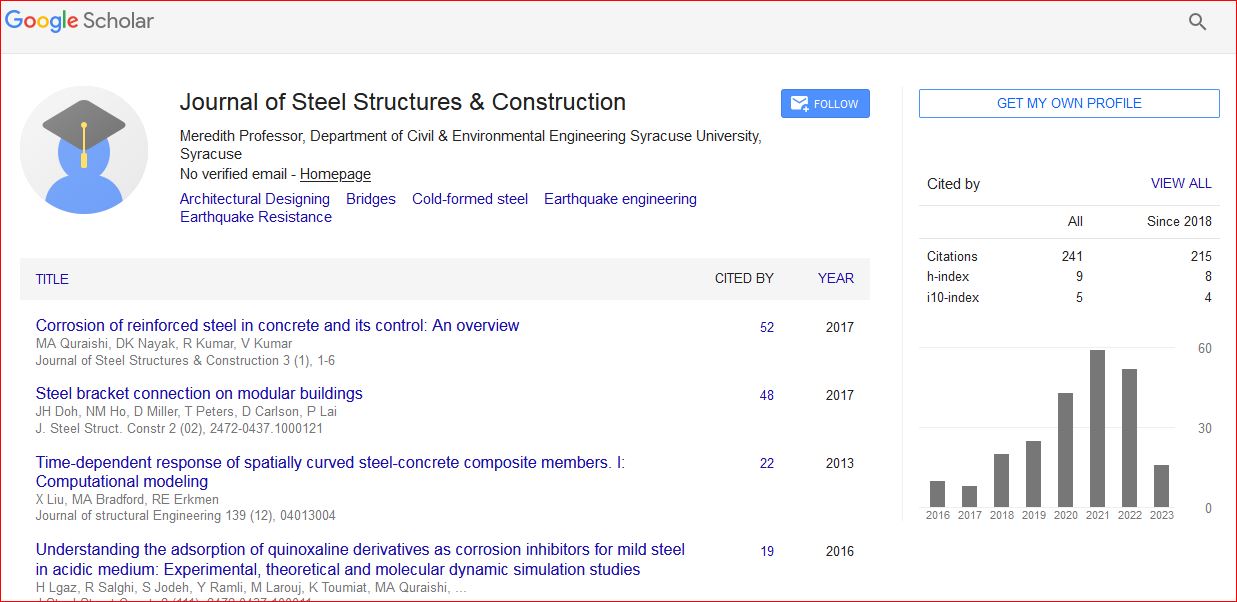
Journal of Steel Structures & Construction received 583 citations as per Google Scholar report